|
|
|
 garycohenrunning.com
be healthy • get more fit • race faster
| |
|
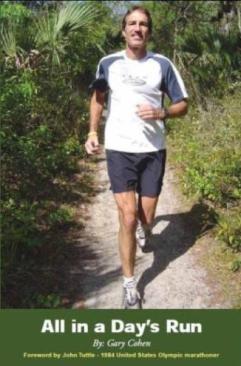 
"All in a Day’s Run" is for competitive runners,
fitness enthusiasts and anyone who needs a "spark" to get healthier by increasing exercise and eating more nutritionally.
Click here for more info or to order
This is what the running elite has to say about "All in a Day's Run":
"Gary's experiences and thoughts are very entertaining, all levels of
runners can relate to them."
Brian Sell — 2008 U.S. Olympic Marathoner
"Each of Gary's essays is a short read with great information on training,
racing and nutrition."
Dave McGillivray — Boston Marathon Race Director
|
 |
|
|
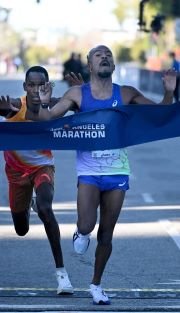
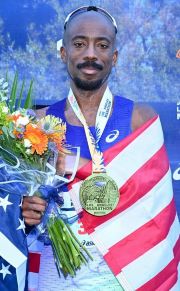
Nathan Martin is the 2026 Los Angeles Marathon Champion, coming from behind in the latter stages and unleashing a ferocious kick to win in 2:11:16.50 by one-hundredth of a second, At the 2023 Grandma’s Marathon in Duluth, Minnesota, Nathan finished fourth in 2:10:45, his marathon personal best, the record for the fastest American-born black marathoner. He finished eighth in the 2021 New York City Marathon and seventh in the 2024 Olympic Trials Marathon. Nate also competed in the 2016 and 2020 Olympic Trials marathons. His strong road races include wins at the 2020 Naples Daily News Half Marathon and 2023 Project 13.1 Half Marathon, second place at the Bobby Crim 10-mile (2016, 2019) and USA 20k Championships in New Haven, Connecticut (2019, 2024), third place at Garry Bjorkland Half Marathon (2022, 2024) and fourth at the 2016 USA 25k Championships in Grand Rapids, Michigan and 2024 Cherry Blossom 10-mile. At Spring Arbor University, he was six-time NCCAA Champion (Indoors – mile 2010; 3,000 meters 2010, 2013; 5,000 meters 2013; Outdoors – 10,000 meters 2010, 2013) and three-time NAIA Champion in 2013 (Indoors – 5,000 meters, Outdoors – 10,000 meters and marathon). Nate also won five Mid-Central Conference Championships (mile 2010, 2011; 5,000 meters 2010, 2011 and 4 x 800-meter relay 2011). He graduated from Three Rivers High School (Michigan) in 2008 where highlights included State runner-up at 1,600 meters and State fourth place in cross-country his senior year. Nate led his Three Rivers Wildcats team to three Region Cross Country Championships and two ‘Top Ten’ finishes at State. His personal best times include: 1;500m – 3:52.79; Mile – 4:16.08; 3,000m – 8:14.92; 5,000m – 13:52.70; 8k – 24:22; 10,000m – 28:45.07; 10k (road) – 28:07; 12k – 35:27; 15k – 44:53; 10-Mile – 46:00; 20k – 58:26; Half Marathon – 1:01:45; 25k – 1:15:01; and Marathon – 2:10:45. Martin is the cross country coach and teaches at Jackson High School in Jackson, Michigan. Nathan was extremely generous with his time as he spent over two and a half hours hours on the telephone for this interview in April 2026.
|
|
| GCR: |
THE BIG PICTURE We will discuss details of your recent victory at the 2026 Los Angeles Marathon shortly. In the big picture, after a month-and-a-half since you won, what are your thoughts on you being on the list of Los Angeles Marathon champions with outstanding athletes such as: John Korir, 2025 and 2026 Boston marathon champion; John’s brother, Wesley Korir, 2012 Boston Marathon champion; Paul Pilkington, and Mark Plaatjes?
|
| NM |
Yes, it’s really crazy because, honestly, I'm a guy who goes to a race and, whether I do amazing or it's not my day, I move on to the next thing. The biggest aspect was knowing how many people were connected to the L.A. Marathon and hearing stories about who are past winners. It has built over time, and I realize that I accomplished something big. It becomes more amazing as different people reach out to me. I truly feel a part of history and am honored that I was able to pull off the win and am now realizing how big it is.
|
|
| GCR: |
As marathon athletes, journalists, and fans, we are used to there being many black distance runners at the front of the pack, being on the podium, and winning marathons, but most are from African nations. What are your thoughts on racing the fastest marathon time by a USA-born black athlete of 2:11:05 at the 2020 Marathon Project, dropping your record further to 2:10:45 at the 2023 Grandma’s Marathon and breaking the record of the legendary Herm Atkins of 2:11:52, which had stood the test of time for 41 years since 1979?
|
| NM |
Representation is one hundred percent important to me. I view it as something that provides a different angle to make sure that there's another way for people to believe in something. A good example I give is that I'm never going to know what it's like to be a woman or know what it's like to be a hurdler either, but I'm amazed with what Sydney McLaughlin does. So, being able to inspire people in general is what I want to be able to do. When people hear my story or how I grew up and see what I was able to pull off, then they may think, ‘So can I.’ It reflects what's possible in your circumstances. It helps people to think of how to get over those hurdles. If I can get over those hurdles, then anybody can. I just made a reflection on that and a representation of what it looks like to power through and give what you have to see what that that produces.
|
|
| GCR: |
You have raced many strong performances at ten miles, 20 kilometers and the half marathon. When compared with the marathon, what are your relative strengths at intermediate distances, which do you enjoy racing more, or do you enjoy both in different ways?
|
| NM |
When I was growing up and in high school, I was primarily a miler. Then I went to college and my coach said, ‘ I don’t think you're a miler.’ So, they moved me to 5,000 meters. I had success and then, at the tail end of college, stepped up to marathons. I knew I had talents for bigger aerobic type races and so one of my underlying strengths is that my aerobic engine allows me to push more when some other guys might not be able to. In the shorter distances there is more intensity and there are hard workouts where you have to grind through big sessions and survive them. Sometimes I'm definitely not on it. But I can handle the big workouts for 10-mile races and half marathons and crush them the majority of the time. I always can fight aerobically and so these days it's definitely the marathon that is best for me. Sometimes I think it would be awesome to be a 10k runner and do a race every other week and training would be a little bit different. I wouldn't have to train for so long for limited races and then hope they go well. When it doesn't, I reset but I know where my strengths are and it's more of an aerobic gift so do I package my racing in a way that maximizes success at many distances.
|
|
| GCR: |
You still have great racing ahead of you but, as you reflect on your running career so far and twenty plus years of training and racing, how exciting is it to be putting in the hard training and racing and pushing yourself to try to reach your ultimate best in terms of times and competition?
|
| NM |
The longer you go, the training and racing gets repetitive, so you have seen the angles a lot. So, you're comfortable making sure the training and racing pan out. However, no race is the same and so getting through a race knowing that I gave everything is an awesome feeling. There is definitely a cherry on top when you come out with an amazing time. I know that there are going to be hardships, but when I get past those hardships and am accomplishing big things it's just awesome. That's one of the reasons that I run is that I want to test my abilities and see what they can produce and what I can achieve. What I'm seeing that still happen, even though I've had a crazy long career, is super and personally inspiring to me. There are racing goals that I still hope for but I'm still seeing it, so I can I have confidence when I'm talking to my athletes or whoever and I can truly mean what I say when I'm telling them to keep fighting and pushing through and giving everything that you have.
|
|
| GCR: |
Since you teach and coach, how have you developed what works for you in terms of time, effort, and energy necessary to achieve excellence as a teacher, coach, and athlete?
|
| NM |
It starts off by understanding what your biggest goals are and making sure that you're prioritizing those correctly. I genuinely enjoy connecting with people and feeling like I'm having an impact on their lives and so that's why coaching is at the top with my substitute teaching. I don't want my experiences only to benefit me. I want to benefit other people. So, I think of how to maximize that properly. Then I think about my running journey and how much I'm going to get out of that. I focus on how much I still have to give, and I prioritize that as well. When tough decisions have to be made, I determine what's the most important thing. I may decide that I'm not going to substitute teach for a couple months because I need to prioritize coaching or running. Or when I'm in a down-training cycle I can put more effort into coaching and I can accept a few more jobs to teach. It’s understanding what my goals are and understanding how to position them. There were weeks during earlier times in my career when I wasn't sponsored, so I didn't have the choices I have now and I had to give all my energy to all three areas of running, coaching, and teaching. It was super taxing and debatably hurt all three areas but now. These days I understand what moments I have to fight to be my best in running and what moments do I have to figure out what would be awesome to be a little bit better in these other areas. Now I figure out the particular focus and give my full energy. But it's obviously always challenging because when there are new curveballs such as spin off from more media commitments, I have to fit in a new dynamic. But it's understanding baseline, what my true goals are and making sure that I don't let the biggest steps toward those goals fall apart when the demands get overwhelming. I aim to work from the top to the bottom as there is only so much that a person can do.
|
|
| GCR: |
THE 2026 LOS ANGELES MARATHON You ran 2:12:55 at the California International Marathon in December 2025, so you were fit coming into the Los Angeles Marathon. How did you feel about your race at CIM. how was your build up coming into the 2026 Los Angeles Marathon, and what were your goals and pre-race strategy?
|
| NM |
My coach and I knew that I was in really good shape. Before the California International Marathon, I ended up getting sick for four or five weeks. It was bad and there is a good possibility that it was a strain of COVID. But I'm one of those guys who wants to fight through obstacles, and I still want to give myself a chance. I don't want to think that because things aren't perfect so then why try? My coach and I decided to give it a shot at CIM and see what happens, so 2:12 was a solid time. But it wasn't what I knew was in my body, so I wanted to give it another shot with my fitness level. We talked it over and knew that the Los Angeles Marathon was going to be a fantastic race to target. We decided to go for it even though it was only nine weeks after CIM. That is a truly short official marathon build, but I was working off of fitness I already knew I had. We had to sharpen it and make sure this time around that I could access what we knew I could achieve. We knew that the Los Angeles Marathon course was hilly and knew that it was going to be hot weather. Since I was training in Michigan, I could find hills, but the anticipated heat portion was a bit tricky because it was so cold outside in Michigan. So, we focused on proper preparation while maintaining the fitness I had. We were able to execute that super well and to race while balancing all those important aspects of the race.
|
|
| GCR: |
I’ve run fifty marathons, including multiple times in Boston, Chicago and New York and some days I was just in the zone. How did the first half marathon to fifteen miles go, did you feel more comfortable than usual, and did you just have it on that day?
|
| NM |
Sometimes the timing of everything is right. There are times when you put in a crazy amount of work and you should be ready for a great race, but things are off. Other times the preparation was okay, but you show upon race day feeling like you're on. This was one of those days when I was ready to maximize my effort. I could feel that my body was ready to go. But for the first five miles I was a little bit nervous because the early hills in the race can be challenging for me depending on how well I train and what kind of moves are made on the hills. Early on I thought these guys were going to drop me because I was struggling when somebody pushed the pace. I thought I was in good fitness coming into this race but one more push and I might not be able to stay with these guys. Luckily, I had trust in my training and closed the gap when I thought it was appropriate to close it. It worked out on those pushes by the other runners. I was thinking that I was tired, maybe I wasn’t In a marathon it's hard to tell because you never want to make a move too early and then get to the last eight miles you're thinking, ‘Oh my goodness why did I attempt that because I am feeling it?’ For most of this race I was feeling better than I was giving myself credit for. But I wanted to get to that last 10k knowing that I was ready to fight and I could cover whatever moves were made. Generally speaking, in some marathons you never feel fantastic but don't feel too bad. Anyway, up towards 10 to 15 miles there were different moves that were made and people were trying to surge to break us. I was always able to cover those moves and felt good. There were even times when I thought we were going too slow and I had to keep the pace honest.
|
|
| GCR: |
As the race progressed and Kenya's Michael Kimani Kamau was out in the lead, what were your thoughts in the chase group, when did you make your move and how far from the finish did you see Kamau and began to work to close the gap?
|
| NM |
Michael took off with around six or seven miles to go. Michael made a big surge. At that point there were a few people making surges and the pack would always catch them because the surge was too much to sustain or too soon to break people. So, when Michael took off, the pack was sensing that it might be similar. But he kept going and opened up such a big gap it was in the back of our minds that we could catch him but realistically we were fighting for second place at this point. Right around five miles to go was when I made my move. The biggest reason I did that was because it was inside the 10k window to go and there was no reason not to start pushing and testing myself at that point. When I made my surge, it broke the people who were with me. At that point I didn’t know what was going to happen if I started pushing hard, but I knew I could fight for the last few miles even if it wasn’t pretty because I surged too hard. I started pushing from there and it wasn't until two miles out that I could even see Michael and the pace cars. I kept in my mind that it's a good day, it's going to be a solid finish and I'm going to be happy with the effort. Around a mile out was when I started seeing Michael and the pace cars and began thinking, ‘Wow! I'm actually catching him and there’s a shot.’ Then around 800 meters to go I thought, ‘There's a real shot and I need to go for it now.’
|
|
| GCR: |
Late in the race when you were tired, sore, and drained, can you describe mentally, physically, and emotionally how much effort and focus this took to reel in Kamau?
|
| NM |
One hundred percent it was tough and I switched between ‘I'm in a lot of pain and I'm willing to fade at this point’ and ‘I'm willing to push myself so hard that I might not make it to the finish line strong but there's a chance that, if I do, I can win the race so I'm willing to go for it.’ After I took off to try and catch Michael, I was in a tremendous amount of pain. I’m not trying to say it was the worst thing on the planet but all through that last half mile I was questioning myself, ‘Why am I putting myself through so much pain? He is still so far away.’ But I knew in the back of my mind that regardless of whether I catch him or not, if I don't give everything here, I'm going to be disappointed. I didn't want to feel that feeling and wanted to see what happens, so I decided I’m going to fight through. The whole process that last quarter mile was ‘Maybe I'm getting close. Keep fighting. Keep fighting.’ It wasn't until around the last eighty meters that I began thinking, I could win this race. One more push and I think I can get it.’ That's when the whole feeling of being in the zone happened. I started to process in a way where I could just kind of feel ‘Push, push, push and you can get there.’ That's exactly what I did, and I was able to get the win.
|
|
| GCR: |
When you hit the finish line, thought it was so close, did you think that you won or did you have to wait for the official notification?
|
| NM |
It was way more waiting for official notification. I felt that I crossed the tape first. I was confident in that, but the tape wasn't necessarily a finish. So, I didn't know. After about a couple of minutes people started confirming that they were quite sure I had won and then, after that point, I was thinking, ‘Oh my goodness. I pulled it off. That is incredible.’
|
|
| GCR: |
When we come into a race, we have ‘A goals’ and ‘A+ goals.’ Were you even thinking that you could challenge to win the Los Angeles Marathon or was this beyond comprehension of your race plan? And then was it almost surreal afterward, on the podium, and with the media and fans? Was it almost other worldly?
|
| NM |
It was stunning. I did an interview the day before and I said all I want to do is just race smart and be able to race with the leaders and something greater than that will happen if I just race with them. I never vocalized that I'm going to win this race. I was going to be happy to finish it and to execute a plan to best of my ability. I hoped that an opportunity opened up for a really good day and it was surreal how that plan came to fruition in the best possible way. When I finished, everything I planned had worked out. It was awesome and cool that I won. There were many emotions but then I was not ready for the media storm. I was half out of it and trying to do multiple five-minute interviews. I managed them well and I had one of those feelings where I knew I definitely did something big because a lot of people were talking to me.
|
|
| GCR: |
What was the reception like back home and at Jackson High School where you teach and coach?
|
| NM |
The biggest thrust was they were excited for me one hundred percent. They were proud of me and so many people were reaching out. The biggest feeling was being able to share with friends and family. I truly felt like they were part of what I had accomplished. In the Jackson community where I coach the people were telling me that I made the city proud. In my hometown they were saying the same thing as it made them feel like they're part of what I did. It is fun to get attention and for people to recognize your accomplishments, but it feels way better when you're able to truly share it with people. So that was the best part - adding in the community and seeing how excited they were.
|
|
| GCR: |
Back when you were in college, your mom got cancer and passed away and then your dad passed away a few years later. Was there a point after the race where you looked up to heaven and felt that your mom and dad were looking down on you? I’m getting chills thinking about this. Nathan, did you have a point like that?
|
| NM |
Oh, praise God, it was like that one hundred percent. The way the race went and how everything worked out almost felt like grand design. It truly felt like my parents were with me and, looking back on it and seeing the videos of me finishing, my thoughts are, ‘How did I do that?’ It was one of those moments when I felt like my parents were with me and that gave me extra strength.
|
|
| GCR: |
Six weeks have gone by since the Los Angeles Marathon - have you recovered and fully resumed training, will this be a steppingstone to a strong 2026 racing season, and have you selected a fall marathon in which to race and compete?
|
| NM |
I'm getting back into training and have started workouts. It's been a bit of a slower process just with adapting to all the additional attention that kind of came after the Los Angeles Marathon. There are the media and travel so it's an adjustment. Therefore, I’m getting back to training but a little bit slower than planned. But I was super fired to go to the Boston Marathon in a more promotional capacity versus racing. It was a great experience to connect with people. But seeing how fast people ran in Boston, the competitor in me has me thinking that I refuse to get left behind, So, it fuels me to realize it's time to get some work in, to target some key races and then see what the body still has. I'm targeting some fall marathons and, hopefully, New York or Chicago will be the key ones that I would love to be able to race. I will trust my agent and trust my coach and what they think is the best path forward. These are the people I've put my kind of faith in and, if they say it’s one of these two races that's where I'm going to go but, if they say there's another opportunity, then I’ll strongly consider it.
|
|
| GCR: |
YOUTH AND HIGH SCHOOL During your years in Elementary and Middle school, did you play many sports and when did you start running and noticing that you had running talent?
|
| NM |
When I was around eleven years old, I decided to play Little League baseball. I don’t remember why I did it, but there was a sign up and I thought that would be pretty cool. Then I ended up getting hit with a baseball and I didn't like that. My parents said you have to finish, but I said, ‘Nope, I got hit and now I am done.’ Then they said it was okay and they hoped I would figure out some sport to participate. I didn’t search for anything but in middle school when I was in sixth grade there was a transition from recess in elementary school to free time. In order to earn free time, we had to run a mile and a third on the school property. We had to give good effort towards it and I'm not sure if they gave us times back then. I was thinking in my head that it doesn't even matter because I'm going to win and I'm going to push myself. As a kid, you're not really thinking clearly, and I thought it would be awesome. Then the reality set in that a mile and a third for somebody who's just a sixth grader who doesn't know anything about running way harder than I thought it was going to be, so I ended up like 30th or 40thin my gym class. I remember thinking to myself that this was not good at all and I wanted to do better. I don't know if it's that I wanted it more or I just got lucky with genetics or something but, by the next year, I was either I was first or second in my gym class and at that point people were telling me that I should run cross country and do track in the spring. I thought that sounded like a whole bunch of extra work and I didn't want to do that. By eighth grade there were so many people saying I should run so I ended up running in the first or second cross-country race of the season. I can't remember because I joined a bit late. We had a few days of practice, and I ended up ended up being the first runner on the team. I can't remember how I finished the race, but I thought, ‘Wow! I am good at this.’ Then the rest is history from then onward.
|
|
| GCR: |
In high school, you ran for the cross-country and track and field teams. Let’s discuss cross country first since it has a great team aspect. I noted that your Three Rivers High School Cross Country team was the Region champ in 2004, 2005 and 2006 before finishing third in 2007, and finished.in the top ten at State your sophomore and junior year. How much did the upperclassmen such as Karl Armstrong, Ryan Lucas, Logan Heivilin, and Shawn McCurdy help you to become a good cross-country runner?
|
| NM |
Those guys are amazing teammates and not only were they focused on themselves but they wanted us to work together as a team. That was fostered by our coach Gene Schroll. Coach would tell us that some of us are very talented but the question is how do we work as a team to accomplish the goals we had? As a freshman, I was thinking it's fun to hang out with the guys and push myself, so I'll do that. Having my teammates supporting me and trying to catch some of them made it so all of us worked harder and pushed each other. I remember when there was this crazy feeling at Regionals because we had a guy who got injured halfway through cross-country, so he wasn't having the best season and that put me in the top spot on the team. I thought that was cool because we had a strong team at Regionals. I remember giving everything I had, I finished sixth, and just after I finished some of my teammates came in right after me. Karl Armstrong was seventh and Ryan Lucas was eighth. They were celebrating because they knew we qualified for State. I was so happy that the guys had already finished because it was surprising that they finished close behind me. I was wondering what was going on as they tabulated the team scores and then we found out that we won Regionals by five points. We weren’t on anyone’s radars and that was one of the best team feelings I've ever had. We did something special and everybody was excited we were going to States and that snowballed the next couple of years with amazing finishes and celebrating so much as a team. We were first team from our school to win Regionals and Conference for cross country. Those are awesome moments that I shared with my teammates.
|
|
| GCR: |
It’s tough because, once you leave your Region and head to State, the competition ramps up. You improved your four years at State from 72nd to 33rd to 17th to a strong fourth place as a senior. How was the feeling your senior year to finish in the top five at State and to be an All-State runner?
|
| NM |
I was super team focused. I did well as an individual, but I was thinking of how that would help the team. We were able to celebrate as a team. I love giving effort and I love that it produces results but that's the extent of it. I go about my business and connect with my friends. So, it was awesome to finish high as an individual, but how did we do as a team? How were now Carl, Ryan, and Jacob doing? They started getting me excited about the sport, so it was definitely towards the end of my senior year I was thinking I had a shot to win. Then I started thinking about how do I rise to that challenge. My senior year I still had that team component but there was also a chance to do something big. I was trying to figure out how do I pull it off and I definitely went for it my senior year. When we were back in high school everybody just ran like knuckleheads at the start of the cross-country races and we ended up at 4:36 for the first mile when I’m usually at 4:45 pace or something like that. We lost that pace as the race went on but I ended up finishing in fourth place and that was awesome. Yes, for me it's always more team focused and connecting with others, but that final State meet fourth place was a cool experience.
|
|
| GCR: |
During the track season your freshman and sophomore years you started showing promise. Your freshman year at the 2005 Region meet you raced 1,600 meters in 4:38.20 for fifth place and didn’t qualify for State. Then your sophomore year at the 2006 Region meet you raced to second place in the 1,600 meters in 4:34.40 behind Austin Brown in 4:31.90 before finishing 12th at State in 4:29.14. Was this part of your maturation and thought process that you didn’t make State as a freshman, made it to State as a sophomore, but now wanted to place higher as a junior?
|
| NM |
Track season is 90% different from cross-country as it's more individualized. Though there's still a team component, it's harder to get everybody on board because there are many different training groups because there are so many different events. In each event it becomes super hyper competitive as you see more individuals you're racing who are always trying to beat you. We are constantly trying to stay ahead of the competition. We had a crazy big rivalry which Sturgis High School which only a fifteen-minute drive from Three Rivers High School. We would always go back and forth in the four by 400-meter relay. I was definitely trying to be competitive and stay ahead in my races because, if I didn't, they were working to stay ahead of me. I think I could have done better in my sophomore year when I finished second at regionals. We had run again like knuckleheads and, at the end of the race, I started vomiting. That was one of the only times I vomited because I was sure out fast early and, being a sophomore, you're still learning a whole bunch of things so get into States. This was the big time and what the top-notch runners were doing. I was trying to determine how to close that gap and, in my head, I was thinking I should trust coach, give 100%, listen to him and I'll get there. Eventually, I started doing better and finished stronger my junior and senior year.
|
|
| GCR: |
Your junior year you won the 2007 Region 1,600 meters by seven seconds in 4:20.32. Also, you raced a quick 1:57.74 for 800 meters behind Tommy Brinn in 1:57.05 and were on the 4 x 800-meter relay that finished second in 8:24.64. Were you more of a speed runner compared to some of your 1,600-meter foes who ran 3,200 meters?
|
| NM |
I was a hundred percent a speedier runner. I was super fortunate that I had an aerobic base and naturally was an aerobic athlete. Since I'm doing marathons now there's something there and being able to focus on speed and intensity in high school was just a crazy good combination. That served me well and the mile was the key event. Tommy Brinn in the 800 meters was a monster. We knew I wasn’t going to beat this guy, but I surely wouldn’t beat him giving anything less than 100%. My junior year I remember we took off and we had tried to create a plan to try and beat this guy. I remember my coach telling me to stay behind whoever's leading it and hopefully the race will go out slowly. Then the plan was for me to take off and as hard as I could with 400 meters to go. That's how I executed the race. Tommy still got me, but it was one of those races where I did everything I could and ran super well.
|
|
| GCR: |
Continuing with your junior year, at the 2007 State Lower Peninsula for 1,600 meters, Dan Jackson of Dexter was out front at the end in 4:15.84. Then there was a group of six runners from 4:18 to 4:20 including Neil Grundman in 4:18.10, Joe Dimambro of Fenton in 4:18.97, his teammate, Alex Ralston in 4:19.61, Brendan Smith of Chelsea in 4:20.09, you in 4:20.52, and Addis Habtewold of St. Clair in 4:20.63. What was it like being in the mix with so many top runners, not finishing as high as you had hoped, but still showing major improvement from 12th place the prior year?
|
| NM |
There was much more pressure at that point. My sophomore year I made the finals at State without thinking about it. As a junior I came into State with the fastest seed time and it was one of those instances where we knew I could win. At that time, tracking the other runners wasn't as easy as it is these days with all the online resources. I didn't know what the other guys had been running but I had the fastest time coming in. So, I thought I could pull it off. The nerves got to me a bit. It was nice to place higher than my sophomore year and I was super happy about that, but I messed it up and I could have won or I went too hard. But improving was a good feeling.
|
|
| GCR: |
Your senior year at the 2008 Region 1,600 meters you won in 4:19.60 won by ten seconds and were second at 800 meters in 1:58.70. On top of that, the Three Rivers 4 x 800-meter relay team took second in 8:13.40 as your teammates were Travis Sealy, Jeff Freese, and Ryan Deneau and then the same four guys ran the 4x400-meter relay in 3:29.40 for another second place. Was it a lot of fun to score lots of points for Three Rivers and to be on both relays?
|
| NM |
It was outstanding and the most fun was doing my part to help out the team. Running in many events was something I got used to. Training back then was good but there was a focus way more on how we scored points. We would race ourselves into shape. These kinds of concepts are good for the team but not the most efficient thing for individual athletes. Regardless, I enjoyed the whole process and giving my all. I got used to it so, in my head I wasn’t worried that I had to do four events. It was way more that I was ready to execute and how do I get it done? So, we ended up qualifying for State in all of those races. I was able to get through my own individual races and qualify for States and that was an awesome feeling just being able to again help the team.
|
|
| GCR: |
At the 2008 State Lower Peninsula Mile where you were second in 4:15.82 behind Bobby Aprill of Dexter who ran 4:12.98 it was interesting as he also won the 3,200 meters in 9:16.41, you were a speed guy, Dan Nix of Williamston was third in 4:16.29 and was speedy as he was second at 800 meters in 1:55.93, and fourth place Isaiah Vandoorne of Grant, who ran 4:17.44 was a strength guy who was fourth at 3,200 meters in 9:30.35. How did that race play out with two speed-oriented guys and two strength-oriented runners and what was the key that led to Bobby Aprill winning?
|
| NM |
One of the biggest challenges distance runners were going through is that Dexter High School was a powerhouse. They had a complete grip hold for a long time though they weren't quite as strong my senior year. The things their athletes were doing could not be matched at the time so I'm guessing they had good coaching and good training. Bobby Aprill was, let's just say, a noticeably confident guy. When you combine all three of those scenarios plus he knew how to execute, he was ready to perform. When it came down to race time, he that's exactly what he did. He was the big bad boogeyman and was a media darling at the time. But I was a close second coming into the 1600 meters to Bobby Aprill, so the question was how do I get an edge on this guy? With our limited knowledge at the time, I had everything I needed to win in my head. I decided I was going to push it and fight with whoever I could and so it came down to race execution. Bobby Aprill put a gap on us that we couldn't close. I just knew that I was more fit and prepared than I was in my junior year, and I knew I wasn’t going to make the same mistakes. I pushed and fought and cleaned up what I was able to clean up because of nerves or less experience my junior year. I was able to pull that off, I made a hard push with 400 meters to go, and nobody had the fitness to overtake me.
|
|
| GCR: |
COLLEGE YEARS You wrapped up high school, so were you considering attending several colleges who recruited you, and how did you make your decision to select Spring Arbor?
|
| NM |
My family didn’t have a history of going to college, though a couple of my relatives went to Community College. We didn't have a huge plan of where we need to go and what is going to give us the best opportunity. What really worked was who was connecting with us the most and really wanted us at their school. I got letters from many colleges but, when you're a guy who's not really thinking about it, the letters felt like they were from some random person that wanted me to go start school. It was cool I guess. What happened was that Spring Arbor’s Coach Dante Ottolini was at a random race where Ryan, Jack, and I were competing. Dante talked to our Coach Schroll, then he talked with us. Coach Schroll suggested that we go to Spring Arbor for a visit. So, we went visiting, it was an interesting Christian university, and we figured that we would visit again. The coach was just persistent, and said they were going to be at Portage, and we would get to see his team. At that track meet, we connected with his team, and they seemed like cool guys. Coach Ottolini was connecting more than any other coach so I decided to make the move and go to Spring Arbor which my high school coach supported. He thought that Coach Ottolini really wanted me there and it was going to be a better fit than going to a school that might be more competitive. Coach Schroll felt Dante would ensure that the important things were taken care of and not just how fast I was. I made that transition to Spring Arbor and am glad I did.
|
|
| GCR: |
Let’s discuss some of your top-level races at Spring Arbor. At the 2010 NCCAA Indoor Championships you raced two competitive races and won both. You won the mile in 4:17.0, only four hundredths of a second ahead of Evan Thayer of Cedarville in 4:17.04. Did you set the pace or come from behind and was that an amazing battle for the win?
|
| NM |
That race was one of the first times I raced an indoor mile. I remember people saying Evan Thayer is an extremely fast guy with a crazy good kick. I was smart enough to not let the race come down to a kick. I led the race for the majority of my time trying to keep the pace. With about 250 meters to go, I knew that I had to go then because if I didn't this guy might just kick me down. So, I took off as hard as I could and I actually got him in a photo finish. I knew he was coming, I made one final push, and it was barely enough to get him at the line.
|
|
| GCR: |
At 3,000 meters, you won in 8:45.03 with Austin Warner of Trinity Christian two seconds back in 8:46.44 followed closely by Chris Vaughn of Cedarville in 8:46.71. What were highlights of that victory?
|
| NM |
I might have done the 3,000 meters before the mile, but I can't really remember. In that race I just held on to second place until I felt like it was time to go and then I took off and secured the win.
|
|
| GCR: |
At the Mid-Central Conference Championships, you scored lots of points for your team. In 2010 you won at 1,500 meters in 3:55.37 and 5,000 meters in 15:15.31. The next year, in 2011, you repeated victories at 1,500 meters in 3:56.77 and 5,000 meters in 15:02.21, plus were a member of the 4x800 meter relay team that won in 7:50.84. How exciting was it to score so many points for your team in our sport which has both an individual and team aspect?
|
| NM |
It was one hundred percent exciting and again it meant a lot to me because my teammates and a bunch of people were happy and felt it was amazing for me to win. For me it's a great feeling but it dissipates quickly because we move on to the next event so it's way more about how the points I score helped my team, who else is doing well, and how we can all celebrate together. Fighting for something as a team was a great feeling.
|
|
| GCR: |
Three years later at the 2013 NCCAA Indoor Championships, you were much faster and so was your competition. You won the 5,000 meters in 14:41.17 ahead of Geoffrey Njongo in 14:48.6 and doubled back the next day to win the 3,000 meters in 8:17.16 over Roberto Diaz in 8:20.6. Were those races where you set the pace or kicked from behind?
|
| NM |
At that time, I was confident in my running ability to race 5ks and 3ks and to race many high-quality people. I knew what moves needed to be made and I would end up being naturally more robotic. I knew the moves to be made two laps to go or three laps to go and, when I did that, most of the time people have a hard time staying with you. In my head I was thinking that's what I was going to do. We had an honest pace for both races though maybe not how fast we could have gone if we had like a rabbit. But it was a decent pace, and I just felt I could hit them harder than most people, took off and scored those points for the team and it worked out.
|
|
| GCR: |
Two weeks later at the NAIA Indoor Championships, you led the 5,000 meters but were passed by Phil Rizzo of St. Francis on the last lap. It’s hard to come back, but you were able to pass Rizzo on the home stretch to win by less than half a second in 14:22.14. What was that duel like as it is so hard to retake the lead from a competitor that has made a move and passed you?
|
| NM |
After the 2013 NCCAA Indoor Championships, there was a scenario where I got sick a couple weeks before the NAIA Indoor Championships. I wasn’t training super great, but I had insanely good fitness but thought I could still pull the win. During the semifinals and before the finals, I felt good. I wanted to keep the pace honest, so I led for the majority of the race. I could tell somebody was behind me and, when we got the last lap, because it was a 300-meter track I was thinking, ‘I can either push now, or I can wait just a little bit longer.’ I wasn't feeling bad, but it was definitely a little bit harder since I was leading. Right around that 250-meter mark to go is when Phil Rizzo made a surge. He made the choice for me so I decided to push it a little bit and hopefully it would work out. Rizzo started gaping me and I knew I needed to decide immediately or else I wasn’t going to be able to win the race. With about 150 meters to go, something clicked in my head, and it was time to go. I followed that directive and gave a final surge to the finish. I passed him and was able to take care of my first NAIA title.
|
|
| GCR: |
Outdoors you won the 10,000 meters at the NCCAA Outdoor Championships in 29:37.99 way ahead of the second-place finisher in 31:01. Was that a time trial where you were racing the clock?
|
| NM |
For the NCCAA 10,000 meters, my coach and I decided to go for a personal best though we expected that nobody would be able to hold that pace and stay in the race. We thought I could get a good time. I think barely missed my PR, but I remember like pushing super hard to go for it and it definitely cooked me.
|
|
| GCR: |
A few weeks later you won the NAIA 10,000 meters in 29:57.79 over Edward Taragon in 30:09.38. Was this a race where you were off the front or was it more competitive?
|
| NM |
For the first three to five days after the NCCAA 10k, I felt super tired. It unnerved me because I had the NAIA 10,000 meters plus a marathon I was going to attempt. I barely survived the NCCAA 10k, so it was a bit daunting. But again, I trusted my coach and trusted in my training and so, by the time we actually got to the NAIA Championships, I was feeling a lot better and a lot fresher. I decided to be smart and in the 10,000 meters and to see what happens early. In the early part of the race, that first 5k, it was pretty relaxed and I was in third or fourth place for the first three or four miles. I had talked to one of my teammates at the time, Carl Anderson, who asked me about my race plan. I didn't actually have a plan so, as soon as he asked me, I created one in my head to see what the guys do, keep it relaxed, but if nobody takes it with nine or ten laps to go that I'm going to take off and see what happens. I was preparing myself to take off as some other person was leading it and he made a slight surge around two miles to go. At that point there was another nudge and it woke me up as it was time to go. The leader made a surge and then I made a surge to pass him in such a way that the announcers thought I was getting lapped. They finally realized I was leading the race. I shocked so many of the other runners because nobody was expecting a move at that point. I gapped the field by about five seconds and held that lead for a couple laps. And then someone behind me must have decided that couldn’t happen, so he closed that gap I made in one lap. He ran a 64 second lap to close it. There was an amazingly fast runner, John Gilbertson, who had run around 28:30 that season, so I thought he must be the guy who caught me but then I looked back and it was Edward Taragon. He is fast but I wasn’t in as much danger as if it was Gilbertson. We kept grinding and hitting laps in 66 and 67 seconds. I think that 64 lap caught up to him and he just started fading a bit. A gap started opening and kept increasing and I knew it was time to go right then. I took off super-fast and opened up a big gap with a lap to go. I kept going to the finish and I ended up winning. I did my best to not do anything crazy and to avoid getting super tired. I needed my body to hold up because we had the marathon in barely a day and a half.
|
|
| GCR: |
You wrapped up your collegiate career by winning the NAIA Marathon in 2:19:19, eight minutes in front of Nic Penning in 2:27.31. What are memories from your first marathon and winning the NAIA championship?
|
| NM |
Luckily, my body held up, and I went into the marathon thinking I needed to avoid making bad moves. I had to execute well and make good decisions and get through it as well. I was decently conservative in the first half marathon. And then after that point it went on well, so I started pushing the pace and was getting down close to five flat miles for the final five or six miles. That opened up a big gap on the field. I was able to finish strong, finish in a good time, and I ended up breaking the NAIA record. It was a good time and an incredibly good day.
|
|
| GCR: |
POST-COLLEGIATE MARATHONS Seventeen months after winning the NAIA Marathon, in October 2014, you raced 2:15:47 for sixth place at the Twin Cities Marathon. What did you do to change your focus from the 5,000 meters and 10,000 meters in college to zeroing in on the marathon and what did you do to drop your marathon time over three minutes?
|
| NM |
I didn't gain as much fitness as it seemed like I did on paper. I definitely gained some, but it wasn't I did some kind of crazy training and rewrote what I was able to do. We executed a little bit better, and we gained the fitness to be able to accomplish that time. I had started substitute teaching, and I was trying to balance a lot. I was trying to make sure I had my finances in order because going to a race and hoping to make money is not the best strategy to try and figure out post collegiate life. So, we went into the race knowing I could get a good time and, hopefully, good enough to qualify for the 2016 Olympic Trials. I executed the race well, was able to grind pretty hard that last 10k, and was able to finish strong.
|
|
| GCR: |
In your first two Olympic Trials marathons you ran nearly the same times with a 2:21:28 at the 2016 Olympic Trials Marathon in Los Angeles for 23rd place on a hot day and a 2:21:26 at the 2020 Olympic Trials Marathon in Atlanta for only 69th place. What did you learn from those first two Olympic Trials marathons based on your fitness on the starting line and your results 26.2 miles later?
|
| NM |
Those first two Olympic Trials were definitely learning lessons. In 2016 I knew I probably was not going to the Olympics, but I never want to count myself out. But there were so many good runners that I was questioning how I could beat them. I knew I needed to take this experience and do whatever I could. I was still too ambitious for the heat. I made the mistake of telling myself that it's hot but it's not that hot. I was trying to get myself pumped up and motivated, so I went out at a pace that was pretty aggressive for the fitness I was in. If everything came together and it's only the conditions were with temperatures of 50 degrees and not 80 degrees, the pace may have been right. So, a lot of not great decisions were made there. At one point I remember taking one of those wet rags and pouring that drenching water on my face and instantly I started feeling better. I was thinking, ‘Oh my goodness, if that caused me to feel a difference, then it must be really bad out here.’ I was tired for a big chunk of that race, but I still wanted to grind, and I still wanted to fight. I was really that I didn't give up and decide this wasn't worth pushing because I wasn’t doing as well as I had hoped. That was the decision of a huge number of runners since it was so hot. That spoke to me and told me that I had to be a little bit smarter, had to trust my fitness, and had to adjust when it was time to adjust. The next time around at the 2020 Olympic Trials I'd like to say I learned some lessons. In 2020 I was way more fit, but there was a lot more pressure on me just because I'd done really well in some races that showed I could be a top contender if everything executed well. In preparation for Atlanta, I put too much into training and cooked myself a bit going into Olympic Trials. But I wanted to make an Olympic team, thought I had a chance and I wanted to fight through to finish as high as I could finish even if I might blow up. Then that is what happened, I tried to fight through, but it caught up with me towards the end. So, it was similar to four years earlier in growing after fighting and pushing through. I had big learning curves and realized it isn’t about what you're trying to achieve, but it's about where you're at and how do you maximize the work that you've put in to get your best result. I also learned there's a point when it's time to be reckless and it's time to go for it ,but you have to make sure you time that right. You can’t just go from the gun because you can easily set yourself up for failure. Those are things I thought about going into 2024 Olympic Trials.
|
|
| GCR: |
In between those two Olympic Trials you raced the USA Marathon Championships in Sacramento, California in consecutive years, finishing tenth in 2017 in 2:14:35 and coming in 13th in 2018 one second faster in 2:14:34. What were similarities and differences in your effort and results those two years?
|
| NM |
The first time around in 2017, I came in with every good fitness. I felt good that my training had been going well. I felt fit and had the mindset to go for it. It was one of the races where I was more aggressive in the first half and then slowed down. But I remember feeling strong and really good. I was giving the effort I had and so I produced that time. The next year in 2018 I wasn't being coached by an outside coach for that whole year to a year and a half as there were just some complications with my college coach and the school. He thought it was best to part ways for a while, so I was coaching myself. I thought I was getting the best out of me because I knew what I needed. But in the bigger picture it's hard to see your own weaknesses because you're so tired or you're too close to the picture. I wanted to race even more to my potential at that point because I was getting older, but I had less fitness. So, the second time around I felt horrible. After the first ten miles, I was thinking, ‘Oh my goodness, I have another sixteen miles.’ But I worked to fight through to see what happened and as it was crazy that it produced the same time though I felt way different.
|
|
| GCR: |
Let’s discuss the 2020 year as there was the Covid pandemic which cancelled races and then the year ended with The Marathon Project in Chandler, Arizona in December where you popped a 2:11:05 for ninth place, a big personal best time, and quite a breakthrough.
|
| NM |
In 2018 and 2019 we started training better and things started clicking. I started feeling that I was accessing the potential I had. Obviously, the Atlanta Olympic Trials didn't go the way I wanted, but we knew we were in crazy good fitness, and we could have accomplished really good things in the remainder of the 2020 year if there was no Covid. The only thing there was to do in 2020 was to train harder and pass the time doing that. So, when The Marathon Project popped up, it was the only race where there were a lot of high-quality people scheduled to race. At the time we were struggling so hard to get into races because I didn't have an agent at the time and I didn't have a lot of notoriety. Whatever it was, even though I was running similar times as some of the other guys it was hard to get into races. We knew we had fitness so we knew we would have to prove it at a high level with a good event. Honestly, going into The Marathon Project we were thinking, ‘Let's fight for 2:09,’ because I was in that good of shape. We went into the race and four or five miles in I'm just not feeling good. I'm trying to hold 4:55 mile pace or something like that and so I backed it off because again I've learned so many lessons that I can't be forcing the pace and I have to accept what my body's giving me and to go wherever I could achieve on the date. So, we backed up the pace a bit and I was taking good nutrition. I did all the things I needed to do and grinded it out as well as I could and I ended up getting a huge PR. I ended up going 2:11:05 and it was not exactly what we were looking for but it was a great time. We executed what we could on the day. Breaking the record for the fastest American-born African American marathoner was a distinction that I didn't even realize I could have fought for. It was a great experience.
|
|
| GCR: |
Your next big marathon performance was at the 2021 New York City Marathon as you ran 2:12:57 for eighth place. I’ve raced there three times and that is not an easy course. Was that race superior to your Marathon Project race and what were your takeaways?
|
| NM |
I always keep saying I'm not a good hill-running guy, but so many of my best performances and achievements have been on hilly courses so that's ironic. We trained hard and we made sure we were as prepared for the hills as we could be and so I went into the 2021 New York City Marathon, knowing again I was in good shape. I told myself to be smart, not make moves that I shouldn't make and to be confident in my fitness. I was with a big strong U.S. pack that was grinding. I planned to stay with them for as long as I could and, if I were feeling good, take off on them, but not just accept wherever we're at. When we got past fifteen miles, we got past this huge hill which may have been the last big bridge hill. I remember going down the hill thinking, ‘Oh my goodness I'm starting to feel really good.’ On downhills I feel fantastic and that rejuvenated me. During the next mile I felt like I could take off if I wanted to. I remember grabbing one of those thoughts that it's time to go and so I took off. I was thinking that I was going to have a crazy good day. I felt amazing at that point but then some cramping started setting in and the opposite feeling came that I might not be able to finish this race. The cramping was that bad. It felt like something was going to lock up so I had to slow down the pace a bit. That’s when other people came back into the race. A couple of U.S. guys came back. Ben True and I were racing back and forth and that took me out of my conservative mode. I didn’t push him and tried to be smart. I couldn't let him leave me and so we fought for the last four miles together. I knew he was a strong track runner so in that last 400 meters I tried to go before he did because he has a crazy kick. Plus, at the time my kick was not as strong as it is these days. Anyway, he took off and I gave him what I had to stay with him and battled through, and I finished where I did.
|
|
| GCR: |
We can jump forward to June 2023 to the Grandma’s Marathon in Duluth, Minnesota where you placed fourth in your all-time personal best of 2:10:45. What were highlights of that effort?
|
| NM |
That was the first race where I trained with my new coach, James McCurdy, for the whole buildup. He has different philosophies on how to manage certain aspects of the whole training program. It worked out that I was feeling better. Post-2020 I was getting a little bit more stressed out with races, and I felt like a little bit more was on the line. It was important to target a race where there was low pressure, and I was going to trust my fitness and see what happens. It was another race where the leaders set extremely fast paces and I needed to let go. I ran my own race and for the majority of the first 10 miles I was grinding the miles along with my roommate. After a while, I could tell he was getting tired and I couldn’t wait up for him, so I took off and grinded through the whole rest of the race by myself. There are always people to key off. I would focus on the next group of people to catch and the next group and the next group. I don't know where I was in terms of place about halfway through the race, but I remember catching a decent chunk of people who might have went out too hard or I was just going crazy good. The last three miles I really fought as hard as I could and I'm producing a new PR, had a particularly good day and it was super awesome.
|
|
| GCR: |
Let’s focus on the 2024 Olympic Trials Marathon. I’m retired now but, at the time, I was the Chief Financial Officer of the Greater Orlando Sports Commission, and we were the behind-the-scenes team that brought the race to Orlando and managed the event. Did the final days go smoothly as far as touring the course, shoes and nutritional fluid bottles checks, transportation, and adequate warmup area?
|
| NM |
The whole organization and everything were very well done. Also, Orlando is very scenic and there are so many different things to do. Obviously, because I was running marathon I didn't do everything you could do but it just was an overall good experience. All marathon trials are slightly different, but each organizes really well. Your team managed it well and it was the most scenic location I'd ever been to. It was a very flat fast course which I was super happy about. It was a really impressive experience and definitely set me up well to race the best Olympic Trials I had raced.
|
|
| GCR: |
The race started conservatively until Zach Panning took the lead around six miles and pushed quick miles within a couple seconds of 4:50, either above or below. Connor Mantz and Clayton Young were the big guns with Panning. Since you were focused on making the Olympic team, what were your thoughts during those middle miles as the pace quickened?
|
| NM |
Big kudos to Zach Panning for picking up the pace because at that point everything in the whole process to get to the Olympics was pretty convoluted. There were not three spots that were guaranteed and I think the last thing anybody wanted was to get to the last 10K with everybody being fresh and then it would come down to who was the best 10k runner. If the Olympic qualifying time wasn’t met, then only two would qualify based on certain criteria. So, Zach took off. We had been running along at a pace I wouldn't say was pedestrian, but for people trying to qualify for Olympics we definitely were lollygagging because we were running five flat miles which every person that field could do without too much trouble for the first five or six miles. When he took off, about twenty guys including me felt the race had started and we were trying to get one of the Olympic spots. Letting Zach go was not happening and for every single person who didn't go in that pack the highest they finished was around eighth place. So, I didn’t go with the pack, you were going to struggle to be in the top ten. For the twenty guys who went with Zach’s surge, it was almost like this this death march because he had introduced a pace that nobody felt bad at but we knew in the back of our minds that high 4:40s for each mile and seventy degree weather even on a fast course is just not sustainable. It came down to who was going to feel bad first and could I overcome when I started feeling bad. Around mile thirteen was where I felt people start falling off a bit. I knew we needed to get the last 10k because I was feeling amazing. I was ready to push and fight, and I had an ‘I dare you to try and drop me’ feeling. But my tone definitely changed around 17 or 18 miles. The race was definitely catching up with me and at that point the remainder of the pack started leaving me. There was the most indescribable pain I've ever been in which I felt like for that last seven miles. I couldn’t even picture a world where I was finishing. No matter how hard I tried, it felt like I was doing a mile race every mile of that last seven miles just trying to finish. I’m glad I grinded through and finished the way I did in seventh place but there was definitely one of those moments where I thought, ‘Hey it's the Olympic Trials and you never know what's going to happen you can't give up.’ I know where my heart is in races and I'd say one of my biggest accomplishments was coming in seventh place with the strong field the conditions on the day, and how hard I fought to finish.
|
|
| GCR: |
There were a strong fifteen to twenty men at the 2024 Olympic Trials Marathon and you held your own with a 2:11:00 for seventh place. I know you would have loved to make the top three, but was this your greatest accomplishment as a marathon runner?
|
| NM |
There are moments when you achieve something and you think, ‘Wow! This was a special moment.’ Then there are moments where you live up to the fitness you have and sometimes you don't appreciate that because it's not flashy because you didn't finish in the top three or you didn't win the race. But you know that as far as execution is concerned it was one of the best things you achieved. I saw the 2024 Olympic Trials as everything coming together and I would say that's one of the best moments, if not the best moment, of kind of my career because everything I could do I was able to do. It didn't obviously pan out for me to finish in the top three, but it truly brought out an effort, and it was amazing to finish where I did.
|
|
| GCR: |
Later that year, I interviewed Clayton Young, Leonard Korir, and Dakota Lindwurm and they each mentioned that running the three-loop course and going by the crowds was exciting as the crowds were boisterous and helped them. What are your thoughts on the crowds, the scenery and how they compared to your two previous Olympic Trials marathons?
|
| NM |
The crowd was cheering so loud and there were so many spots for spectators to get to. That was a big thing because, if you had people who were cheering for you, they were running from this location and that location. The crowd was super connected too because they didn’t stay at one spot. They cheered loud as they could and if they were lucky were able to get to another spot to cheer. The spectators could see who they were looking for multiple times, so it was great. Hearing how much energy that people had definitely boosted me up at times and really got me through.
|
|
| GCR: |
POST-COLLEGIATE OTHER RACING HIGHLIGHTS Six times you raced the Bobby Crim 10-mile with a best performance in 2019 of second place in 46:56. What can you relate about the Bobby Crim 10-mile in terms of the terrain and your competitors?
|
| NM |
It’s one of those races that is definitely competitive and in 2019 it was insanely competitive. To be honest, it was funny at the pre-race media event because that was the point at which I had gained a new level of fitness, but we hadn't seen it in racing yet. The other top entrants and I were telling the race organizers we were hoping if it's a really good day to run 47:45 or something like that. We were hoping to break 48 minutes, so breaking 47 minutes was a big shock. There were a lot of top U.S. guys that decided to run it that year. Parker Stinson had just broken the 25k American record. Dathan Ritzenhein was in the race. I'm thankful I really didn't know everybody’s names. I'm in a race and planning to push hard. Dathan's here so that's somebody I knew was strong. And so, we got into the race and I'm feeling rather good, but the pace is so much faster than I planned. I remember linking up with Dathan and a group of runners he was running with. And I just remember feeling like where I am I'm feeling surprisingly good and we get to this portion where it's the hilliest portion of the course. It is super, super intense, and about halfway up the hill I was thinking to myself, I'm feeling good so let's just take off.’ I surged up the hill and broke the pack I was with. It was hard but I knew if I kept going, I could have a really good day. A mile later Dathan caught back up with me, and I had to show him some respect because he's definitely not slow. I was trying not to make bad moves against him because he would punish me later, so it was like us battling back and forth. Eventually we got into third and fourth place going into last mile and at this point I was way more known for taking off with a mile to go versus having like a crazy finish for the final 400 meters. I remember thinking that I needed to go with reckless abandonment and so I took off as hard as I could. Dathan didn't go with me at the time but again it was like a suicide pace based on not even knowing what it was because we were running in the 4:40s. I ended up closing my last mile at that point with hills in the mid 4:20s. I caught the second-place guy, and I focused on finishing strong. My thoughts were, ‘Don't do all this effort and then let them catch you now.’ Then I turned the corner which was about 400 meters or 450 meters to go, and I saw the race leader. I thought he was nowhere to be seen and so I definitely gave what I had to try and catch him, but the gap was just a little bit too big, and he got me by a few seconds. That was definitely an awesome race to finish as runner up.
|
|
| GCR: |
That same racing season, you had a great race at the USA 20k Championships in New Haven, Connecticut. I’ve run that race and it is an awesome event. Leonard Korir won in 59:06, followed by you in 59:32 and Parker Stinson at 59:41. What do you recall of that race and was there a battle between Parker Stinson and you for much of the way?
|
| NM |
Because I had this ability to go with reckless abandonment for the last mile at suicidal paces, when I did that it wreaked havoc on my body and I would be pretty cooked. For two or three days after the Bobby Crim race, I was so tired that I couldn’t do my run for the day because I wasn’t feeling good. My coach thought it was probably a big risk running that 20k the next weekend, but we already had the hotels booked so figures we might as well go there, and he hoped I would feel better. I started feeling better when I was a few days post-Crim and so it was worth at least trying to race. I started feeling even better the day before the race and I felt good enough to go. We raced and battled and I definitely didn't feel quite as sharp as I did at Crim, but I still wanted to fight. I remember there was a moment with a big hill at about three miles to go and the pack I was with had Parker Stinson, Reed Fisher, and another guy. They took off and gapped me by eight seconds or something like that. I was thinking, ‘Oh well, it was a good effort.’ But then I started to feel better and better and better as I went down the hill. That woke me up and I knew I could still fight. I went into that semi-reckless abandonment mode, and I passed them and just started taking off and they didn't really go with me. It allowed me to open up a big enough gap to hold them off until the finish.
|
|
| GCR: |
As you were closing in on the 2020 Olympic Trials Marathon, you ran a race that I have run numerous times, the Naples Daily News Half Marathon, in southwest Florida. How was it facing off with the defending champion, Tyler McCandless, and winning in 1:03:37 as Tyler was second in 1:03:51?
|
| NM |
At that point in my training, we definitely were cooking my body too much. I definitely was feeling tired and I think more tired than I should have been, but I was ready to race and to challenge myself anywhere against whoever. The thought was to be smart as this was more of a race trying to prep you for the Olympic Trials than it was trying to run some crazy fast time. But since I am super competitive, I was still going to do whatever I could to win. It was just a battle back and forth with Tyler. We were going at a decent pace, nothing insane, but we were clipping off a lot of 4:50s. I had gotten so used to getting that reckless abandonment feeling that if he was still there with me when I'm about to go, I'm going to take off so hard that we're both going to die from it. But if he wasn’t willing to do it, then he was definitely not winning the race. That's exactly what I did and that was insanely painful because I closed in a 4:21 mile. I was definitely feeling that for the next week or two, but I’m going to go for the win and that's what I did. It was a pretty cool race.
|
|
| GCR: |
Jumping forward to 2024 and races after your great seventh place in 2:11 flat at the Olympic Trials, you obviously needed some time to recover. Two months later the Cherry Blossom 10-mile race was beyond fast as Wesley Kiptoo won in 45:53, followed closely by Raymond Magut in 45:55, Hillary Bor in 45:56 and you with a big personal best in 46:00. On the international scoring tables, that race scored 1148 which is your highest score at any race of any distance. What are your memories of running so fast – an average of 4:36 pace per mile – for ten miles?
|
| NM |
It was fantastic. I didn't like the hills, and it was another one of those races where I'm thinking since my PR is 46:57 it would be impressive just to PR coming off the Olympic Trials. I was unsure what kind of shape I was in after the Trials. I hoped this would be a good effort. I remember feeling particularly good that day. The pack was trying to hold an extremely fast pace so there were multiple times they dropped me. I wasn’t going to fartlek with the surges. I decided to fight and push and every time they fartlek they opened up a gap again and I closed it. Wesley and Hillary are known for fartlek, and they were leading that charge. Eventually it broke the pack. They did this repeatedly and then after five miles they stopped doing that. We came to the five-mile mark crazy fast, and I was thinking I couldn’t do anything fast because I was tired, but I would not let these guys drop me. I kept pushing and trying to keep fighting to stay with them And at some point, we slowed down just a tad bit, and I remember thinking to myself that I felt really good and we were slowing down. I thought that if they weren’t making any kind of push, then I'm going to make the push. My mindset was that I could do a long finish push if that is what it takes. When we got to a mile to go, nobody made any kind of big push and so I surged hard, so hard again that it was not the best decision For that first 400 to 600 meters I was on sub 4:20 pace. I was feeling cooked and I didn't even drop these guys and so they were able to hold out a little bit. Wesley Kiptoo must have held back and decided he would finish strong. Because Wesley didn't go with my surge, he managed his energy a little bit better and passed me with 800 meters to go. He was able to open up a big gap going into that final hill and then Hillary Bor and Raymond Magut opened up a gap on me, and I wasn't able to close it that last little bit.
|
|
| GCR: |
Five years after your strong second place at the USA 20k Championships in New Haven, you again finished in second place with a time of 58:26 behind Hillary Bor in 58:09 and ahead of Biya Simbassa in 58:29. Was that another race where Hillary threw in fartlek surges while you managed your energy and was Biya Simbassa with you the entire way?
|
| NM |
Hillary, Biya, and I had raced a whole bunch that year because we were all trying to get points on the USATF circuit because whoever ranks the highest gets prize money at the end of the season. We're all friendly and race often with each other but it was definitely a thought that we need to beat each other if we if we want to rank higher. I had outkicked both Biya and Hillary in a previous race by a decent chunk. In this race Hillary made a surge. It was so fast and ridiculous that I knew he couldn’t hold that and so I wasn’t going to be dumb and try to go with him. I stayed conservative and so did everybody else, but then in the back of my mind, since he surged, it was time to fight to catch him as soon as I could There were three or four other people who were with me, but nobody wanted to take the lead. They just made me work more to catch Hillary. That was the only race where I just got a bit mad at people. They were telling me that's racing. I was wondering how to actually catch him because he opened up a huge gap. I'm trying to figure out if we can catch Hillary and I definitely need some need some help. I was trying to wave some guys to take the lead and push for a bit. Aiden Reed at the time took on that challenge so he helps push the pace for a couple miles. When we finally hit the hill, that's when people started working a little bit more. It didn’t seem that we could catch Hillary. We were all at fighting for second place at that point, but we might catch Bor in the process. We definitely started speeding up and at that point I was hanging on a little bit more because Sam Chelanga was with us as well. Sam and Biya started making moves to try and finish second and I was thinking that after all this work I did they were going to drop me. I couldn't let that happen. With a mile to go, Sam Chelanga made the first definitive move to try and lose the gap that Hillary had created. A group went with him, and I had to go with them. Hayden went with them, but I thought that it was just a little bit too early. Sam and Hayden faded with 600 meters to go. And then Biya took over with a hard surge. But I was feeling really good and planned to take off as soon as we got into striking distance. Biya was leading me at that point and surging. Then I'm not sure what the reason was or if he just got tired, but he didn’t want to be leading our small group at this point and he wanted somebody else to push. Biya backed off a little bit and then I took the lead of the pack and at that point I wasn’t giving up. I started pushing pretty hard and then with about 200 meters to go it was time to kick I took off like really hard. I wish I knew what time I clocked for my last 200 meters. It was probably 28 seconds, and it might have even been 27 seconds. I finished strong and was able to get second place.
|
|
| GCR: |
TRAINING Let’s go back to your high school days and your coach in cross country and track and field. What were his main coaching principles? Plus, what did you focus on for cross country in terms of weekly mileage, and specific training sessions?
|
| NM |
My coach was Gene Schroll. His big focus was intensity. But, since he wanted to keep us as a team, he had to think of how he could get this one guy to back up another guy and what move or what workout he needed to give us so that we could manage the intensity. It worked out in the early 2000s because very few people were on to threshold running at that point, especially at the high school level. That is the efficient way to train and so it was way more about how hard we could grind. If you look at runners back in that 2004-to-2008 period, you will see a very consistent pattern to go out hard and survive. Then you can see the effects of threshold work and better training because, if you look at the racing times now, it's like insanely efficient with race splits. Oach Shroll was following that trend so that when we raced and our body wanted to give up, we could fight through this. That was the core of how we trained. Our mileage wasn't anything super high. We might have been getting in 30 miles a week. Some of the kids these days are running weekly mileage in the 80s and 90s and I'm sure many programs in my day definitely were having their athletes running 50 to 60 miles a week, especially Dexter high school as I was referencing earlier as they were a powerhouse. I can't imagine they pulled off those times without having most of their guys running sixty-plus mileage a week.
|
|
| GCR: |
How did that change during track season – was it more speed or distance oriented?
|
| NM |
It shifted as track season was more time oriented. It still had that intensity component as Coach Schroll wanted to see us working hard and see us pushing and fighting. I remember a specific workout because I was the fastest guy on the team at the time. Coach Schroll was talking about how we were going to do repeat 400 meters that day. He said that if we got tired and wanted extra rest where you need extra rest that was when he wanted us to fight through that. Then he followed up saying that, if I see you getting tired, I promise you I'm going to give each and every one of you that extra rest except for Nathan. So, it was that kind of mentality and mindset that was our focus.
|
|
| GCR: |
When you went to Spring Arbor University and were coached by Dante Ottolini, what were the primary changes under his tutelage compared to high school and what were some of your favorite workouts in college?
|
| NM |
The biggest change was that Dante was way more ‘Xs and Os’ than Coach Schroll. Coach Schroll was way more focused on how we do this all together as a team and how do we motivate you individually and as a group. Dante was more scientific - if we do this if we do that, then these results should happen. He stressed that we needed to be as efficient as possible and make the biggest possible adaptations we can. It was a big transition because I was so used to giving hard effort and that was good enough. I switched from giving hard effort to this is the time I needed to hit and we're going to do these repeats and get this much recovery. Also, the goal was to feel good doing that. It was a big transition because I would have another repetition, but I might only be getting 30 seconds of recovery. It paid ridiculous dividends because it was more efficient and I raced significantly faster off of that training. One of the go to go to workouts Dante would have us do was 20 by 400 meters with some hammers in there. We would hit a pace that was two-mile effort or 5k effort and Dante would give us 60 seconds of recovery. Every so often we were going to hammer 400 meters, so instead of running 68 or 69 seconds, we would do 63 seconds. He wanted that intensity factor that definitely was more popular at the time, but he wanted it with the idea that there's a reason behind it and there's a bigger goal that's working towards this more structured system.
|
|
| GCR: |
Post-collegiately, Dante coached you for two stints, James McCurdy coached you for a time and you had a period of self-coaching. What were the similarities and differences between the two coaches and coaching yourself and what were your usual weekly mileage, long runs, and key workouts that helped to be your best?
|
| NM |
Dante knew that we had this potential and therefore that's where we were going to train at because he wants to get the best out of us while we trained. Rather than training at ‘B plus effort,’ we would train at ‘A plus effort’ as long as everything was working. That was good and bad. It was good because it meant I was always trying to achieve the most that was in my body. It was bad because there were times I wasn't feeling good or when things weren't lining up, because I was coaching or substitute teaching and it's taking energy away from me. It was a hard time changing workouts around and Dante wanted me to try to execute the ‘A plus effort’ and try our best to mitigate the reasons I couldn't do that. Again, high performance and efficient training was the goal. We also tried to get in as many miles as possible. I discovered it didn't work for me and the more mileage I'd put in the more tired I'd be and the harder it was to do the workouts. So, we stayed around 70 miles per week most of the time and sometimes peaked into the 80s. When I transitioned to being coached by James. it was similar training - 75 to 80% the same. The primary difference with James was he knew what I potentially could achieve, noted where my fitness level was currently, and set a path so we maximized the ability to get to that kind of next stage based on holistically what's going on. That's why I still make gains into my 30s. Switching coaches helped because it was a different philosophy that built on gains under the old system. James felt we were not getting 100% and in the theoretical world that we could get more if we were hyper efficient at the level we were working. It paid dividends. Dante and James both focus on threshold and they both focus on mileage, but James pays more attention to an athlete’s current fitness and what we can maximize at ‘B plus effort’ with ‘A plus efforts’ at certain moments.
|
|
| GCR: |
COACHING Since you learned from Dante, James, and yourself, when you coach teenagers who are in high school, what are your primary coaching philosophies that you utilize beyond the daily training sessions?
|
| NM |
Based on my experiences, I know what has helped me and what hasn't. There was a brief period when I was stressed out about running and there was a negative effect on me. There were aspects I thought through including figuring out the purpose of various training sessions. It helped me determine what it is that my athletes need. An ‘A plus effort’ is what we want but it's how we get them there. On a day-to-day basis I look at where my athletes are at right now and what are the hurdles stopping them from becoming a great runner award. Threshold running is a fundamental way to change aerobic ability, so I always focus on that. Equally important is where's my athlete is at, what can they handle mentally, what can they handle physically, and what's the best plan to give them challenges that indicate the best way to make progress. Complicating the situation is that some athletes want to compete in dual sports or, worst case scenario, some have a tough home life. I try to help them to find a way to overcome challenges and I prescribe for them the best training possible. I factor in their current fitness level, note those other components, and do my best to determine what they can manage and what makes them better holistically no matter what the outside factors.
|
|
| GCR: |
What are the differences between self-motivation and motivating others of various talents and drive?
|
| NM |
It’s super tricky because where I coach is in an inner-city school. The higher the drive the kid has, the more that every coach notices it. The most talented kids compete in multiple sports. The less talented kids usually only do one sport. So, there is a big range of how to motivate kids. What I've noticed is for the highly motivated kids I just have to point them in the right direction and they are going to be good. Hopefully, they listen because I don’t have to do a lot more than guiding them well, giving good ‘go to’ workouts and instilling good principles so you're not you're not ego driven. The less talented kids are where the real work is at because I can’t want success more than the athlete wants it. I have to get them to see their potential. Some kids can't even create a picture of what they can accomplish because they're too young to of understand the sport or how their home life might make it harder for them to succeed. I help them in laying the foundation of what their potential is and then getting them excited about it. As an example, to the world breaking seven minutes for a boy miler it is not anything that anybody is going to necessarily cheer about. But I have to get that kid excited about it so he's willing to fight for it. Then when he accomplishes that it's like he broke 4:30 or something like that. So, with any of my athletes it's creating a picture of what they can accomplish and getting them to buy into that picture. Sometimes that works out well and they're ready to crush it and other times it is just not working so maybe I need to develop better skills.
|
|
| GCR: |
From the dozens or hundreds of athletes you have coached over the years, are there any particular athletes’ performances or journeys that come to mind as you help youth to succeed?
|
| NM |
There are a couple kids that come to mind. There are always ups and downs so it's hard to talk about the journey without the downs. Sometimes there is a big down and they overcome it. But some of the biggest stories were just kids who had a big hurdle to get through, and we managed to find a way. I have one kid who didn't come into cross country with a lot of talent. He was eager and wanted to be good. As a freshman, he was a bit of a knucklehead, but he was willing to put in the work. He kept grinding and he got faster. By his sophomore year he had put in so much work over the wintertime and coming off winter training in his first race he hit a PR. I was wondering how in the world he did that because it was an absolutely ridiculous improvement in the 3,200 meters. Unfortunately, soon thereafter he developed an issue with his big toe. There was some kind of infection plus more complications, and he had to have surgery. Afterward, he had to take six weeks off and missed the whole rest of the season. He tried to come back but it wasn't quite the same. Also, it disrupted training to the point where he went into his junior cross-country season and he wasn't running super well. I could see that it took a toll on him with his motivation and how much he thought he could achieve. It was a tough process because I'm trying to motivate him and I could tell he had lost the spark he initially had. Then he ended up not doing winter training and told me he wasn’t coming out for track. Here was a kid who had so much belief and now it was gone. This past fall he decided for whatever reason that he was going to run cross-country his senior year. He wanted to finish high school doing something and ended up having an okay season. He wasn’t quite where he was as a sophomore, but it was impressive seeing him come back and fight through. He still had some battles with motivation because of where he could have been. I'm still working through this with him, but he put in a little bit of work over the wintertime and now he's in track. The biggest thing is that as a coach I know he feels like he has lost potential, but his mindset has had a big shift from how fast he runs to what matters is giving good effort and seeing what that can produce. I was talking to him last week after an okay race that didn’t compare to the times he was running as a sophomore. I was conveying that it's not what you wanted but he was feeling that at this point ‘I'm out here, I'm going to give effort, and I'm going to just see what I can do.’ He said, ‘the times don't matter to me - I just want to finish out strong this track season.’ As a coach that's what I want to hear. I want to feel like I have pushed kids forward and given them more opportunities, and now his mindset is particularly good, and that is ultimately awesome. This kid definitely is going to achieve a lot.
|
|
| GCR: |
MISCELLANEOUS AND WRAP UP We discussed some of your strong competition in high school such as Tommy Brinn and Bobby Aprill, that race with Phil Rizzo in college and post-collegiate races with guys such as Wesley Kiptoo, Ben True, Biya Simbassa, Hillary Bor and Parker Stinson. Who are some of your favorite competitors for their ability to always give you an honest race and you knew you had to be at your best to win?
|
| NM |
There are so many of those people you mentioned. ln high school racing, Tommy Brinn was amazing because he was in my conference. Most of the time I lost to him in the 800 meters. He never ran the mile because he knew that would be different. But he was outstanding. He always had a good personality. Racing him was always challenging, where I felt that if I am not at one hundred percent, I don't stand a chance. My competitors are always getting me pumped up and ready to try to race my best. Some of the favorite people that I raced and that I enjoy racing to this day are Hillary Bor and Biya Simbassa. They are always competitive and we always want to beat each other but, at the end of the day, we're simply good friends and we're happy for whatever each of us accomplishes. Don't get me wrong as I don't think any one of us likes to lose to each other, but we're always happy with what each other achieves. It's always good going into a race knowing that if I have it, I'm going to make sure that I use it and try and get you on the day. But we know we're all training and racing extremely hard, and we all want to accomplish great things. So, Hillary and Biya are my two favorite people to race and everybody else are more in niche situations. Sometimes it's fun to race them and sometimes the feeling is, ‘Okay, well here we go.’ Sometimes we get to races and see people we know, and we think that's awesome, let's connect, and let's hang out. Other times that person is in the race and I have to deal with that attitude. But it's all part of racing, so it’s all good.
|
|
| GCR: |
You mentioned that you may race the Chicago Marathon or New York City Marathon this fall depending on input from both your agent and your coach. Are there any races on your bucket list such as the Boston Marathon, London Marathon, Berlin Marathon and do you have a time goal such as breaking 2:10 or 2:09 or do you aim to be your best, and the time will be what it will be?
|
| NM |
I definitely want to get to some of the biggest races and to do a few more marathon majors. They might not be in the cards in my in my peak fitness just because we're always looking at what's the best from a financial standpoint and opportunity standpoint. You never want to go and put yourself in a bad spot. This is my career and I need to maximize that even if I have big goals I still want to accomplish. I want to live up to the abilities that I know are in my body. I know without a doubt I have a 2:07 marathon somewhere in my body with a potential of 2:06. After seeing how fast people ran at the Boston Marathon, maybe even faster than 2:06. But I know 2:07 is in my body and I believe I could fight for 2:06. I want to see those times before I hang up the shoes. I just know it's in my body and Lord willing that I can get it. Even a 2:08 would be faster than I've ever run and something that I will still celebrate if it happens. Those would be my biggest time goals. If I still want to have a chance to go to the 2028 Olympics, I have to run closer to low 2:06 or in the 2:05s. So, that is the fitness I need, and I am working towards giving myself the best chance to truly accomplish these goals.
|
|
| GCR: |
Do you plan on racing as a master athlete on the roads or in track and field age-group competitions or is a transition to fitness running with an emphasis on teaching, coaching and mentoring youth more likely?
|
| NM |
Whatever I do, I just want to be connected in the running community. I'm helping where I can with coaching. After coming off of the win at Los Angeles, I’m talking to as many people as I can. I’m introverted, if I'm being one hundred percent honest and am doing a lot of new things tax me a bit. I don’t think that I want to host events, but I truly do want to make sure that whatever I'm doing I'm connecting with people on some level. I enjoy helping others because that's what makes me feel like I have like a big purpose in the world. It's great to earn more money because I'm racing faster and getting more attention but, in the end those aspects of running feel very momentary. If I continue to run one of my goals is to determine how I can connect with more people when race times aren't the goal. I could aim for master’s records, but it depends on how I can best set myself up financially and how do I best connect with the people in something that makes a difference. So, those are the biggest factors that will determine what I'm doing into my forties and beyond.
|
|
| GCR: |
When you are asked to sum up in a minute or two the major lessons you have learned during your life from the discipline of running, being a part of the running community, life balance, helping and coaching others, and overcoming adversity, what you would like to share with my readers that will help them on the pathway to reaching their potential athletically and as a person – the ‘Nathan Martin Philosophy?’
|
| NM |
When we are facing challenges in life, the two biggest things are to give good effort and to put trust in people. That has gotten me the furthest in life. We do have to be cautious with people because sometimes there are people who have bad intentions. If we don't have good discernment, they might lead you down a path that you didn't want to go down and that could cause problems. But we have to trust people because nobody knows everything. We have to believe that there are people in our corner who want the best for us and are willing to give their time and energy to help us out. We need to give good effort as there are so many people that have so much potential and so much talent but all they can see are the hurdles in front of them. They think there is no point in trying because there's a hurdle that seems impossible to get over. They want to complain about situations or obstacles but most of the time if you give an effort, you don't get over that hurdle cleanly or the best way you want to or it shouldn't have been there, but you need to fight to get over it. So, giving good effort is going to work out way more than not working out. I'd say those are two biggest factors that have got me to this point in life and have led to my success.
|
|
| |
Inside Stuff |
| Hobbies/Interests |
I'm extremely big into playing card games, strategy games, and board games. I like playing these games with people. Anything that is competitive and connects me with people, I am all for it. I like more of the thinking games. On a day-to-day basis if you put any kind of strategy game for me to play with people, I'm going to try and learn that game as fast as possible. That is usually the only time I will smack talk is when I’m playing strategy games because there is nothing actually on the line. If people get grumpy, I feel that’s too bad because it’s just a game. There have been a couple times when someone was seriously mad because they didn’t understand that I was only joking
|
| Nicknames |
I used to hear ‘Nate Dog’ all the time. My mom called me by nicknames, and I don't know actually what she was saying but it was like ‘Skaterate’ or ‘Nateorate.’ ‘Nate Dog’ was super big for a while. A lot of my athletes just call me ‘Martin.’ They don't even put coach in front of it but with my last name they are showing a little respect
|
| Favorite movies |
I like movies that have good plots and good twists like ‘Inception’ and ‘The Matrix’
|
| Favorite TV shows |
I’m a bit nerdy in this but I’m a fan of animated shows – ‘anime’ for short. I like high level thinking cartoon shows where it's a cartoon, but they put a lot of energy into it and it's like very thought-provoking or flashy. I also watched a lot of game shows as well as strategy shows like ‘Big Brother,’ ‘The Trainers,’ ‘The Devil's Plan’ and ‘Survivor.’ I like thought provoking shows that help me to understand how things work That’s why I like being a coach because I think though plans and help people through them. I one hundred percent like ‘Survivor.’ One time I binge watched about five seasons of ‘Survivor’ and then afterwards thought that it was a little bit too repetitive
|
| Favorite music |
That shifts as I'm a guy who likes anything with a good beat. If there's a tune or artist that is really catchy because of the beat, I'll listen for months and months and then I'll switch to another artist. I listen to anything where I feel that I'm motivated to run The music can range from high-end pop songs to high end rap songs to dubstep techno. It varies within that range
|
| Favorite books |
I'm not a big book reader, but the biggest one that I thought was unbelievable would be ‘Ender's Game.’ It combines all the things I really enjoy. These aliens were trying to invade and take over the earth and to fight against them the government recruited all these child geniuses to go through this high-level program so that they could be prepped and ready to fight against the aliens. There's like a whole bunch of behind-the-scenes intrigue, all the kids are exhausted from the many simulations they're doing, and the politics was amazing. The book was extremely well done
|
| First cars |
My very first car is one I won as a prize at the Bobby Crim ten-miler for being the first Michigan runner. I didn’t even have a driver’s license, so I had to rush through that process to get one. The car was for a one-year lease, and it was a 2014 Buick Verano. When I received it, the car had four miles on the odometer. I won the one-year lease car again the next year. That was pretty cool and I was very spoiled by my first car. After that, my official first car I've owned was a Chevy Aveo Hatchback that definitely get the job done. It wasn’t the prettiest or flashiest car but was good enough to drive around and pretty cheap and so mom drove that for awhile
|
| Current car |
My current car is 2017 Subaru Outback. It was super cheap. I definitely wanted a flashier car, but because I don't want to drive and it’s not worth playing flashy car prices and so that landing on that it's just really reliable car on top of just being able to take a lot of coaching stuff with me or transport athletes to practice or meets
|
| First Jobs |
My first job was detasseling corn that I did in my 8th grade year which I hated by the way. That was the most unfun job I've ever done. Then there was a job I had consistently where there's this program through Michigan Works that help teens find jobs just to help get a little bit more money in their pocket. So, I worked at Goodwill for a while and that was pretty fun. I got to work with one of my really good friends at the time who was also one of my teammates. We had a lot of fun doing that work. I also worked at a summer camp for a little bit as well in high school and got some experience with maintenance
|
| Family |
I have plenty of siblings. I have six sisters which was brutal. I'm glad I made neighborhood friends. I was very tame compared to how wild my sisters were. Every week there was a new story about a sister. I would be wondering what was wrong with them and why they would do some of these things but obviously I love them. Ah far as my parents - I wouldn't say my mom was a ‘Stay at Home’ mom, but she earned money through cooking. She generated funds knowing that my dad was a factory guy and that's how he brought in the money. My dad was a super relaxed and chill guy, and I inherited my personality from him. He used to very much go with the flow. He was an extremely big family-focused guy who liked doing things together. My mom was the complete opposite. She was a firecracker and you did not cross her. If she were upset about something, you would know it and it did not matter who it was as she would voice her opinions. When she did that it was impressive because she instilled that you don't back down to people if you have a problem. Her methods helped me out, especially early on when I got into situations where racing was super stressful. My parents taught me to give good effort. They instilled many good characteristics and values in me. I miss them for sure and hopefully I'm being a good representation of the values they encouraged in us
|
| Pets |
We had a couple of dogs and the one we had for the longest was like a pit bull mix named ‘Keno.’ He was a great dog who always did something crazy in the house like tearing up something which my parents weren't a big fan of at the time. I loved him to bits. He was a super energetic dog. I could take him out runs. I remember one time it was comical because it was a hot day and I put Keno on my bike as I did all the time. I'm on my bike somewhere and he just took to it. One time I was running, and my friend went with me on the bike. I didn't have the best bike at the time so the chain would always pop off. So, I'm running and we're getting close to getting back to the house and I have put on this big gap on my friend and Keno. I didn’t know what the heck was going on with them. We were almost to the house so I couldn’t figure out why in the world they just let me leave them behind. Then about two minutes later they had closed the gap on me, and it was only about 400 meters. My friend told me when they caught up that the chain popped off and Keno took off and pulled the bike right up to me. Because Keno was such a super energetic dog, we ended up having some housing issues that we had to kind of resolve and so we weren't able to keep Keno. We had to give him away. We had a but few other dogs, but Keno was the most memorable one. I want to get another pet but currently with my running right now I don't want a situation where I have to either force or make a decision because I have a pet or have to give them up because I'm not like in a super stable situation. I'll get a pet as soon as I decide to settle down and get a house
|
| Favorite breakfast |
I'm a big sausage, egg, and pancake guy and I can eat that for seventy percent of breakfasts. But from a health perspective and what I thought was the unbelievable best nutrition, usually I default to oatmeal
|
| Favorite meal |
For dinner again because of the nutrition focus I try and get a lot of rice and pasta just because it helps fuel my running. But I like ribeye steak and sushi when I can eat anything and not care about calories
|
| Favorite beverages |
I'm a big fan of strawberry lemonades or any type of lemonade. I drink a lot of Gatorade, occasionally have soda pop, and I like a lot of Arizona products. I'll get Arizona half and half or Arizona fruit punch
|
| First running memory |
I remember meeting Ryan Deneau at the track, and he was just a really good friend later in high school. I remember I met him in 8th grade at that track, and this might be just a general running connection versus anything specific. This was the first time we ever met and talked and the first thing he said to me was something like, ‘What if there was like a force field around the track and we couldn't get out.’ I remember thinking to myself, ‘Why would this kid randomly come up to me and say that?’ So that that's one of the first running memories
|
| Running heroes |
I'm a guy who just doesn't like to look too deep into stuff. I'm going to do this next thing so let's execute it. All that early running influence would be my coach, Gene Schroll. He was the basis for the point where I enjoyed running and really enjoyed the team atmosphere of cross country. The big runners at that time who come to mind are guys I wanted to beat versus heroes per se. They were Galen Rupp, Meb Keflezighi, Dathan Ritzenhein and Ryan Hall. Since I raced them, it was hard to put them on a pedestal. They are almost mythical figures though now. It’s hard to create those mythical guys these days because there are so many people running fast and so much access to information
|
| Childhood dreams |
Some of my personality comes from watching a whole bunch of TV shows as a child and one show I used to watch which will be familiar to twenty percent of people is ‘Dragon Ball Z.’ The reason I got on that tangent is because when I used to watch Dragon Ball Z all the time there were big things happening all these plans things and as a kid I'm thinking all I'm going to be amazing and I'm going to do all these super cool things. It wasn't like I had any particular idea, but I was going to give 100% to it and be super cool. At one point I did get into doing video stuff. Before YouTube was popular, I was going to do something like YouTube, but I would call it NateTube. I planned to make these videos, but that didn't go super far. I still have passion because I still do some video stuff today with either my Instagram or creating videos for my athletes or some of my own teammates.
|
| Embarrassing moment |
One time I was at the State finals, and I did well in the 1,600 meters. Then it came to the 800 meters and I'm thinking I would do well also in that race. I gave a good effort around 1:58 and I finished sixth or seventh. They had the podium ready to present awards and they called the runners. I get up on to the podium and I'm thinking I'd finished sixth and the top eight got awards. So, I'm standing around on the sixth-place step and they call somebody else’s name. I figured that I must have finished seventh, so I moved down to the seventh position. Then they called another name and I guess I must have finished eighth, so I dropped down to that step. But again, they call some other person's name and I'm thinking, ‘What the heck! I'm fairly sure I finished sixth.’ So, I go over to the guy after they're announcing and the whole crowd is watching. He told me that there were three runners who ran fast in the second heat to beat my time so that’s why I didn't finish in the top eight
|
| Favorite places to travel |
I've been to a couple different unique places such as I went to Canada for some cross-country trips. That was pretty cool learning about the culture. I was thinking about miles and their distances switched over to kilometers. Also, in Canada their milk was in a bag instead of a carton. I went to the Dominican Republic for a cross-cultural trip and in college and it was good to experience like the different culture and how everything worked. We were doing it from our perspective, but it's still cool to see how different people live and operate. Another cool place is the times I get out to Flagstaff and that running environment. The places to run and the experience is cool as well
|
| Choose a Superhero – Batman, Superman, or Spiderman? |
I would have to pick Spiderman because Spider-Man is the most relatable character out of all three of those. Superman is cool and everything but he's perfect in every way. He is super strong and a cool dude who can do whatever he wants but where’s the story behind it? The story is that Superman shows up and the bad guys lose. You would think that Batman would be more relatable but he's a genius with some kind of crazy intellect and he also is a billionaire. So, where's the connection? You have smart people helping you and if something doesn't work you have billion-dollar technology. Spiderman has abilities but is still a kid trying to figure out life. Plus, he has all these random stresses to complicate his life
|
| Choose a theme park – Disney World or Universal Orlando? |
I've never been to Disney World or Universal Orlando so I would definitely say both. I want to experience both theme parks
|
| Choose a Sylvester Stallone character – Rocky, Rambo, or Dwight on ‘Tulsa King?? |
I haven't seen ‘Tulsa King’ so I would say ‘Rambo.’ Rocky is cool but Rocky’s storyline to me is more like overcome this and you can do anything. It feels way more like in Hollywood you can overcome everything. There are great actors and he did a good job with ‘Rambo.’ This this guy feels real and he is trying to do what he needs to do to in his mind to survive
|
| Choose the beach or mountains? |
I don't want to say I'm lazy, but I want to give energy to things I give energy to and just relax in the times I feel like I need to relax. So, the beach definitely is for me. From a scenic point, the mountains are a much cooler adventure, but the is what I would pick to relax and hang out
|
| Choose a tough guy – Vin Diesel or The Rock? |
I would have to say that The Rock gets it only because he is a way more diverse tough guy, he has like way more layers to him than Vin Diesel who has pretty one-dimensional toughness. I liked Vin Diesel in a couple of different movies, but The Rock has wrestling, he has funny movies, and he has movies where he is the tough guy
|
| Choose movie secret agent coolness – James Bond 007 or IMF Agent Ethan Hunt? |
I'd have to pick James Bond as he just always seems like he has the upper hand and he has that cool debonair and suave demeanor where he's cool and collected
|
| Final comments from Nathan? |
You did a fantastic job and I'm glad I was on it with the majority of the questions. You're very thorough and it is super easy to give the answers. Thank you so much
|
|
|
|
|
|
|