|
|
|
 garycohenrunning.com
be healthy • get more fit • race faster
| |
|
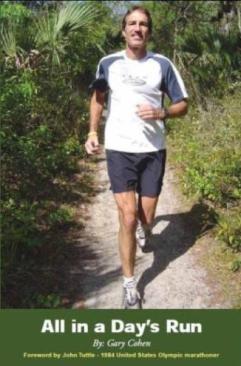 
"All in a Day’s Run" is for competitive runners,
fitness enthusiasts and anyone who needs a "spark" to get healthier by increasing exercise and eating more nutritionally.
Click here for more info or to order
This is what the running elite has to say about "All in a Day's Run":
"Gary's experiences and thoughts are very entertaining, all levels of
runners can relate to them."
Brian Sell — 2008 U.S. Olympic Marathoner
"Each of Gary's essays is a short read with great information on training,
racing and nutrition."
Dave McGillivray — Boston Marathon Race Director
|
 |
|
|
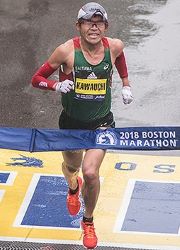
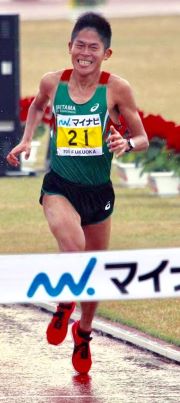
Yuki Kawauchi won the 2018 Boston Marathon in brutal conditions including near-freezing temperatures, driving rain and hail, plus wind gusts exceeding thirty miles per hour. Yuki passed defending champion, Geoffrey Kirui of Kenya, in the last two kilometers and won by over two minutes in 2:15:58. He is well known for his amazing feats of running more fast marathons than anyone in history. Yuki has raced 128 sub-2:20 marathons, eclipsing former record holder, Doug Kurtis, who ran 76 sub-2:20 marathons. Yuki’s other marathon feats include: sub-2:19 – 120; sub-2:18 – 111; sub-2:17 – 102; sub-2:16 – 93; and sub-2:15 – 80 times. At the elite level, he raced sub-2:11 an amazing 28 times. In both 2014 and 2017, Yuki broke 2:16 a record twelve times. In 2013, Kawauchi ran under 2:09 with two weeks in between and under 2:08 with six weeks in between, both records for the shortest time span. He has 74 marathon podium finishes with 54 Gold Medals, 10 Silver Medals and 10 Bronze Medals. His international marathon wins include the 2013 Gold Coast Marathon in Australia, 2013 Luxor (Egypt) Marathon, 2016 Zurich Marathon, 2017 Oslo Marathon, 2018 New Taipei City Wanjinshi Marathon, Vancouver Marathon (2019, 2023), and the Sydney Marathon (2012, 2022). Yuki represented Japan at four World Championships (2011, 2013, 2017, 2019) in the marathon and won Bronze Medals at the 2014 Asian Games and Fukuoka Marathon three times (2011, 2013, 2016). He is the fastest ‘Seven Star’ Marathoner with an average time of 2:13:43 for the seven major marathons. Kawauchi has also won over four dozen half marathons. At Gakushuin University in Tokyo, his 14:08 for 5,000 meters still stands as the school record 17 years later. At Saitama Prefectural Kasukabe Higashi High School, Yuki’s best time for 5,000 meters was 15:07. His personal best times are: 1,500 meters – 3:50.51; 3,000m – 8:01.42; 5,000m – 13:58.62; 10,000m – 29:02.33; 10k (road) – 28:53; 10-miles – 47:28; 20k – 59:17; Half-marathon – 1:02:13; 30k – 1:29:31; Marathon – 2:07:27 and 50k – 2:44:07. At age 38, after two years marred by injuries, a healthy Yuki ran sub-2:15 recently and is taking aim on running 150 sub-2:20 marathons and returning to sub-2:10 form. His primary sponsor is Aioi Nissay Dowa Insurance, which supports his competitions and the ‘Marathon Caravan’ all over Japan which including lectures, events and running exchanges. Kawauchi’s secondary sponsors are Morinaga and Company, Garmin, ASICS and Zygospec. Yuki was very gracious to answer questions translated into Japanese for this interview in February 2026.
|
|
| GCR: |
THE BIG PICTURE First, thank you for agreeing to this interview. Many runners have raced under 2:20 in the marathon. What does it say as to your ability to run under 2:20 for 128 times, and more to come, when no one else has done so more than 75 times?
|
| YK |
I've broken 2 hours 20 minutes in marathons 128 times as of the Osaka Marathon on February 22, 2026. This record demonstrates three abilities. First, it shows ‘the running power to consistently break 2:20 multiple times.’ Second, it shows ‘unlike other elite athletes, I have continued to run full marathons frequently.’ Third, it speaks to ‘the mental strength to maintain my running power for over 15 years since my first full marathon in 2009, while forging ahead on the path I believed in.’ My current results are 149 completed marathons; sub-2:20 – 128; sub-2:19 – 112; sub-2:18 – 111; sub-2:17 – 102; sub-2:16 – 93; and sub-2:15 – 80 times.
|
|
| GCR: |
At the elite level, you also hold the record for the most marathons under 2:11 which you have done 28 times. Is this a more difficult achievement than racing 128 times under 2:20?
|
| YK |
For runners without a personal best under 2:10, breaking 2:11 the most times is extremely difficult. On the other hand, since very few elite athletes run over 100 full marathons, the Guinness World Record for most sub-2:20s is likely more difficult.
|
|
| GCR: |
Most elite marathon runners race two or three marathons per year. How challenging is it to race so many marathons in one year and to be so fast as you were in both 2014 and 2017 when you broke 2:16 a record twelve times in both years?
|
| YK |
For an athlete with a personal best close to mine to attempt this challenge for just one year, it would be physically demanding. However, few professional athletes would take on such a challenge without financial reward, especially risking injury. On the other hand, amateur athletes like my former self might find it ‘interesting’ and attempt it. In that sense, it's fair to say professional athletes face greater difficulty breaking my record than amateurs.
|
|
| GCR: |
Another challenge is to race fast marathons close together. Was the year 2013 your best overall marathon racing since you ran under 2:09 with two weeks in between and under 2:08 with six weeks in between?
|
| YK |
In 2013, I broke 2 hours 10 minutes five times in a single year, ran 2 hours 10 minutes and one second at Gold Coast, winning medals in eight events including five victories. Except for the setback at the Moscow World Championships, it could be considered my most outstanding year overall.
|
|
| GCR: |
You have been on the podium in the marathon 74 times with 54 Gold Medals, 10 Silver Medals and 10 Bronze Medals. How rewarding is it to finish with so many podium finishes and is it always exciting to break the finish line tape as marathon champion?
|
| YK |
No matter the race, winning gold always brings immense joy and pride. More than half of my gold medals came from ‘local marathons where winning was expected.’ Sometimes, I find the silver or bronze medals I fought desperately for at international competitions more satisfying than those gold medals from local races where victory was taken for granted.
|
|
| GCR: |
Very few top marathon runners race longer distances, but you hold the record for the most sub-3:00 fifty-kilometer ultramarathons. How does it compare racing the extra eight kilometers versus the marathon and also winning the Okinoshima Ultramarathon?
|
| YK |
I only won the Okinoshima Ultra Marathon once, in 2012. From 2013 onward, I participated as a guest runner in demonstration races that were not eligible for awards, so I did not win. In the 2011 race, my first attempt at the 50km distance, I lost consciousness due to heatstroke and collapsed around the 49th kilometer. I have run nearly 800 races, excluding track races where I was disqualified for falling behind a lap, and the only race I ever had to abandon was the 50km race in Oki. This is a symbolic episode that shows that if you run a marathon distance giving your all, you cannot manage a 50 kilometer race.
|
|
| GCR: |
When you completed the Abbott Marathon Majors, your average time for the six races in Tokyo, Boston, London, Berlin, Chicago, and New York City was one of the fastest on record. How exciting was it to complete the Abbott Marathon Majors and to have one of the fastest average times?
|
| YK |
I wasn't the fastest at the time. Emmanuel Mutai of Kenya held the fastest record at the time. In 2025, Geoffrey Kamworor of Kenya, who ran in Chicago, surpassed me.
|
|
| GCR: |
THE 2018 BOSTON MARATHON – WINNING IN CHALLENGING WEATHER Based on your marathon races in 2017 and early 2018 plus your training, did you feel you were ready to compete for the victory and did the forecast of cold temperatures, rain and strong headwinds give you increased hope?
|
| YK |
When I decided to run the Boston Marathon in 2018, I knew I wanted to aim for the top 10 or a place on the podium at the prestigious Boston Marathon. I had also been training well, having won the Wanzhen Marathon in Taiwan a month earlier in a race without pacemakers. After arriving in Boston, the weather forecast predicted that the temperature would drop day by day, and the rain and wind would get stronger, so the day before the competition, winning a medal on the podium became a realistic goal, and I was so confident that I thought I might have a chance of winning.
|
|
| GCR: |
When you took the lead and pushed the pace in the first ten kilometers, were you making it known to your competitors that they would have to contend with you?
|
| YK |
When I took the lead and set the pace for the first 10 kilometers, I told my rivals, ‘I'm ready to fight you. Were you trying to tell me to do it?’ One month earlier, in the Wanjinshi Marathon in Taiwan, I ran alone at the front and won the race. In the Nagano Marathon in 2013, I took the lead from the start in the cold, sleet-filled weather, kept the lead, and one by one, I left the Japanese and Kenyan runners behind. In a long sprint after 40 kilometers, I pulled away from the Russian runner who had been competing with me the whole time and won the race. From these experiences, I thought, ‘Even though the level of my rivals is different from past races, I can trust my experience.’ I believed that if I ran a good race, I will definitely get a good result.
|
|
| GCR: |
How were you feeling at the half marathon point when you were running with the lead pack?
|
| YK |
After being caught by the leading group, I was almost left behind at around 13 kilometers. After catching up, I got ahead of the leading group on every downhill stretch which I was good at, and stamina-wise I was pushing the other runners to the limit. I was able to drive aggressively, cutting down on my energy, so I thought, ‘I can keep up my strong will. If I can do this, I can definitely get a good result today.’ I forgot about the time difference and the difference in achievements and focused on running the race as a single athlete.
|
|
| GCR: |
After 17 miles, Geoffrey Kirui made a big move and ran strong for the next five miles as he opened up a lead of over ninety seconds by mile 22. Could you see him ahead of you and did you think your chance of winning was gone, or was it still a long way to the finish and anything could happen?
|
| YK |
The conversation among the other competitors began immediately after they heard that Galen Rupp had fallen off the pace. Kirui's long sprint was very intense. It was hard like Heartbreak Hill. It was as if he had already surpassed our limit. Not only me, but everyone else could not keep up with him in this amazing long sprint. The large group that had been maintained even though strong athletes were gradually dropping out was unable to keep up with the pace. Kirui's spurt caused the race to collapse, and he was soon out of sight. So, I was left behind. However, after this spurt, I was in the second-place group formed by Abdi and others from the Netherlands. I was able to keep up with the group, and after running with them for a while, I picked up the pace and moved into second place as we ran over Heartbreak Hill, were running down the hill, and then began running the streets of Brookline. At that time, Geoffrey Kirui was not in sight at all. However, running the traditional Boston Marathon in second place was extremely exciting for me. I felt so high that I thought, ‘I was born for this day.’ Although I was feeling more and more like that, Kirui was not slowing down, and I was thinking, ‘I can't see the first place at all, I'm just in second place. I wonder if Toshiheko Seko, who won the race 31 years ago, was running while looking at a view like this.’
|
|
| GCR: |
Over the next five kilometers, Kirui faded and you caught and passed him. What were your thoughts and emotions as you reeled him in, passed him, and took the lead?
|
| YK |
I was overtaking the female runners who had started earlier, but the 40 kilometer mark when I passed Kirui near Fenway Park, I wasn't sure I was in the lead. Kirui was running at the same speed as the women due to fatigue and the wind and rain. After 40 kilometers, Kirui disappeared from view. However, after passing Kirui, I didn’t know if he was close behind me. I thought it was a possibility because cars and other vehicles were following me. I wasn't sure, even if I was in the lead, if there was a chance I would be overtaken again. I was thinking about this, so I ran desperately without letting my guard down for even a moment until I broke the finish line tape. I was convinced that I was in the lead when I spoke to the tournament staff in the last 300 meters. In the technical meeting before the race, only the winner was guided to the right. That explanation was given and it came back to me. ‘I just want to finish like this’ was the only thought I had as I made my final sprint.
|
|
| GCR: |
One of the ultimate achievements for marathoners is to win a major marathon. What are your thoughts and emotions about winning the 2018 Boston Marathon and how exciting was it to break the finish line tape as Boston Marathon Champion, receive the laurel wreath, and to have won so convincingly on a day with such adverse weather conditions?
|
| YK |
The moment I crossed the finish line was unbelievable, like I was in a dream. That's how I felt. I was exhausted after the finish and collapsed or had to be carried away. I usually feel this way, but right after finishing Boston, I felt something deep inside me that I had never felt before. An incredible feeling of joy welled up inside me, and I cheered and shouted. That wonderful performance was praised by many event staff at the finish line and the spectators along the road. In 2011, I had won the silver medal in the World Cup team event held in conjunction with the marathon at the Daegu World Championships. At Daegu, I was so moved at the award ceremony that I thought, ‘I want to stand on a stage like this as an individual someday.’ The thoughts of my younger days, when I thought, ‘I want to do this,’ came back to me. And while I achieved a good result of finishing sixth in the 2015 New York City Marathon, I also felt a little regretful that ‘I tried three times in New York City, but I couldn't reach the podium.’ A lot of different memories intersected in Boston. It was a very moving moment, and the moment when the Japanese flag, the Hinomaru, was raised at the top of the award ceremony, I was so happy that I cried.
|
|
| GCR: |
RUNNING AS A YOUTH, IN HIGH SCHOOL AND COLLEGE Did you play in a variety of sports as a child?
|
| YK |
I attended a sports kindergarten from ages three to six, so I tried many different sports. I tried skiing, swimming, gymnastics, soccer, and various other sports. However, since I was born in March and Japan's kindergarten and elementary school entrance ceremonies are in April, I was smaller than the other children and wasn't good at any of them. But trying various sports did make me healthy. In elementary school (ages 6–12), I started running in first grade (age 6). I also attended swimming school and joined a youth baseball team starting in fourth grade (age 9). I achieved slightly better results in swimming, but I was completely terrible at baseball. In junior high school (ages 12-15), I joined the track and field club, which is a standard school club activity in Japan.
|
|
| GCR: |
What can you tell us about your first 1,500-meter race at age six and is this what set you on the pathway to becoming a runner?
|
| YK |
Yes, this started me in running. My parents found a poster at the supermarket advertising a ‘Kids' Health Marathon’ and signed me up. It was a 1.5-kilometer road race. In that 1.5-kilometer race, I finished fifth with a time of seven minutes and 30 seconds. Seeing that result, my parents thought, ‘If we make sure our child trains properly, he might win a medal at next year's competition,’ and they became my coaches. As an elementary school student, I followed my mother's training regimen without question.
|
|
| GCR: |
What were the main components of the training formulated by your mother?
|
| YK |
The training consisted of daily time trials over the exact distance of the next upcoming race. No tempo runs. No intervals. Every day was a time trial. Furthermore, if my time trial time was slower than my personal best, I was penalized with an additional lap around the park of 470 meters to 1,200 meters as punishment. If I didn't run within five seconds of my personal best in this time trial, I was punished with another lap, and then forced to run multiple laps until I met the standard. And if I couldn't clear the standard no matter how many times I ran, I was left behind in the park and had to run home alone. Conversely, on days when I achieved a personal best in this time trial, I was rewarded with treats like burgers or ice cream. As a result, at next year's competition, I ran the 1.5-kilometers in six minutes and twelve seconds, placing second and winning a silver medal. Because of this, for the six years until I graduated elementary school, I continued this time trial every day except when it rained. Because I did this grueling time trial every day, I didn't like running when I was in elementary school. I just ran as a duty, following my parents' instructions daily. My parents called this practice ‘marathon training,’ so I thought I would run marathons in the future.
|
|
| GCR: |
How did the coaching by your mother, who was a middle-distance runner in her youth, get you ready for your teenage years, what training did you do differently in junior high school, and what race times did you run?
|
| YK |
My mother's guidance lasted until elementary school ended at age twelve. I believe the six years of daily all-out sprint time trials, timed by my mother and father, laid the foundation for learning to ‘give my all.’ However, there were better, more specialized training methods available. In junior high school (ages 12-15), I joined the track and field club. I trained twice a day, morning and evening, incorporating interval training and strength training, and building up more specialized training. However, I continued participating not only in track races but also in two and three kilometer road races held on Sundays across the Kanto region, which I started joining around age ten in elementary school. In road races, I made it onto the podium many times, both as an elementary and middle school student. But I only placed third, never once taking first place. On the other hand, in track races, I advanced past the district preliminaries and reached a level where I could compete in the prefectural championships. However, I was unable to qualify for national competitions beyond the prefectural level. My personal best for the 1,500 meters in my first year of junior high was 5:06. My personal best for 1,500 meters in my third year of junior high was 4:28 and my 3,000 meter PB was 9:28. Additionally, in junior high, I enthusiastically participated in the relay race where the team passes the sash. At my school, in autumn, not only the track and field club but also the soccer, baseball, and basketball clubs gathered their fastest runners to form a temporary ‘Relay Club’ to compete in the relay race. In this Ekiden, we won the district preliminaries every year and advanced to the prefectural tournament for three consecutive years. This experience became my motivation when choosing a high school. Initially, I planned to apply to an academic high school, but I wanted to pursue my potential through serious Ekiden training. So, I applied to and enrolled in Saitama Prefectural Kasukabe Higashi High School, which had placed fifth in the Saitama Prefectural High School Ekiden at the time.
|
|
| GCR: |
How did your training change in high school, who was your coach, and what were some of your best races, results, and times?
|
| YK |
My high school coach was Mr. Sugawara. Unlike middle school, I was prohibited from freely participating in road races on my own initiative. Instead, I focused intensely on competing in ‘Ekiden’ and ‘track races.’ Speed training increased significantly and, during training camps, we ran 20 kilometers on hilly courses. Both the quality and quantity of training were vastly different from junior high. Furthermore, there were many seniors and classmates faster than me, so I trained desperately every day to make the Ekiden team. As a result, after entering high school in April, I ran the 3,000 meters in 9:00 by August, just four months later. By autumn, I could run the 5,000 meters in 15:34. Even in my second year of high school, I improved my times further, running the 5,000 meters in 15:07. I made the Ekiden team starting my freshman year, won the prefectural tournament, and ran in the Kanto High School Ekiden. In my second year, I again won the prefectural tournament. At the Kanto High School Ekiden, I ran the fourth leg, placing eighth in that section, and our team achieved the school's best-ever result, placing seventh overall. Through my sophomore year, I lived a life of rigorous training and strict discipline, never doubting that we could become faster and stronger. Like many other Japanese high school long-distance runners, I was serious and worked incredibly hard. What threw me off track was an injury during the winter of my sophomore year. I strained my iliotibial band from hard work, and the injury became recurrent. My senior year was spent cycling through injury and recovery, preventing me from competing in most races. Thoughts like ‘I have to push myself because I'm the long-distance captain’ and ‘I enrolled in this high school to run in the Ekiden’ fueled my impatience. I kept returning to training before I was fully recovered, only to have the pain flare up again and force me to rest. For over a year, I struggled with this vicious cycle of injury. While I managed to run in the Ekiden, my performance fell far short of the previous year's. Overcome with regret and self- pity, I cried, wondering, ‘What was the point of enrolling in this high school?’ Due to my poor performance over this year-long injury, no university scouts approached me. I gave up on attending a university where I could excel in Ekiden and chose to enter Gakushuin University through academics. At that time, quitting track and field was not an option for me. Because I had been running continuously since I was six, I had this obsessive thought: ‘If I stop running, what will I have left?’ This feeling stayed with me even when my injuries prevented me from running properly. Therefore, unlike many athletes who had given up, I started thinking, ‘How can I make running enjoyable again?’ and ‘At university, I want to focus on healing my injuries.’ So, the reason my mindset differed significantly from other Japanese marathon and Ekiden runners stemmed from this major setback at age 17 or 18.
|
|
| GCR: |
How tough was it for you both academically and athletically to keep focus when your father passed away when you were in high school?
|
| YK |
When my father passed away, both my family and I were enveloped in deep sorrow. Fortunately, I had already been accepted into university, so academics weren't an issue. Regarding athletics, I thought, ‘I'll push myself for my father, who supported me through my long injury.’ In March before entering university, I won a 10 kilometer road race with a time of 32:14. Also, just before starting university in April, I ran my first half marathon. Although I slowed down in the latter half, I finished fourth with a time of 1:12:16.
|
|
| GCR: |
At Gakushuin University in Tokyo, what did Coach Seiichi Tsuda do with your training and running form to help you become a better runner?
|
| YK |
The training that had focused on speed up until high school has changed to training focused on stamina. Big changes had been made, such as four hard workouts a week becoming two, and two practice sessions a day becoming one session a day. There was a transformation. This change in training method reduced the injuries that plagued me in high school and allowed me to continue training. It was now possible to stack. The training methods I used at Gakushuin University and after graduating from university as an amateur runner are still used today. This is the basis of my training method, even though I am a professional runner. Coach Tsuda said, ‘We'll run at a pace of 20-30 minutes, which is not easy but is bearable.’ The instruction focused on distance running of 10 kilometers and short recovery intervals. Also, Coach Fukunaga, who is a university alumnus and worked at the National Tax Agency, sometimes led me during practice. In addition, I was blessed with good seniors and juniors at university, and I was good at stamina training for distance running. I did speed drills with my teammates who were faster than me. This helped me get faster and stronger.
|
|
| GCR: |
What were some of your top results in the 1,500 meters and 5,000 meters and did you win many races during this time?
|
| YK |
In November, just seven months after entering university, I was able to run 5,000 meters in 14:38, breaking the standard record for the Kanto University Track and Field Championships at the time. By my third year of university, I had improved that record to 14:08 and competed in the Japan Student Track and Field Championships. I also achieved victories and good results in the inter-university competitions held several times throughout the year. In particular, the 5,000 meter meet record I set in an inter-university competition against Konan University still stands 17 years later. I ran 1,500 meters in 4:13 in my first year of high school, but this time was not as good as the times of my high school teammates. My high school classmates could run the 1,500 meters in under four minutes. There was a runner who came in second at the National High School Track and Field Championships. So, in my second and third years of high school, I didn't run 1,500 meters and instead focused on the relay race and the 5,000 meters. At university, I didn't do any specialized training for the 1,500 meters but rather trained for the half marathon and 5,000 meters. Although I was practicing while competing, I was able to improve my 1,500-meter personal record to 3:56.
|
|
| GCR: |
What are your memories of racing the 2006 Hakone Ekiden, a two-day-long university men's relay of ten legs that covers the 134.9-mile distance from downtown Tokyo to the hot-spring resort town of Hakone and back?
|
| YK |
I was not selected by the university team, but by the top runners from the universities who were eliminated in the qualifying rounds. The Kanto Student Federation Selected Team (now called the Kanto Student Union) started on the second day. This was the first time in the history of Gakushuin University that someone had ever run the sixth section. I attracted a lot of attention as the first athlete to run in the Hakone Ekiden.
|
|
| GCR: |
During your senior year in college, you ran the 2009 Beppu-Oita Mainichi Marathon in 2:19:26 and the Tokyo International Marathon in 2:18:18. Was it relatively hard or easy for you to adjust to marathon racing and had you found your best distance?
|
| YK |
After turning around at 27 kilometers, I got a tailwind and broke away from the group five kilometers earlier than planned and accelerated. In the end, I completed the first half marathon in 72 minutes, but the second half in 67 minutes. I was able to do this and finish my first marathon in under 2 hours and 20 minutes. I accelerated to a sub-5:00 mile pace for the last 2.195 kilometers and was exhausted after the finish. I didn't collapse and it was just a fun marathon. Having gained confidence in Beppu-Oita, I was able to stay with the leading pack at the Tokyo Marathon. However, I fell behind the leading group after just 15 kilometers, and the remaining 27k was hellishly difficult. It was a disastrous race, and after the finish I collapsed and was taken to the medical room, my whole body in convulsions. I was in so much pain that I didn't recover for more than 40 minutes. So, in Beppu-Oita, I thought, ‘The marathon is easy,’ but in Tokyo, I thought, ‘It's difficult.’
|
|
| GCR: |
MAJOR CHAMPIONSHIPS How exciting was it to compete in your first World Championships Marathon in Daegu, South Korea in 2011 where you finished 18th in 2:16:11? Did you pass runners toward the end or fade a bit?
|
| YK |
My pace was slowing, but I persevered and overtook many runners towards the end, including some from Morocco. The Japanese team won the silver medal in the World Cup Marathon team event, which was held in conjunction with the World Championships, beating Morocco, the bronze medal winner, and finishing behind Kenya, the gold medal winner.
|
|
| GCR: |
Two years later you again finished in 18th place at the 2013 World Championships in Moscow, Russia with a time of 2:15:35. Were you satisfied with your performance or hopeful of a top ten finish?
|
| YK |
I was not satisfied at all. In 2013, I was in the best shape of my marathon career, running the Beppu-Oita Mainichi Marathon in a new course record of 2:08:15 seconds. Two weeks later, I won the Kumamoto Nichinichi 30 kiloneter Road Race in 1:29:31 seconds. Three weeks after that, I placed fourth in the Seoul International Marathon in 2:08:14. I also won the Gold Coast Marathon in July, tying the course record at the time, so I was on a roll. Therefore, I set my goal of finishing in the first six places and was disappointed with the results at the World Championships.
|
|
| GCR: |
The 2014 Asian Games Marathon was a battle for medals as Bahrain’s Hasan Mahboob won in 2:12:38, followed by Japan’s Kohei Matsumura in 2:12:39 and you in Bronze Medal position in 2:12:42. Can you please describe the final part of that race as the three of you fought to win?
|
| YK |
I made a bold move at the 25k uphill stretch, but ended up wasting my energy and, combined with a missed water intake, I dropped out of the lead pack. After that, I managed to catch up with the other runners, and we were back in a group of four. Around the 40k mark, Mongolian runner Bat Ochir looked like he was in pain, so I picked up the pace, thinking, ‘If I can pick up the pace now and shake him off, I'll be sure to win a medal.’ Bat Ochir dropped back, but having made two attempts at the 25k and 40k mark, I no longer had the energy to make a final sprint. After entering the stadium, I lost to the other two runners in the final stretch, finishing in third place. My goal at the Asian Games was to win the gold medal. However, around the 40k mark, I started thinking, ‘It's fine as long as I can win a medal.’ If I hadn't changed my original goal of winning the gold medal, I shouldn't have made a move around the 40k mark. If I had held back until the end, I might have won the gold medal, or I might have finished in fourth place and missed out on a medal. Even now, I sometimes wonder, ‘Was that choice the right one?’
|
|
| GCR: |
At the 2017 World Championships in London, England, you made the top ten with a time of 2:12:19 for ninth place. Did you stay with the lead pack in medal position for much of the race and were you pleased with your top ten finish?
|
| YK |
I felt refreshed right after finishing because I thought I had done my best. However, I gradually began to feel regretful that I had missed out on an eighth-place finish by just four seconds. During the race, I had fallen and hit my leg on a sign for a water station. I sometimes wondered if I could have placed eighth if those things hadn't happened. What's more, Daniel Wanjiru of Kenya, who finished four seconds ahead of me in eighth place, was punished three years later for an anti-doping violation. His record from the 2017 London World Championships was not erased, but I sometimes wondered if he had really been clean at the London World Championships.
|
|
| GCR: |
JAPANESE MARATHONS You raced the Fukuoka Marathon twelve times, and earned the Bronze Medal three times in 2011, 2013 and 2016 with times of 2:09:57, 2:09:05, and 2:09:11. What are your memories of this iconic race and was it a thrill to be on the podium three times?
|
| YK |
In 2011, I competed for third place with the superstar of the Hakone Ekiden, ‘Mountain God’ Masato Imai. When I achieved third place. It was the highest ranking for a Japanese runner. My sub-2-hour 10-minute time made me a strong contender for the London Olympics the following year. It was a race that showed my abilities as an individual. In 2013, I picked up the pace at the halfway point when the pacemakers were off and briefly took the lead. Despite this aggressive race, I came in third place and won the Incheon Marathon in Korea the following year. This was a run that would determine who would represent Japan in the marathon at the Asian Games to be held in 2014. In 2016, it was my last attempt to represent Japan in the World Championships marathon as an amateur runner. I had been training well for this race, but on the day before the race, I injured my left ankle on a step. I sprained my ankle and it became very swollen. In fact, the morning after the Hofu Yomiuri Marathon in December 2014, I was jogging on a snowy, icy road. Then, I slipped on a curve and sprained my left ankle badly, and since then I've been spraining my left ankle frequently. In 2015, when I placed sixth in the New York City Marathon, my left ankle was severely swollen and painful, I was advised by his teammates to withdraw, but I ran anyway. I was originally not selected for the Japanese national team for the London World Championships, and when I was selected, he sprained his ankle. However, I felt that I couldn't just give up, so I decided to participate. Due to the condition of my ankle, I decided to run in the second group. It was raining heavily, and as I was running with the second group, the cold numbed the pain in my ankles. Furthermore, the cold weather slowed the pace of the first group, and by the halfway point At this point, there was truly little difference between the first and second groups. As a result, I made a move after 25k and made a sprint, temporarily taking the lead. Although I was overtaken by two other runners along the way, I persevered and was the top Japanese runner. I finished third in the Fukuoka marathon, almost guaranteeing my place on the Japanese marathon team for the 2017 World Championships in London. I was relieved after finishing in third place, as I had achieved it in such a difficult situation. I cried tears of joy because of the emotion. However, there have only been a few races where I have shed tears of joy, including the one in Fukuoka in 2016.
|
|
| GCR: |
At the Hofu Yomiuri Marathon, you made the podium eleven times out of sixteen attempts with five Gold Medals, four Silver Medals, and two Bronze Medals. Were any of these races especially close or memorable and were the race organizers and spectators especially fond of you since you raced so well there so many times?
|
| YK |
I won the Hofu Yomiuri Marathon five times, the most in the history of the event, and was on the podium 11 times in total. It's a race that suits me very well and since I've achieved many places on the podium, it's one of my favorites. In 2011 and 2013, I competed for the championship with Mongolian Serud Batochir. In 2012 and 2014, I made a perfect race plan with a long sprint from 32k to the finish. By defeating the Kenyan runners and winning the championship, I became a competitor who left a lasting impression on the people of Hofu. The fifth victory in 2023 was also a close race between three of us until the 40-kilometer mark, when I thought ‘It's going to be a rough battle.’ But at the moment the others let their guard down, I made a long sprint and won. My wife and son came to support me at this marathon, so it was a very memorable experience. It remains a wonderful memory to have been able to take part in the winner's interview together. In 2024 and 2025, I was unable to perform well due to injuries, but this year I hope to get back to a state where I can aim for victory again. My main goal for 2026 is to be competitive. Whether I can compete for the lead again in this race will be especially important for my future competitive activities.
|
|
| GCR: |
You were extraordinarily successful at the Ibusuki Nanohana Marathon, winning it all four times you raced there in 2015, 2016, 2019, and 2024. Is this a special race for you and for the fans since you are a four-time champion?
|
| YK |
In addition to four victories at the Ibusuki Nanohana Marathon, in 2020 I also won a guest award. As a runner, I ran as a pacemaker for the other runners up to 30k, and then this year and last year, I started from the back and finished in the top position. I overtook over 100 runners, encouraging them, and although I was not eligible for awards, I finished in the equivalent of eighth and tenth place. While there is wonderful hospitality and support from the roadside, it is a difficult course with many slopes. In recent years, there has been no runner who has broken the 2:20 mark in this race, so there has been little chance of winning or recording a record. Rather than aiming for a record, the main focus is on training and interacting with other runners. This event, along with the sand baths that are rare in this region, made it a special event for me.
|
|
| GCR: |
The Lake Biwa Mainichi Marathon has a very deep field, and you had four top finishes there - fourth place in 2014 in 2:10:38, seventh place in 2016 in 2:11:53, eighth place in 2019 in 2:09:21, and tenth place in 2021 in your personal best time of 2:07:27. How challenging is this race and what do you recall from your personal best time in 2021?
|
| YK |
This event has now been merged into the Osaka Marathon and is no longer held, but it was a race that started in the afternoon. It was often hot, so I don't think many records were set. On the other hand, since the start time was changed to a morning start, most of the course was up and down. The flat course allowed for many good records to be set. In particular, the 2021 Lake Biwa Mainichi Marathon, was where I broke my personal marathon record for the first time in eight years, There were 42 runners who finished under 2 hours and 10 minutes in the marathon. It was a race in which many runners broke their personal records. I was not in the fast-leading group, but was running in the second group, and I had plenty of time. After the 30k mark, the pacemaker dropped out and I overtook several other runners from the second group. I started to move faster and overtook the runners who had dropped out of the lead group one after another. One of the reasons I went from amateur to professional was that I had not been breaking my personal marathon record for over five years. ‘I still haven't been able to do that,’ and ‘I thought I could definitely run under 2 hours and 7 minutes. ‘It was something I thought I would regret if I didn't release it.’ This event was my goal for about 10 years, since the 2011 Tokyo Marathon, to finish under 2:08. Being able to run in under 2:08 was very meaningful in my life, and I decided to become a professional runner. It proved that what I did was not a mistake. However, one of the runners who broke away from the second group went on to finish in under 2:07. I finished the race on time, so I was a little disappointed that I only managed to finish in under 2:08.
|
|
| GCR: |
You won more than two dozen other marathons in Japan. Do any of these victories stand out in your memory for great competition, a close finish, tough course, or inclement weather?
|
| YK |
I have a special memory of breaking my personal record and winning the 2013 Beppu-Oita Mainichi Marathon, setting a new course record at the time. Around the 32-kilometer mark, I was locked in a one-on-one battle with Kentaro Nakamoto, who placed sixth in the 2012 London Olympics marathon. We continued to compete until the 40k mark, then made a long sprint at the final water station to win. It was the first time I'd broken the course record in 17 years. Although I was a strong contender to represent Japan at the London Olympics, I missed out due to a disappointment in the 2012 Tokyo Marathon with a relatively slow 2:12 time, so beating Nakamoto, who had performed so well at the London Olympics, was an incredible joy. This victory also earned me a spot on Japan's marathon team for the Moscow World Championships that year. Even now, 13 years later, I still hear people say to me, ‘I started running after seeing that dead heat at the Beppu-Oita Mainichi Marathon,’ or ‘The Beppu-Oita Mainichi Marathon run by Kawauchi and Nakamoto was the best race I have ever seen.’ In that sense, it was a marathon that inspired not only me, but many other Japanese runners.
|
|
| GCR: |
INTERNATIONAL MARATHONS The international marathon you raced most was the Gold Coast Marathon in Australia where you finished in the top ten eight out of nine times with one Gold Medal, one Silver Medal and two Bronze Medals. What were highlights in 2013 as you won in 2:10:01, well ahead of Taiga Ito in 2:11:52?
|
| YK |
In 2013, I was in top form. At the Gold Coast, after the pacemaker stopped at 30k, I picked up the pace and made a move. For a while, I was competing with Ito and an Ethiopian runner, but halfway through, I pulled away and ran alone, and I continued to run in the Gold Coast. The timer at the finish line showed a new course record of 2:10:00, but in the end, my official time was 2:10:01 seconds, which tied the course record, and I missed out on the course record bonus of 5,000 Australian dollars. Still, I was incredibly happy to have won the traditional Gold Coast Marathon, and my image of jumping into the sea in celebration made the front page of the Gold Coast newspapers.
|
|
| GCR: |
What can you relate about the epic battle you had at the Gold Coast Marathon in 2016 with Kenneth Mungala as he outsprinted you by one second 2:09:00 to 2:09:01?
|
| YK |
After the pacemaker dropped out, I continued to compete with Mungara until the last few hundred meters, but I was extremely disappointed that he made the final sprint that lost me. However, the difference was more than just a second, and the fact that we were competing allowed me to once again achieve a sub-2:10 time, something I had not been able to achieve since I sprained my left ankle in December 2014 and fell into poor form. This gave me a positive feeling that I was ‘back to the form I was in before my injury.’
|
|
| GCR: |
What were the key points at the 2017 Gold Coast Marathon as Tokuya Noguchi won in 2:08:59 just ahead of Kenneth Mungala in 2:09:04 and you in 2:09:18?
|
| YK |
This was a race I was determined to complete in under 2:10 in order to achieve a good result at the London World Championships the following month. On the other hand, I think Noguchi and Mungara were fixated on winning. I think that difference in their determination showed in the end. Of course, I was disappointed that I lost, but more than that, this race gave me a sense of confidence that I could compete at the London World Championships the following month.
|
|
| GCR: |
You won international marathons in many cities including Sydney, Luxor, Perth, Zurich, New Taipei City, Oslo, Vancouver, Niagara Falls and New Caledonia. Were any of these races extra special due to interesting courses, great fans, or a close competition?
|
| YK |
My victory at the 2018 New Taipei City Wanjinshi Marathon is a special memory. Having placed second in this race in 2016, I was aiming to win. My strategy was to break away from the pack and beat the African runners, primarily Kenyans and Ethiopians. When I took off, several runners tried to keep up. However, taking advantage of the course's many ups and downs, I increased my speed with each downhill stretch, seemingly beyond my ability to complete the marathon. By the 5k mark, I had left everyone behind and was in the lead. The gap between me and the African runners in second place, who were holding back, continued to widen, and by the halfway point, I had opened up a lead of over one minute 20 seconds. After that, I was pressured by the runners who had broken away from the second-place group and started to pick up the pace, but I ultimately managed to hold on and win, keeping a lead of about 40 seconds. However, the damage caused by running alone in this humid, up-and-down race was great, and I was taken to the medical room in great pain. But I felt immensely proud to be praised by the Taiwanese people at the awards ceremony and surrounded by the enthusiasm of the wonderful fans. I also believe that my successful solo run in this race led to my breakaway start and victory in the Boston Marathon one month later.
|
|
| GCR: |
Are there any other marathon races in places you competed like Stockholm, Cape Town, Venice, Melbourne, Seoul, Prague, Vancouver, Nice, Marrakesh, Tallinn, or other cities that you wish to mention for beautiful cities or other reasons?
|
| YK |
The Vancouver Marathon in April 2019 is a memorable event for me because I won with my fiancée, Yuko, whom I was planning to marry a month later in May. At one point, both Yuko and I were left behind by the first-place runner, but we managed to make a comeback in the final stages and win. The people in Vancouver are kind, it's a scenic port city, and there are many great parks perfect for jogging. My wife and I both love it. Another fond memory is that after the race in a different year than the one in which we both won, I was invited to a home party by someone involved with the race with my wife and son, who had accompanied me, and we were treated to some delicious hamburgers.
|
|
| GCR: |
HALF MARATHONS AND OTHER DISTANCES You raced several half marathons in the University Division from 2007 to 2009 with times from 1:03:13 to 1:05:43. Was it rewarding to earn Bronze Medals at the 2007 Kanto Region Half Marathon and 2008 Ageo City half Marathon and were these results an indication that the marathon was in your future?
|
| YK |
I am enormously proud of winning the bronze medal in the second half marathon at the Kanto Intercollegiate Track and Field Championships in 2007, my third year at university. After beating out many other successful runners in the Hakone Ekiden, I can say that winning the bronze medal was one of the highlights of my athletic career as a university student. It was a wonderful experience to be able to take part in the award ceremony at such a prestigious event. At the Ageo City Half Marathon in my fourth year of university, I was competing with Suematsu, who was in second place, until just before we entered the stadium, but I lost in the final stretch. Although I was disappointed that I lost at the last moment, winning the bronze medal over many runners who were active in the Hakone Ekiden not only gave me a great boost of confidence, but also left an impact that almost guaranteed my participation in the following year's Hakone Ekiden as the sixth section of the Kanto University Athletic Federation selected team.
|
|
| GCR: |
At the 2022 Yamaguchi All-Corporate Half Marathon, you raced your personal best time of 1:02:13 but only finished in 66th place. What was it like to race so fast and be with and behind so many other top runners?
|
| YK |
In Japan, the Hakone Ekiden and New Year Ekiden, which are similar in distance to the half marathon, are popular, so I wasn't really thinking about my ranking in this race. Because of this, I wasn't running in the lead pack from the start, so it was more like chasing rather than being chased. More than anything, I was happy that I was able to achieve my first personal best in ten years, despite the continued cancellation of races in Japan due to the impact of COVID-19.
|
|
| GCR: |
You have won dozens of half marathons all over Japan. Out of all these victories, are there a few that rise to the top of your memories?
|
| YK |
In 2012, at the Suffolk Land Shibetsu Half Marathon in Shibetsu, Hokkaido, I competed against corporate and university runners and made a long sprint at the water station at the 15k mark. Although I was caught at one point, I pulled away again in the final stretch to win the race, which was a very satisfying race for me. I have only won twelve half marathons, both domestically and internationally. In addition to these twelve victories, I have finished in first place in 65 other half marathons, but in these 65 cases I was a guest runner, not ranked and therefore not eligible for awards. But I believe ‘racing is practice.’
|
|
| GCR: |
Though you are known for racing longer distances, what are your recollections of September of 2022 at the Yokohama Nittai University Time Trials when you raced your 1,500 meter best of 3:50.51 and the next day raced your fastest 5,000 meters of 13:58.62?
|
| YK |
This was only six days after winning the Sydney Marathon in a new course record of 2:11:52. I have a wonderful memory of finishing first in my group in the 1,500 meters, beating my personal best by a large margin, and then breaking my personal best in the 5,000 meters the next day, which gave me a lot of confidence.
|
|
| GCR: |
Similarly, did you feel the most comfortable racing 10,000 meters on the track in 2010 when you raced your personal best of 29:02.33 in June in Shibetsu and then came close with a 29:03.94 in September at Yokohama?
|
| YK |
The two races were similar in time, but completely different. The Hokuren Distance Shibetsu in June 2010 was a race that both Coach Tsuda and I were strongly committed to, aiming to ‘run under 28 minutes, something I hadn't been able to do in college.’ So, when I saw that the runners in my pack up to the 9,000-meter point had run under 28 minutes, while I was just two seconds behind, I was filled with frustration and cried. Yamada, a teammate in the Hakone Ekiden who joined the YKK corporate team, was watching and said, ‘If the amateur runners are crying in frustration like this, then we who make it our job as athletes have to work harder.’ On the other hand, although I was unable to improve my personal record of 29:02 in September and was unable to break the 28-minute mark, it was still a happy race. This was because I was in poor condition in August due to the extreme heat, and I was unable to complete the training menu given to me by Coach Tsuda, which was causing me mental distress. Then, the moment I fell while jogging and hit my knee and felt the intense pain, I thought, ‘Okay, this is the end of my training.’ For a moment, I thought, ‘I can take a break from practice.’ Even though I had suffered from injuries in high school, I felt that my mental state had reached its limit when I thought about such things, so I told Coach Tsuda, ‘Please let me take a little rest.’ I abandoned the training plan that the coach had given me, and after a short rest, I started to plan all of my training and practice on my own. So, for the first time in my competitive career, I was able to achieve my goals through ‘training that I came up with myself.’ The 29:03 seconds that I was able to achieve was the catalyst that helped me regain the confidence I had lost.
|
|
| GCR: |
How do you like the distance of ten miles, which is not raced too often, but you ran a strong 47:28 in 2014 for fourth place at Karatsu?
|
| YK |
When I set my personal best in the 10-mile race at the Karatsu 10 Mile in 2014, it was the same as in 2013. I had maintained my good form, and I had not only stamina but also speed. Speed training for marathons is just as important as track racing. In this day and age, where thick-soled carbon shoes and spikes are the norm, speed training is even more important than track racing. Breaking this Karatsu 10-mile record once again is my long-term goal for over two years now. I think it's the key to recovery from injury.
|
|
| GCR: |
At the 20-kilometer distance, Benjamin Ngandu was able to outkick you at the 2014 Takashimadaira Road race as your personal best of 59:17 was three seconds behind his 59:14 time. How tough is it to win when your strength is distance and many runners have more speed?
|
| YK |
It's exceedingly difficult for me to win in distances shorter than 20k or a half marathon since I'm not very fast. However, I can beat opponents in marathons who I can't beat in those short distance races. Winning is great, but I think it's fine if I can win the marathon even if I can't win in the short distances.
|
|
| GCR: |
Possibly one of your best races was at the 2013 Kumamoto Kumanichi 30-kilometer Road Race. You had just raced a personal best marathon two weeks earlier of 2:08:15, yet you won by three seconds on the new hillier course as you outkicked Fumihiro Maruyama. Did you wear him out with strong pacing and surges so that you were able to have more left for the sprint at the end?
|
| YK |
As you say, it's not well known, but my victory in the Kumamoto Nichinichi 30k with a good time is one of my best races. It gave me a lot of confidence to win a race that had such strong competitors as not only Maruyama, who I was competing with until I made my final sprint on the final downhill, but also Miyawaki, who has a half marathon record of under one hour, Shitara, a star of the Hakone Ekiden, and Daniel from Kenya. I knew there was an overpass a few hundred meters before the finish line, so I decided to make my final sprint there. I won the race thanks to the difference in understanding of the course between me, who had expected it to be a perfect race, and Maruyama, who had expected there to be no more ups and downs like the overpass. I was really happy to finish in first place in front of a huge crowd, and I felt like I could push forward at a pace of three minutes and zero seconds per kilometer for the remaining 12.195 kilometers of a marathon. This race made me think, ‘I have the ability to run under 2:05, and I can definitely run under 2:07 at the very least.’
|
|
| GCR: |
TRAINING What is your typical weekly training volume of miles or kilometers and how long are your long training runs?
|
| YK |
My average distance per week is 140 kilometers. I mainly do long jogging when there are no races. The longest distance I've ever run is 101 kilometers, but my usual distance is 30 to 50 kilometers.
|
|
| GCR: |
For tempo work on the track, have you done repeat distances of 1,000 meters, 2,000 meters, 3,000 meters, or a variety over a period of time?
|
| YK |
Training 10-12 times 1,000-meter intervals and three to seven times 2,000-meter intervals are good. It's a practice I've adopted.
|
|
| GCR: |
For speed, do you do repeat 400 meters, repeat 200 meters, ladder workouts, fartlek, or hills and, if so, could you describe in some detail?
|
| YK |
I also occasionally incorporate 10-20 times 400-meter intervals and three sets of five 200-meter intervals. I sometimes speed up the pace only on uphill stretches, like fartleks, or do hill sprints. I don't do ladder training.
|
|
| GCR: |
Do you do any cross training of swimming or biking, use weight training, and have specialists for chiropractic, massage, or acupuncture?
|
| YK |
Cross training such as swimming, cycling, and mountain climbing is done mainly in case of injury, but also to provide a run-off when fatigue builds up. Weight training is limited to bench presses and trunk twists using light weights as part of movement development. I get massages and acupuncture about twice a week after races or hard work. I also take alternating baths in hot springs about twice a week to prevent injuries.
|
|
| GCR: |
Have you adjusted your training as you are older and also to reduce the chances of injuries that you sustained in 2024?
|
| YK |
While returning to the training I had before my injury, I was also doing things I hadn't been able to do before my treatment and injury. I am trying to prevent the condition from worsening again by adding heavy strength training.
|
|
| GCR: |
MISCELLANEOUS AND WRAPUP What do you say when people question the ‘Kawauchi Style’ of racing so often, especially since you have such great success?
|
| YK |
I started the ‘Kawauchi Style’ 15 years ago, which is to practice for races every weekend. Many managers, coaches and athletes frequently questioned this and say, ‘If I had participated in the races like Kawauchi, I would not have been at my peak in time for the actual race.’ Many people told me that my career as a runner would end in a few years. However, in reality, I have been active for a long time, from 2011 to the present. I have achieved many things that many other athletes have not achieved. I was selected as a member of the Japanese marathon team four times and won the Boston Marathon and a bronze medal at the Incheon Asian Games. I was able to achieve these results although I have been in poor form for the past two years due to a long-term injury. But I am returning to good form even though I will soon be turning thirty-nine years old. I am an athlete, supported by corporate sponsors. I competing in the MGC (Marathon Grand Championship, the Japanese representative for the Paris Olympics marathon). I placed fourth in the Japanese Olympic Trials and, for the first time in my competitive career, qualified for the Japanese Olympic Games. I was also selected as an alternate for the national team. Almost all of the corporate and professional runners of my generation have retired, and I am now an amateur runner. They either become professional athletes and continued running, or they quit running and become managers or coaches. Currently, there are not many marathon athletes of my generation or older who are active as corporate or professional athletes. There aren’t even five remaining. This fact alone has put a stop to those who criticized my ‘races are practice’ style. It was different, and I was able to understand my approach and way of thinking about running. It can be said that there was no one else there.
|
|
| GCR: |
Since you just raced your 128th sub-2:20 marathon, do you see a future goal of possibly reaching 150 sub-2:20 marathons?
|
| YK |
Yes, once I reach 150 times, I will reapply for Guinness World Records. My Osaka Marathon result of 2:14:30 was my first sub-2:15 since my injury two years ago. I’m finally on the road to recovery now. This year I will once again break 2:10. It took a long time to return to form, but I will definitely do it.
|
|
| GCR: |
Do you foresee competing strongly as a master racer since you will be forty years old in March 2027?
|
| YK |
If I have potential, I'll keep trying, but if I don't, I'll just go for the fun run route. I plan to enjoy running more than ever.
|
|
| GCR: |
What are the differences for you since you made the switch from ‘Citizen Runner’ with a full-time job to a professional runner several years ago?
|
| YK |
Seven years ago, I switched from being a recreational runner to a professional runner, which gave me more time. This extra time allowed me to hold training camps in cool, high-altitude areas during the scorching heat of summer, allowing me to continue training even in the summer. Outside of training camps, I also began to go to acupuncture and hot springs more frequently. In addition to my competitive activities, I have also been able to give lectures at schools and take part in many events to promote running, which has allowed me to travel to various areas across Japan even when I'm not participating in competitions. I have also started social media activities on Twitter X. On X I have about 68,000 followers who follow me and are interested in my activities. In addition, when I was a civil servant and an amateur runner, I was prohibited from having a second job, so I was not able to receive sponsorship from companies or participation fees from tournament organizers or lecture organizers. Now, my main sponsor is Aioi Nissay Dowa Insurance, and I also receive sponsorship from Morinaga and Company, which sells energy gels and snacks, Garmin, which makes running watches, and sports manufacturers. I am sponsored by five companies, also including ASICS and sunglasses manufacturer Zygospec.
|
|
| GCR: |
What are some of your goals for the future in terms of personal development, coaching and mentoring others, speaking engagements, racing into your forties and fifties, and do you see yourself slowing down or doing as much as you can?
|
| YK |
Currently, I am continuing to train hard, aiming to improve my personal records and do well in competitions, while also engaging in various activities such as giving lectures at schools and appearing at events. My main sponsor, Aioi Nissay Dowa Insurance, is incredibly supportive of not only competitions but also community contribution activities, and is conducting a running promotion activity including lectures, events and running exchanges, called the ‘Marathon Caravan’ all over Japan. So far, this ‘Marathon Caravan’ has been held before and after the road races I have participated in, in Wakkanai City, located at the northernmost point of Japan, Nemuro City, located at the easternmost point, Yonaguni Town, located at the westernmost point, and Ishigaki City, close to the southernmost point. One of our major goals is to conduct this activity in all 47 prefectures of Japan at least once. We have already conducted this activity in over 35 prefectures over the course of about seven years. For more information about this activity, please see the Facebook page ADChallengeSupport. As I get older, the balance between competition and other activities may change in the future, but as long as I believe in my potential as an athlete, I plan to continue balancing competition and other activities in my current style. I will also continue running full marathons until I am 81 years old, which will be 50 years after my victory at age 31 so that I can complete the Boston Marathon 50 years after winning, when I will be invited back as the winner of the Boston Marathon. In the past, only two Japanese people, Keizo Yamada and Kenji Kimihara, have completed the Boston Marathon 50 years after winning the Boston Marathon. I would like to be the third.
|
|
| GCR: |
Based on what you have learned from the discipline of athletics, facing challenges, and overcoming obstacles, what advice do you give to youth and adults so that they can be their best and reach their potential as athletes and human beings with the gifts they have been given that all comes together in the ‘Yuki Kawauchi philosophy?’
|
| YK |
It is important to ‘think about the direction of your efforts.’ If you work hard in the wrong direction or in a direction that doesn't suit you, your efforts will not lead to good results. On the other hand, as was the case with my style of ‘racing is practice,’ if you believe you are right, even if those around you think otherwise, your efforts will be rewarded. It will be difficult to get faster if you give up on the idea that you can't get faster by practicing with limited time while working full-time. On the other hand, if you believe in your own potential and believe that you can get faster by concentrating and putting in effort even in limited time, and you can create a training plan while imagining yourself doing well, then it can be said that anyone can take on the challenge of achieving that goal. Another important thing is to ‘enjoy running.’ Painful and difficult running does not necessarily lead to your best results. If it doesn't lead to good results, you will feel great despair. On the other hand, if you enjoy running, even if it doesn't lead to outstanding results, you will not despair and think that the time you devoted to running was wasted. And by ‘enjoying running,’ you will be able to enjoy not only your training but also your daily life. My life became more positive and fulfilling, and strangely enough, with this attitude, I was able to run, and It can be said that facing things head-on often leads to improvement. I love running and traveling. That's why I love racing and I've participated in many races around Japan and the world. I race the courses in the ‘Kawauchi style’ almost every weekend. For runners who hate running and traveling, this style of mine is painful and overwhelming. It can seem strange and they may say, ‘I can't stand running a race every week.’ However, for me, who loves running and traveling, races are a way to improve my own competitive results. It is not only a means to improve your life, but also a means to enrich your own life. It can be said that this is the case. I think elite athletes are lucky to be able to approach running with this mindset.
|
|
| |
Inside Stuff |
| Hobbies/Interests |
Taking trips - travel
|
| Favorite TV shows |
When I was a child - Anime, food fights
|
| Favorite music |
Heavy metal J-Pop
|
| Favorite books |
Many books about marathons and relay races
|
| First car |
None - family car only
|
| Current car |
None - family car only
|
| First Job |
High school office worker
|
| Family |
My father was a member of the boxing club until his university days and participated in national tournaments. After graduating from university, he joined the entertainment industry and worked as a staff member at Daction. My mother competed in track and field until high school, started running again around age 50, and finished at age 55. She ran the New Caledonia International Marathon in 3:44:38. My wife, Yuko, won the corporate women's relay race three times in a row, the Kumamoto Nichinichi 30k race, and the Vancouver Marathon. She was also winner of the Hakodate Half Marathon and the Kagawa Marugame International Half Marathon, among others. Yuko’s fastest half marathon is 1:11:03 and full marathon is 2:31. Our children are Ayumu, who is a three-year old boy, and Yumeto, a boy less than one year old. My younger brother, Yoshiki, has raced his fastest marathon in 2:15:50, and 100k in 6:28:03. My brother, Koki, has a best marathon of 2:21:48
|
| Pets |
None
|
| Favorite breakfast |
Bread
|
| Favorite meal |
Hamburgers, udon, pizza, ramen
|
| Favorite dessert |
Tiramisu
|
| Favorite beverages |
Milk, coffee, lemon ginger tea, oolong tea
|
| First running memory |
Sprinting time trials every day
|
| Running heroes |
Kenji Kimihara
|
| Greatest running moments |
1st place - 2018 Boston Marathon winner; 2nd place - 3rd place in the 2011 Tokyo Marathon; 3rd place - 9th place at the 2017 London World Championships Marathon; 4th place - 4th place in the 2023 Marathon Grand Championship; 5th place - Winner of the 2013 Beppu-Oita Mainichi Marathon
|
| Most disappointing running moments |
In 2011, losing consciousness at 49.7k of the 50k race of the Okinoshima Ultramarathon. This is the only race I have ever dropped out of, excluding time overs
|
| Childhood dreams |
Travel around Japan participating in road races
|
| Funny memories |
Wearing a suit, I ran a half marathon in my hometown of Kuki in 1 hour, 6 minutes, and 42 seconds
|
| Embarrassing moment |
At the airport when I participated in the Egypt International Marathon in Luxor in 2012 as an invited runner. I forgot to bring my passport to Egypt and missed my planned business trip. I was unable to board the plane and had to use my credit card to buy an economy class ticket via Qatar
|
| Favorite places to travel |
Iki
|
| Choose a Superhero – Batman or Spiderman? |
Neither - Saitama
|
| Choose a theme park – Disney World or Universal Studios? |
Tokyo DisneySea
|
| Choose the beach or mountains? |
Beach
|
| Choose a Sylvester Stallone character – Rocky or Rambo? |
Rocky
|
| Choose movie secret agent coolness – James Bond 007 or IMF Agent Ethan Hunt? |
James Bond
|
|
|
|
|
|
|