|
|
|
 garycohenrunning.com
be healthy • get more fit • race faster
| |
|
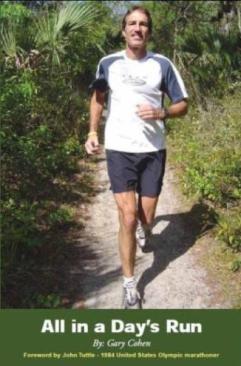 
"All in a Day’s Run" is for competitive runners,
fitness enthusiasts and anyone who needs a "spark" to get healthier by increasing exercise and eating more nutritionally.
Click here for more info or to order
This is what the running elite has to say about "All in a Day's Run":
"Gary's experiences and thoughts are very entertaining, all levels of
runners can relate to them."
Brian Sell — 2008 U.S. Olympic Marathoner
"Each of Gary's essays is a short read with great information on training,
racing and nutrition."
Dave McGillivray — Boston Marathon Race Director
|
 |
|
|
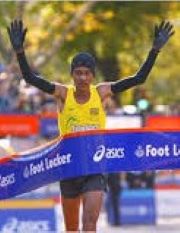
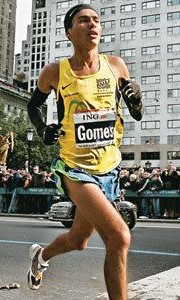
Brazil’s Marilson Gomes de Santos is best known for winning the 2006 and 2008 New York City Marathon. Marilson competed for Brazil in the 2008, 2012 and 2016 Olympic marathons, with a best finish of fifth place in 2012. He competed in two World Championship Marathons, finishing a strong sixth place in 2005. His personal best marathon of 2:06:34 was set at the 2011 London Marathon where he finished in fourth place, one of his three London Marathon ‘Top Ten’ finishes (2010 – 6th, 2012 – 8th). Other Major Marathon ‘Top Ten’ finishes include Berlin (2013 – 6th) and New York City (2010 – 7th). Marilson has represented Brazil at four World Cross Country Championships (two Junior and two Senior). At the Pan Am Games, he won Bronze Medals at 5,000 meters and Silver Medals at 10,000 meters in both 2003 and 2007, before earning the Gold Medal at 10,000 meters in 2011. Marilson won the University Games Half Marathon in 1997 and 1999. His personal best half marathon of 59:33 was set at the 2007 World Road Running Championships where he finished in seventh place. He is a three-time champion of the prestigious Sao Silvestre Road Race 15k in Sao Paulo, Brazil (2003, 2005, 2010). At the South American Championships, Marilson won four Gold Medals at 5,000 meters (2003), half marathon (2008, 2011), cross-country (2008). He won eleven Gold Medals at the Brazilian National Championships, three times at 5,000 meters (2003, 2007, 2009) and eight times at 10,000 meters (2003, 2004 and six consecutive from 2006 to 2011). At the Ibero-American Championships, Gomes dos Santos earned a Gold Medal at 5,000 meters (2006) and two Silver Medals at 10,000 meters (2000) and 5,000 meters (2010). At the South American Junior Championships, he won three Silver Medals at 5,000 meters (1995, 1996) and cross-country (1996). His personal best times include: 5000m - 13:19.43; 10,000m – 27:28.12; 15k – 43:49; Half Marathon – 59:33 and Marathon - 2:06:34. Marilson is married to Juliana Paula dos Santos, a fellow runner who won Gold Medals at the Pan Am Games in 2007 (1,500 meters) and 2015 (5,000 meters). He was very gracious to answer questions translated into Portuguese for this interview in November 2025.
|
|
| GCR: |
THE OVERALL PICTURE Marilson, thank you for agreeing to this interview. When we look back nearly twenty years ago, what does it mean to you to be the only Brazilian and South American to win the New York City Marathon and to be one of only ten men to win this prestigious marathon more than once?
|
| MGdS |
Thank you. I will always be at your disposal. For me, it means the pinnacle of my career, the best moments I've had throughout my entire journey. I have always dreamed of being able to run the New York City Marathon and have watched it a few times on TV here in Brazil, imagining myself one day running the race. Winning the world's main marathon was more than a dream come true; many times I still can't believe I was able to do it.
|
|
| GCR: |
At the 2006 New York City Marathon, you won a close race in 2:09:58 ahead of three Kenyans – Stephen Kiogora in 2:10:06, defending champion Paul Tergat in 2:10:10, and Daniel Yego in 2:10:34. What was your strategy, did the Kenyans use team tactics, what were the key moves leading to your victory and what were your emotions when you hit the finish line tape?
|
| MGdS |
I have always been extremely competitive and brave when it comes to running. I learned from training to run alone, without depending on anyone to set the pace, and this helped me a lot in New York because I strategically decided to stick with the group for as long as possible. If I was feeling good, regardless of who was in the marathon, I would impose my pace. That's what happened, and since I was used to running alone, I managed to gain an advantage a little over halfway through the marathon and reach victory. When I entered Central Park, I was very emotional for being in the lead, and when I crossed the finish line, I remembered everything I went thru to get there, from my beginnings running barefoot, the people who helped me, the years away from home, and when I left at fifteen years old to go from Brasilia to Sao Paulo to train. There were many emotions, and even today, when I watch some videos, I get emotional.
|
|
| GCR: |
Two years later in 2008, you became a two-time New York City Marathon champion as you finished in 2:08:43 ahead of Morocco’s Abderrahim Goumri in 2:09:07 and Daniel Rono in 2:11:22. What was similar and different in this victory compared to 2006 and what were your decisive moves and tactics that secured the win?
|
| MGdS |
This was different from the first time when almost no one knew me. I didn't have the opportunity to gain any advantage beforehand, and I was much more targeted. However, the will to win was the same, and that was the similarity. What was very decisive was never giving up on victory, even when I was at a disadvantage in second place. I never stopped believing, even though I wasn't a fast finisher by nature. I knew I was capable of running fast in Central Park, and that was the thought until the end. It was thru a lot of overcoming that I managed to win for the second time, defeating a great athlete like Abderrahim Goumri, who is very difficult to beat.
|
|
| GCR: |
You raced your all-time personal best marathon time of 2:06:34 at the 2011 London Marathon, finishing fourth behind the Kenyan trio of Emmanuel Mutai, Martin Lel and Patrick Makau. What were and are the mixed emotions of racing your fastest marathon at just under 4:50 per mile, but not making the podium by one place?
|
| MGdS |
Just like the New York Marathon, the London Marathon is also very competitive, and when I ran it, I had two goals: the first was to improve my personal best, which I achieved, and the other was to make it to the podium, which I did not achieve. I have always found it more difficult to run faster marathons, unlike in New York where I adapted better to the course. But I was incredibly happy to have improved my personal best and to be among the best in such a competitive race.
|
|
| GCR: |
The Olympics are the highest stage of world competition. You didn’t finish the 2008 Olympic Marathon in Beijing and were only 59th at the 2016 Olympic Marathon in Rio in 2:19:09. But in 2012 at the London Olympic Marathon, you finished a strong fifth place in 2:11:10, only four seconds behind Meb Keflezighi. How exciting was it to race in the Olympics three times for Brazil and to race so well in 2012?
|
| MGdS |
I had the honor of participating in these three Olympic Games, and for any athlete representing their country in the greatest global competition is a moment of great pride. I have always fought for an Olympic medal, and when you commit yourself to a race like the marathon, many times the result falls short of expectations. The struggle has always been in pursuit of the medal, and sometimes I paid the price by not performing well. In London, I tried my best to be among the top three, even knowing that I wasn't doing so well, as I was recovering from a knee injury that kept me out for three months, and I only had forty days to train. Even so, I had my best performance, and it was a race of overcoming. There are things we don't understand, as I trained so much for the other two Olympic Games and ended up doing better in the one when I trained less.
|
|
| GCR: |
Twice you won the University Games Half Marathon. In 1997 at Catania, Italy, you won in 1:03:32 ahead of two Kenyans - Stephen Mayaka in 1:03:51 and Solomon Wachira in 1:04:05. In 1999 at Palma de Mallorca, Spain, you won a remarkably close race in 1:04:05 over Takayuki Nishida in 1:04:11 with Oh Sung-Keun in 1:04:33, Mark Steinle in 1:04:45 and Takashi Maeda in 1:04:50 not far off the pace. What do you recall of the competitors, racecourses and key moves that led to your two half marathon victories at the University Games?
|
| MGdS |
It was particularly good to participate in the University Games; they gave me a lot of experience in my career. I remember that in the first edition I participated in, I ran with great ease, I felt incredibly good throughout the entire race, and there I realized that my future would really be in the marathon. The second time, I had a challenging situation because I started running and soon felt stomach pains, and I kept running with the group. When the pain intensified, I felt the urge to go to the bathroom, and I looked for a place to go but couldn't find one. I would leave the front group, and when I felt better, I would rejoin them. I ran the entire race like this, feeling pain, sweating cold, and with the urge to go to the bathroom. When I spotted the stadium where the finish line was, I was in fifth or sixth place, and I started running faster, making the final overtaking inside the stadium, and moving into first place. To this day, I wonder how I managed to finish the race. At the end, I went straight to the bathroom and for a medical evaluation that found I had an intestinal infection. Those two races were tests of great learning and overcoming
|
|
| GCR: |
The Pan Am Games are traditionally a prestigious event every four years in the Western Hemisphere. At the 2003 Pan Am Games in Santo Domingo, you earned a Bronze Medal in the 5,000 meters and Silver Medal in the 10,000 meters. In 2007 at Rio de Janeiro, you repeated your positions with a Bronze Medal in the 5,000 meters and Silver Medal in the 10,000 meters. Finally, in 2001 at Guadalajara, Mexico, you won the 10,000 meters by forty-one seconds. How special was it to win these many Pan Am Games medals for yourself and your country and to bring home the Gold Medal in 2011?
|
| MGdS |
The Pan American Games are especially important. Anyone who has the opportunity to participate knows how competitive and difficult the fight for medals is. Since I am not a fast final sprint athlete, I always had a disadvantage because these events are very tactical, and usually decided in the final stretch. Not being a fast final sprint athlete, I always lost positions in the last one hundred meters. It was a dream to win the gold medal in this competition, and I only achieved it after much persistence and preparing myself to run strong from the start without saving it for the end. After three participations, I finally won the gold medal. It was another competition that greatly contributed to my growth.
|
|
| GCR: |
The Sao Silvestre Road Race 15k in Sao Paulo, Brazil is always a highly competitive race that kicks off the new year. You finished second in 2002 in 45:06 before winning three times – in 2003 with a time of 43:49, in 2005 in 44:19 and in 2010 in 44:07. What were the crowds like along the course, how tough and close was your competition, and what are special recollections from those victories?
|
| MGdS |
The Sao Silvestre race is the main and most popular street race we have in the country. It is a race where great legends of running have already participated, so it is always extraordinarily strong. There is a lot of pressure, especially for Brazilians who have the ability to win. In this race, I gradually paved my way, first reaching the podium, which was already quite an achievement for me. Before winning, I was twice in fourth place and once in second place. People cheered for me a lot on the streets of Sao Paulo and the last kilometer was deafening with all the shouting. Two important things to highlight are the experience of my coach Adauto Domingues who is two-time Pan American champion in the 3,000 meters steeplechase. He had already been on the podium several times in the race and taught me how to run the event. There was also the experience I gained over these participations running with the best, such as Paul Tergat, Martin Leo, Robert Cheruiyot, among others, in addition to the learning in handling pressure in major events, which has brought me much more experience.
|
|
| GCR: |
You won at least eleven Brazilian National Championships, winning the 5,000 meters in 2003, 2007 and 2009 and winning the 10,000 meters in 2003, 2004 and six consecutive times from 2006 to 2011. How tough a competitor was Hudson Santos who beat you at 5,000 meters in 2006 and who you held off by less than a second in your 10,000-meter win in 2011 and what else stands out from these races in terms of the competition and weather conditions?
|
| MGdS |
Track events have always been part of my evolution as an athlete, even knowing that I would indeed be a marathon runner. Competing in national games was an opportunity to compete with the best national athletes, including those with different characteristics from mine, like Hudson. This was good for both me and them. Each one adopts their best strategy according to their characteristics. For me, it was always difficult because I knew I couldn't leave it to the end, as there were athletes much faster than me. So I would run strong from the start to try to get away. Sometimes it worked, and sometimes it didn't.
|
|
| GCR: |
How special is it to be married to a fellow top athlete, Juliana Paula dos Santos, who won gold medals at the 2007 and 2015 Pan American Games, since she was able to understand the physical, mental and emotional demands of training and racing at the highest levels?
|
| MGdS |
Juliana is a sensational person. I couldn't have chosen a better person than her. Besides being an Olympian, a medalist in the Youth World Championships, and a Pan-American champion, she is an extremely capable athlete. This way, we lived athletics twenty-four hours a day in our home, supporting each other and understanding and knowing how to deal with the needs and demands that are inherent to the sport. This way, we grew and experienced the best and worst moments of our careers, the ups and downs, and thus we lost and won together.
|
|
| GCR: |
SPORTS AS A YOUTH AND U20/JUNIOR ATHLETE What sports activities are most vivid in your memories from your youth?
|
| MGdS |
I was born on the outskirts of Brasilia, spent my time playing in the streets, running, jumping, playing volleyball, basketball, soccer, and handball. When anything came up that I had the opportunity to do, I did it. I wasn't a child who stayed at home until I discovered athletics, where at the age of twelve I started running barefoot. I was always an active child, and that helped me develop this predisposition for running.
|
|
| GCR: |
What can you relate about being introduced to track and field and cross-country racing? Did you compete for your school, a club, or both?
|
| MGdS |
I got to know athletics through my brother who started participating with a group of runners in the neighborhood where we lived. I always asked him to take me, but at that time they ran thru the Cerrado of Brasilia. They did somewhat long training sessions and my brother was afraid I wouldn't be able to keep up and would get lost, until one day after much insistence he took me to a training session they were having in our own neighborhood, when I ran with extreme ease. That's when I started training with Professor Albenis who guided the group which was basically made up of street runners.
|
|
| GCR: |
Who were your coaches or mentors and what effect did they have on you during training and mental preparation?
|
| MGdS |
My main coach was Adauto Domingues, who was also an athlete and a two-time Pan-American champion in the 3,000 meters steeplechase. I started training with him when I was 15 years old, and when I left Brasilia to go to Sao Paulo. I lived in an athlete's residence and represented my first club, Sesi de Santo Andre. With him, I learned everything an athlete needs to evolve: discipline, patience, focus, goals, determination, and resilience. He was my great mentor, because with him I evolved little by little as it should be when we talk about a child. He knew the ideal moment for me to train systematically, respecting all the phases of a child's growth and development. We grew up together, with him I felt increasingly motivated and eager to win, becoming more competitive. We kept working together until my last competition at the Rio Olympic marathon. It was a long-term partnership that worked out very well, not only because he is a sensational coach but also because he is a fantastic human being who thinks not only about the athlete but about the athlete as a person as well.
|
|
| GCR: |
At the South American Cross Country Championships U20, you placed fifth in 1995 in Cali, Colombia and second in 1996 in Asuncion, Paraguay. How tough were those racecourses and was it thrilling to move up from fifth place to the Silver Medal position?
|
| MGdS |
It is always exciting to participate in these races, and when you improve your placements, it is a reason for great happiness because you can see the evolution that an athlete strives for so tirelessly. I never liked running cross country, but I knew the importance of competing in these races for my development, so I tried to dedicate myself a lot to them.
|
|
| GCR: |
On the track, at the South American Junior Championships, you earned the Silver Medal at 5,000 meters in 1995 in Santiago, Chile and in 1996 in Bucaramanga, Colombia. Were these proud moments for you and your family, and how close were you to winning Gold medals?
|
| MGdS |
Competing in the South American Games was a great source of pride for me and my family because a child who started running barefoot without any pretension suddenly found himself out of the country competing and winning medals. I was happy just to be part of this universe. All of this gave me the drive to keep going and to fight for the highest place.
|
|
| GCR: |
How exciting was it to compete internationally at the World Cross Country Championships U20, at Durham, England in 1995 and at Stellenbosch, South Africa in 1996 and the World Junior Championships at Sydney, Australia in 1996 and to wear the Brazil singlet?
|
| MGdS |
These were my first international competitions outside of South America, and in them, I realized how strong the international level was and how much I would have to train to evolve. I returned home, I was even more motivated to keep training and dedicating myself to improving more and more. Participating in these competitions made me feel capable of evolving and proud to represent my country, Brazil.
|
|
| GCR: |
SOUTH AMERICAN AND WORLD CROSS COUNTRY CHAMPIONSHIPS At the 1999 South American Cross Country Championships in Artur Nogueira, Brazil over 12k, your countryman, Sergio Correa Couto won in 38:53. How tight and competitive was the finish for you as your 39:24 was two seconds behind William Vasquez of Colombia in 39:22 and one second ahead of Jacinto Navarrete, also of Colombia in 39:25? Was it joyful to be a member of Brazil’s championship team?
|
| MGdS |
I have always sought to improve my performance in cross-country races, even though I don't have the typical characteristics of a cross-country runner, but I was happy with my participation, especially this year when we became team champions. Regardless of who won, I was able to give my best just like in any competition I entered, and more than that, I was able to help my team win the very important title for all of us.
|
|
| GCR: |
Was it exciting to represent Brazil at the 1999 World Cross Country Championships, Belfast, United Kingdom where you finished 84th in 43:28, and how tough was that international field?
|
| MGdS |
For me, it has always been very difficult to run cross country, especially the world championship where the start is very fast, and since I am not a fast athlete, I always ended up poorly positioned at the beginning of the race, which often prevented me from having a great performance. But I loved participating in the world championships for the opportunity to be with the best in the world competing in a race that, in my opinion, is the most difficult of the long-distance races, not only because of the technical level but also because of the course difficulties that require a different level of strength.
|
|
| GCR: |
You earned a Bronze Medal at the 2000 South American Cross Country Championships in Cartegena, Colombia, though your 37:59 effort wasn’t close to Daniel Lopes Ferreira in 37:14 and Silvio Garcia of Ecuador in 37:21. Was it still nice to be on the podium as an individual and to help Brazil to an eighth consecutive team championship?
|
| MGdS |
It is always particularly good to perform individually, to give our best, however, it is also wonderful to represent our country and help win titles. I always thought about both things when competing, so even if individually things weren't going as well as I expected, I kept giving my best to help the team in the best possible way.
|
|
| GCR: |
Eight years later at the 2008 South American Cross Country Championships in Asuncion, Paraguay, you won the Gold Medal in 37:28 by thirty seconds. When did you make your move to the front and was it a big thrill to win both individual and team Gold Medals?
|
| MGdS |
Yes. It was a great emotion, hence the importance of the whole process of having participated in previous editions, gaining more and more experience with the competition, which was important for my growth in the competition so that I could become the champion. This year was very special for having won both titles, individual and team.
|
|
| GCR: |
You raced at the 2008 World Cross Country Championships in Edinburgh, United Kingdom and finished fifty-third in 37:17. How tough was the field again as African nations swept the first six team places and was it somewhat of a consolation to be the first South American finisher?
|
| MGdS |
I was happy to be the first South American to finish the race, but at the same time, I knew I had to improve a lot to compete with other runners from other nations, especially the Africans who were on another level. It was always very difficult to compete with them because they simply were and still are the best, but just being there competing with them made me very happy.
|
|
| GCR: |
INTERNATIONAL TRACK AND FIELD RACING There was a very close finish at the 2000 Ibero-American Championships in Rio de Janeiro over 10,000 meters as fellow Brazilian Elenilson da Silva Brazil won in 28:57.98, followed by you in 28:58.74 and Isaac Garcia in 28:59.68. Were you outkicked or were you behind and couldn’t catch the leader?
|
| MGdS |
I was an athlete who always ran ahead, setting the pace. I did this in almost every race because I tried to break away early. I didn't like leaving it to the final sprint because I knew I wasn't that fast at the finish. Besides, I studied my opponents and knew who was fast and who wasn't. In this case, I knew that Elenilson was a great athlete, he was faster and had a good finish. I tried to break away but couldn't.
|
|
| GCR: |
You won at 5,000 meters at the 2003 South American Championships in Barquisimeto, Venezuela 5,000 meters by over ten seconds in 13:52.15 ahead of William Naranjo of Colombia in 14:03.41. Was it a relief to pull away and to have the race under control as you approached the finish?
|
| MGdS |
Yes, in all the races where I managed to create a gap before, it was always about using my best characteristic, which made me comfortable because I knew I was using what I did best, which was imposing a strong pace. Especially in track events where many of them are extremely balanced and end with athletes competing for positions in the final stretch.
|
|
| GCR: |
The 2006 Ibero-American Championships in Ponce, Puerto Rico went the same way as you won the 5,000 meters in 13:42.88 by 21 seconds. Was this race like a time trial as you were out front all alone?
|
| MGdS |
Yes, this race was a race where I wanted to run fast, so I set the pace from the beginning with the intention of achieving a good time, which for me it ended up being. So in this race I achieved my main goals, which were to win and achieve a good time.
|
|
| GCR: |
At the 2006 World Cup in Athens, Greece over 5,000 meters you finished over ten seconds out of first place in 13:47.15. Did the leaders kick and you had no answer? And was it neat racing in the country of the first modern Olympics which were held in 1896?
|
| MGdS |
It was good to have been in Athens for the World Cup, but actually, I wanted to have been there earlier in 2004 for the Olympics, but just being there made me happy. That year I was already running marathons, but even so, I had the time to run the 5,000-meter race at the World Cup, and even during the World Cup, I was doing my specific training for the New York City Marathon, that is, longer training sessions. With the added challenge of having plantar fasciitis, I did many training sessions on the grass of the warm-up track to avoid worsening the situation and to not lose the marathon cycle. I really enjoyed participating in the World Cup and competing with the best athletes from the continents. It was phenomenal.
|
|
| GCR: |
The 2010 Ibero-American Championships in San Fernando, Spain had quite a fast 5,000 meters as Spain’s Ayad Lamdassem Spain raced a 13:32.48 Championships Record to finish two seconds ahead of your 13:34.92 effort. Was this quite the competitive race and was he helped by his home country crowd?
|
| MGdS |
Running at home is always very good, but it also brings a lot of responsibility. I believe that in this case, since he is an extremely experienced Olympic-level athlete, the crowd helped him a lot, meaning he used the crowd to his advantage, which is super normal for someone running at home. Being the athlete he was, it would have been difficult to beat him at home. But I really liked my result and the time achieved, and this happened due to the level of the race.
|
|
| GCR: |
OTHER MARATHON AND HALF MARATHON RACES There was fast and deep competition at the 2005 World Championships in Helsinki, Finland as you finished the marathon in 2:13:40, just 13 seconds behind the USA’s Brian Sell. Was it satisfying to finish in the top ten in the world?
|
| MGdS |
Finishing among the top ten in a world championship is a great pride. I was very happy, but I think I could have done better in this world championship because I was in a good moment of my career. But we are not talking about just any competition as it was a world championship, where all athletes prepare and give their best. I gave my best for myself and for my country.
|
|
| GCR: |
At the 2007 World Road Running Championships in Udine, Italy, you raced a fast 59:33 for seventh place. How much of a battle was there in the last few minutes as you were just behind Yonas Kifle of Eritrea in 59:30 and Dieudonne Disi of Rwanda in 59:32?
|
| MGdS |
Actually, this race was difficult from the beginning. It was the most exhilarating start of a race I've ever run. In fact, the entire race was strong from start to finish and many times I thought I wouldn't make it to the end as all the splits were very fast. I took advantage of the strong pace to improve my personal best and to break the South American record. Of all the races I've run, this one really hurt the most from start to finish; it was a race where I gave my one hundred percent. It's the one race I consider my best performance in terms of time.
|
|
| GCR: |
You won the 2008 South American Half Marathon Championships in Rio de Janeiro in 1:03:18, over three minutes in front of second place Pedro Mora of Venezuela in 1:04:45. Was it fun to race to an easy victory in front of the Brazilian fans?
|
| MGdS |
It was very good to race in front of the fans and win such an important event like this. I enjoyed every moment. I was able to repay all the affection I received from the fans throughout the race.
|
|
| GCR: |
The competition was strong and deep at the 2009 World Championships in Berlin, Germany as you finished in 16th place in 2:15:13. How do you feel you raced that day, what were major points as far as weather and pacing and were you passed late as there were eight men who finished in the 70 seconds before you?
|
| MGdS |
One of the big problems for a marathon runner is preparing for a marathon without any issues. In this case, it was difficult for me to run because I didn't arrive as I would have liked. During the preparation, I had a knee injury that really affected me, preventing me from being in shape. I had to push myself to participate, always believing in the power of will, but in the end, I realized that it was all I could have done.
|
|
| GCR: |
Was your 2010 London Marathon sixth place in 2:08:46 a foreshadowing of your 2:06:34 personal best the following year?
|
| MGdS |
Yes, I already knew that I could run faster because I had set an excellent time in the half marathon. That year, I was already aiming to run at 2:06:00, and the 2:08 was a consequence of trying to run that. Anyway, it made me increasingly confident that it would be possible to achieve a great mark.
|
|
| GCR: |
You placed a respectable seventh at the 2010 New York City Marathon 2:11:51, twenty seconds behind James Kwambai in 2:11:31 and thirteen seconds behind Meb Keflezighi in 2:11:38. Were the three of you running together for much of the last 5k of the race?
|
| MGdS |
Yes, a great race with great athletes. What usually happens are those small differences in terms of time and that's why it's important to never give up and run strong until the end to not lose position. I was happy to be running with great names in world athletics.
|
|
| GCR: |
At the 2011 South American Half Marathon Championships in Buenos Aires, Argentina, you won easily in 1:01:13 as your closest competitor was four and a half minutes behind you. Was this one of those races where you focused on your pace and raced for time?
|
| MGdS |
Exactly, this race was used as preparation for the marathon and the intention was to run strong even if alone, that's what happened, it was a good time considering the circumstances of running. In the end, I was satisfied with my performance.
|
|
| GCR: |
The top three finishers at the 2012 London Marathon were under 2:07, but the next five finishers were bunched as Jaouad Gharib ran 2:07:44, Abel Kirui finished in 2:07:56, Emmanuel Mutai was at 2:08:01, you ran a fast 2:08:03 and Samuel Tsegay was three seconds behind you in 2:08:06. Were the five of you running together during the last few kilometers and what were key moves as each runner hoped to have a strong final kick?
|
| MGdS |
The London Marathon has always been strong, a very tough competition, so often many athletes would finish the race together, each one preparing for it, which is what I did. Even though I was physically tired, I mentally prepared myself to try to make the best finish possible, but I knew everyone there was thinking the same thing and that the finish would be very tough as it always is. I always thought about improving my placement.
|
|
| GCR: |
Your final sub-2:10 marathon was at the 2013 Berlin Marathon as you finished in sixth place in 2:09:24. As Wilson Kipsang raced a 2:03:23 World Record, were you on your own the last few kilometers as you ended up 32 seconds behind fifth place and a minute ahead of seventh place?
|
| MGdS |
In this marathon, I tried to improve my personal best, but I ended up breaking down and not running as I wanted. I was a bit disappointed because I knew it was one of the few opportunities I would have to improve, but when you try to beat your record, you have to take risks, and that's what I did.
|
|
| GCR: |
TRAINING When you were in your early years of running and racing, how many days did you train per week during cross country and track seasons and what was your base mileage or kilometers per week to build strength?
|
| MGdS |
When I was at the beginning of my career, my coach didn't let me train too much. He was concerned about respecting my developmental maturation. Having been an athlete himself, he knew how important it was to respect each stage of training. He was concerned about getting the best out of me at the right time, which is why I rarely reached 100 kilometers per week, most of the time training only once a day. My coach, Adauto Domingues, took great care of me.
|
|
| GCR: |
What were your key speed and stamina training sessions on the track, did you do hill repeats, and was fartlek training a part of your regimen?
|
| MGdS |
I had few injuries in my career, perhaps because I had this variety of training, such as strength training, track workouts, hill training, fartlek, and so on. I was really very fortunate to have had a coach with vast experience who knows a lot about training and respects the periodization of training but, above all, the human being in all aspects of life, without the greed to always be at their best, trying to prolong the career as much as possible.
|
|
| GCR: |
As you became one of the top Brazilian youth distance runners, did you receive additional coaching, how much did you increase your base training and what were your key workouts for cross country and for 5,000 meters?
|
| MGdS |
Yes, as I progressed, not only the training sessions but also the distances of the races I ran gradually increased. I started training in two periods on many days and doing a bit more mileage, averaging 120 kilometers per week.
|
|
| GCR: |
When you stepped up to Senior racing, cross-country distances increased and you began racing 10,000 meters, what were the changes in your training to handle the longer races?
|
| MGdS |
Basically, there were two changes regarding the intensity and volume of training. I trained faster with a higher training volume. Additionally, there was a concerted effort of increasing my strength level, which was one of my deficiencies as an athlete.
|
|
| GCR: |
Similarly, when you added focus on the half marathon and marathon, what did you do in terms of weekly total distance, how long were your long runs, and what were key workouts you did to develop into a top racer at the longer distances?
|
| MGdS |
When I started running marathons, I went through an adaptation process for the training, even though I was already doing a considerable volume of training, but even so, it happened gradually. At its peak, I reached up to 210 kilometers per week divided into 12 sessions.
|
|
| GCR: |
Did you add anything extra to your training when you achieved your best results of winning the New York City Marathon in 2006 and 2008, setting your marathon personal best time at the 2011 London Marathon, and placing fifth in the marathon at the 2012 Olympics?
|
| MGdS |
Yes, as I said, I have always found it quite easy to keep running for a long time, but on the other hand, the strength component has always been my Achilles' heel. With that in mind, my coach focused on improving my strength level because he knew it was what was most detrimental to me. From the moment I improved that, all my results improved, including those on the track.
|
|
| GCR: |
When you look back, is there anything you would do different or additional in training that may have helped you to achieve better results, or are you happy that you did your best to reach your potential?
|
| MGdS |
I did what I had to do. I trained, dedicated myself, was disciplined, used the resources I had at the time, and despite so many difficulties, I reached where I could and ended up very happy with the results I achieved. For that boy who started running barefoot in the outskirts of the city of Ceilandia without any pretension, I had a successful career, from my point of view.
|
|
| GCR: |
MISCELLANEOUS AND WRAP UP How is your health and what do you regularly do to stay in shape?
|
| MGdS |
I run occasionally to stay in shape and take care of my health, but like any high-performance athlete, I carry some remnants from the time dedicated to training. Every now and then, I feel pain, mainly in my calves, but also in my knees, hips, and other areas. But I am always taking care of myself to keep running.
|
|
| GCR: |
What are some of your goals for the future in terms of personal development, continuing to help and mentor others, travel and do you see yourself slowing down or doing as much as you can?
|
| MGdS |
I intend to help other people in the world of running, to stay in this field, which is my passion, and to adapt to every aspect of life, living life in balance, and to make the most of what it can offer me.
|
|
| GCR: |
Based on what you have learned from the discipline of athletics, facing challenges, and overcoming obstacles, what advice do you give to youth and adults so that they can be their best and reach their potential as athletes and human beings with the gifts they have been given that all comes together in the ‘Marilson Gomes de Santos philosophy?’
|
| MGdS |
The main advice is if you really want it and have your goal well defined, then dedicate yourself, believe it is possible, and make it happen. The discipline that an athlete has in their career is the same for anything in life and for any field of work.
|
|
| |
Inside Stuff |
| Hobbies/Interests |
Soccer, going to the beach
|
| Nicknames |
Mauricinho
|
| Favorite movies |
‘McFarland.’ Some parts remind me of the beginning of my career
|
| Favorite TV shows |
Sports programs in general
|
| Favorite music |
‘New York’ by Frank Sinatra, ‘New York’ by Alicia Keys, B. B. Rey and Michael Jackson
|
| Favorite books |
The Mamba Mentality
|
| First car |
Chevette 1986
|
| Current car |
Fiat Fast back
|
| First Job |
As an athlete at the BMF/Bovespa Athletics Club
|
| Family |
Wife Juliana, son Miguel, siblings Marcos and Mirlene
|
| Pets |
At the moment, I don't have any, but I like dogs
|
| Favorite breakfast |
Basic - coffee with milk and bread with butter
|
| Favorite meal |
Pasta
|
| Favorite beverages |
Guarana
|
| First running memory |
Child's three kilometer race at 12 years old in Ceilandia
|
| Life heroes |
My father, my mother, and my wife for overcoming the difficult moments of life
|
| Childhood dreams |
Having a profession
|
| Funny memory |
Leading a race that was supposed to be 10k but the lead car got the route wrong, and it ended up being 5k. Since I was in front, the runners thought I was the one who got the route wrong, so all the runners did 5k
|
| Embarrassing moment |
When I was warming up for a race, someone asked me for an autograph. I couldn't stop at that moment and asked him to wait a little bit, saying I would come back to sign. He didn't understand and cursed at me
|
| Favorite places to travel |
New York and Orlando
|
| Choose a Superhero – Batman, Superman, or Spiderman? |
Spider-Man
|
| Choose a theme park – Disney World or Universal Orlando? |
Disney World
|
| Choose a Sylvester Stallone character – Rocky or Rambo? |
Rocky
|
| Choose a Brazilian soccer star – Kaka, Neymar, Pele, Ronaldo, Zico? |
Pele
|
| Choose the beach or mountains? |
Mountain Campos do Jordao, where I prepared for the NYC marathon
|
| Choose a tough guy – Vin Diesel or The Rock? |
The Rock
|
| Choose movie secret agent coolness – James Bond 007 or IMF Agent Ethan Hunt? |
James Bond 007
|
|
|
|
|
|
|