|
|
|
 garycohenrunning.com
be healthy • get more fit • race faster
| |
|
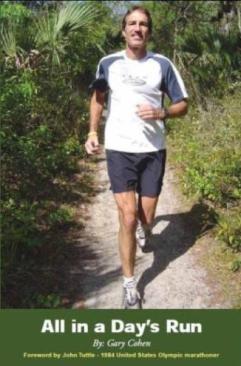 
"All in a Day’s Run" is for competitive runners,
fitness enthusiasts and anyone who needs a "spark" to get healthier by increasing exercise and eating more nutritionally.
Click here for more info or to order
This is what the running elite has to say about "All in a Day's Run":
"Gary's experiences and thoughts are very entertaining, all levels of
runners can relate to them."
Brian Sell — 2008 U.S. Olympic Marathoner
"Each of Gary's essays is a short read with great information on training,
racing and nutrition."
Dave McGillivray — Boston Marathon Race Director
|
 |
|
|
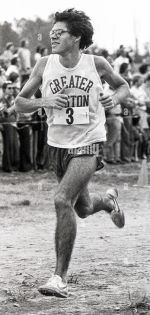
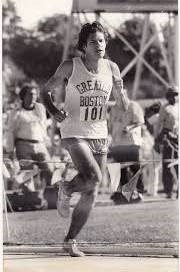
Dan Dillon was a versatile U.S. distance runner in the 1970s and 1980s with outstanding success on the track, roads and cross-country venues. Dan was a member of five U.S. teams that competed in the World Cross Country Championships as Team USA won the Silver Team Medal in 1980 and 1984. His highest individual finish at Worlds was 12th place in 1980. Dan competed in the Olympic Trials in 1980, 1984, and 1988 with a best finish of sixth place at 5,000 meters in 1980. His top road-racing performance was winning the 1981 Jacksonville River Run 15k in 43:34 by two seconds over Jon Sinclair with a strong kick in their epic duel. Dillon was 1978 U.S. Cross-Country Champion. At Providence College, Dan was an NCAA Cross Country All-American in 1977 and 1978, finishing 13th and 19th, respectively. He won the 1980 Big East indoor 3-mile. Dan finished second in the 1980 Prefontaine Classic 5,000 meters in 13:32.32. His 10,000-meter personal best was also in Eugene, Oregon in 1982 in 28:05.75 for fourth place. Dan graduated from Chicopee (Massachusetts) Comprehensive High School where his biggest highlight was outkicking Alberto Salazar by two seconds to win the 1974 Massachusetts Cross Country Championship after finishing second in 1973. He finished third in the 2-mile at the 1975 Massachusetts State Track and Field Championships. As a fifty-year-old Dan ran a sub-five-minute mile and was 2007 USATF Masters National Champion in the 3,000-meter steeplechase in the 50-54 age group. Dan graduated from Providence College and his primary career has been as an audio and sound technician and manager for resorts and concerts. Personal best times include: 3,000 meters – 8:02.18; 5,000m – 13:32.32; 10,000m – 28:05.75; 15k – 43:34; 10-miles – 49:46; Half marathon – 1:04:37; 25k – 1:20:48 and Marathon – 2:16:10. Dan has been inducted into the Providence College Athletics Hall of Fame in 1997, the Western Massachusetts Runners HOF in 2020 and Massachusetts State Track Coaches Association HOF in 2020. Dan and his wife, Patti, an extremely accomplished distance runner, have mentored youth for many years including a stint as house parents for Native American kids who were struggling and coaching the Connecticut Home School Harriers. Dan and his wife, Patti, reside in northeast Connecticut and he was most gracious to spend over two-and-a-half hours on the telephone for this interview in June 2026.
|
|
| GCR: |
THE BIG PICTURE Dan, thank you for being a part of my series of two hundred plus interviews. First, we’re both born in 1957, and when you started running back in the 1970s during the running boom like I did, how did you become interested in running and how did this transition to running competitively?
|
| DD |
I had two brothers who also ran, and I started running before the running boom. My father was an Air Force Sergeant, and we had assignments in Presque in Maine, Vermont, Alaska and Wyoming. These were great outdoor areas to explore. When I was around ten years old, I would be outside with my brothers because mom said, ‘Go out of the house and be home for dinner.’ We would head out the back door when we were in Wyoming and there was nothing but mountains. If we ran in one direction the day before, we would go another way. When we were out hiking and the day passed by, one of us would say, ‘We’re going to be late. We better run home.’ We lived altitude for four years in Wyoming and lived for three years in Alaska. Nobody knew about altitude training back then. And we weren’t training at all. We were just exploring the outdoors. That is how I came to running before the boom. In 1972, when Frank Shorter won the Olympic Marathon Gold Medal, that was when I started paying attention to running as a competitive endeavor. It wasn’t until then. I was going into high school when he won that Gold Medal. Our high school barely had a cross-country team. When we arrived in western Massachusetts, my father was stationed at Westover Air Force base. There were a handful of guys on the team who were runners, but most were junior varsity basketball players. My high school cross country coach was also the basketball coach, and he made them come out for cross country to increase their fitness. He was a great basketball coach who had taken the team to the Massachusetts State Championships. The school couldn’t give him a raise for his basketball coaching, so they raised his salary by making him the Cross-Country Coach and Assistant Track and Field Coach. He knew little about cross country but was a great motivator. That part of his coaching was good. That is how I started the competitive sport of running. There was a team in western Massachusetts, Cathedral High School, and they had about sixty runners on their cross-country team. They took multiple school buses to their meets. They had a record of 79 wins and no losses in dual meets when they came to our little school in Chicopee, Massachusetts, that never had a strong crop of distance runners. They showed up and there were three new Dillon brothers on the team that nobody from Cathedral High School knew about. After the meet, they left with a record of 79 and one, and in shock. We barely had enough runners to field a team but that is how my competitive running started.
|
|
| GCR: |
Some athletes are remembered for a specific victory or medal performance while others come to mind for longevity, consistency, and sustained excellence on the track, roads, and cross-country venues. What was it like to be running and racing strongly for fifteen years through high school, college and post-collegiately as you duked it out with the competition and worked to be your best?
|
| DD |
You hit the nail on the head. Most of my teammates would say that I was an excellent teammate. I wasn’t usually the best guy on the team. John Treacy, my teammate at Providence, was an Olympic Silver Medalist and two-time World Cross Country Champion. At the Greater Boston Track Club, Bill Rodgers was world class, Randy Thomas was at his peak, Greg Meyer was on the team, Alberto Salazar ran for us, and Bobby Hodge was also strong. We had so many top-notch runners. I was always one of the good runners on good teams for Providence, Greater Boston Track Club, Athletics West, and Nike Boston. I wasn’t usually the best runner on the teams but was one of the guys who trained the hardest. I was blessed with many years of running one-hundred-mile weeks without injuries. My coaches would usually tell my teammates something like, ‘Don’t run with Danny every day. He’s indestructible and a freak.’ My teammates wouldn’t run with me every day, only four or five times a week. I didn’t win too many of the big races. I did win the U.S. Cross Country Championships one time and the Jacksonville River Run one year and a couple road races here and there, but I never was a guy who was known primarily for winning the big road races.
|
|
| GCR: |
What were main points and overarching philosophies you picked up from your high school coach, Alex Vyce, and college coach, Bob Amato, along with your strong Irish teammates at Providence, that positively impacted your running career?
|
| DD |
Alex Vyce always told me that I was better than I thought I was. He saw talent there. My older brother was better than me in every sport except running and I adopted running as my sport. My older brother was a year ahead of me in school. Alex Vyce made my brother team captain but, when I was consistently beating him, he said, ‘Dan, you have way more potential.’ He would say, ‘I don’t want you to think about running well in this race. I want you to think about winning.’ He put the bug in my head that I should be winning every race. I remember at the Western Massachusetts Cross-Country Championships my sophomore year him saying, ‘Dan you’ve beaten all but two or three of these guys. You have to figure out how to win this race.’ That was a turning point for me as I started running more quality races. When I was in college, Bob Amato was our head coach, but how could I get better information than from John Treacy? John was a very smart guy. He was a straight-A student and the kind of guy anyone would want to have as a teammate. My high school coach didn’t know about the World Cross Country Championships. When I beat Alberto Salazar, he went on to be a member of the U.S. team and my coach didn’t know it even existed. Alberto ran indoor track, which I didn’t do, and then went to Europe for the World Cross Country Junior Championships. At Providence, John Treacy, Mick O’Shea, and John Savoie knew all about it. John Savoie was the team captain and was hugely motivational for me. One summer I didn’t have a summer job, and he invited me to work with his father who had a construction business. Every morning, John and I would do a ten-mile run and then mix cement and haul blocks for his dad who would lay the blocks. At the end of the day, we would run whatever we could manage. That fall was my first All-American cross-country selection, and it wasn’t from the running but from all the outdoor strenuous physical labor. Sadly, John Savoie died of a brain aneurism when he was only about twenty-two years old while he was playing softball. He was an important person in my life. Anyway, the Providence athletes coached each other. Bob Amato was a sprinter when he was in college and didn’t understand distance running too much. However, with all the international runners on the team, that didn’t matter.
|
|
| GCR: |
That is similar to when I was in high school and our coaches, Joe Pieze and Nick Gettis, were football coaches who were good in track and field at coaching the sprinters and weight men. When I was a sophomore, we didn’t do much distance and would typically do four all out quarter miles with a five-minute rest for speed work. Our top miler, Drew Viner, graduated and went to the University of Florida where Roy Benson was the distance coach. Drew would write letters to me with advice and suggested workouts. Coach Pieze and Coach Gettis were smart enough to utilize what Drew was sending me from Coach Benson since they realized these workouts would help me to be better. So, they had me set the workouts for the team based on this advice and information. Do you think that sometimes it isn’t what a coach does, but what he doesn’t do? Do you give kudos to coaches who are smart enough to think this way?
|
| DD |
I would say that my high school coach also did this. Coach Vyce would read magazines and find out the workouts that Jim Ryun did. There were lots of repeat quarter miles that he implemented into my training plan along with other workouts Jim Ryun did. That is similar to what you are talking about, though he did his homework to find out what we needed to do to be faster and stronger.
|
|
| GCR: |
How did the influence of Bill Squires, the Greater Boston Track Club athletes, and Athletics West Coach Bob Sevene help you to continue your growth as a runner?
|
| DD |
One year when I was at Providence, I was majoring in English Education, thought I was going to be an English teacher, and was having to start thinking about doing student teaching. I realized that I didn’t want to be in the classroom the rest of my life. I was thinking about what major I should change to. At that same time, there was a dorm fire at Providence and nine girls died. One was my friend named Vicki Spence. We used to do coffee house music along with another friend, Stetson Arnold, who helped recruit me to come to Providence, and ended up transferring to the University of Massachusetts at Amherst. Stetson was a good guitar player. Vicki died in the fire and I also was at a point that I needed to reflect about what I wanted to do. Vinnie Fleming was a good marathoner on the Greater Boston Track Club at the time and Randy Thomas was running well and coming into his own. I went to Boston and slept on their floor. The Bill Rodgers Running Center was around the corner. Bill Squires coached us, and he was my first true coach. He said, ‘Dan, you have run some very good performances, but you aren’t anywhere near where you can be.’ He coached me for a few months from November to February. The U.S. Cross Country Championships came up and I won. Bill Rodgers, Randy Thomas, and I were trying to have a three-way tie, but Billy was having a bit of an off day. Randy and I looked over our shoulders and the gapped runners were starting to close in. We didn’t want to let that gap close. We kept our foot on the pedal and Billy faded though he did make the team along with Greg Meyer. Randy and I were trying to tie but Dave Martin didn’t accept ties. They looked at the photo of the finish and said I was the winner. I was a twenty-year-old who hadn’t competed with a U.S. junior team and, in my first attempt to make a senior team, I won the trials. That was a big confidence builder for me. I was working at the New Balance factory at the time because I couldn’t afford to not work. Vinny and Randy had deals with New Balance that provided some funding and they didn’t have to work, but I had to work in the factory for some income. I was running to work, working, running home from work, eating crappy pizza, saving some of the pizza for breakfast, and I had no money. I made my first team because I was with guys who lived and breathed running. A bunch of us would meet at Billy’s store, including Bob Sevene who was my coach later on, and we would run training runs from the Cleveland Circle. I got strong as I listened to the stories from these great runners. It was a continuous time for me not being the best runner on the team but being with a bunch of exceptionally good runners.
|
|
| GCR: |
You made five USA World Cross Country teams. How exciting was it to pull on the USA singlet and to train, race and socialize with teammates such as Craig Virgin, who won in 1980 and 1981, Alberto Salazar, who finished second in 1982, Greg Meyer, Mark Nenow, Pat Porter, Jon Sinclair, Herb Lindsay, and Ed Eyestone?
|
| DD |
It was a strong team to make because the World Cross Country team brought together marathoners, milers, and everyone in between. In Paris, I was roommate with Ken Martin, an up-and-coming steeplechaser who came in second place one year in the New York City Marathon. There was such talent and they influenced me greatly. World Cross Country Medals are harder to earn than Olympic Medals. Don’t let anybody kid you because you’ve got marathoners, 5k guys, 10k runners, milers, and steeplechasers. Cross country suited me because I wasn’t a great runner in the heat but put me on a muddy course in the cold and bad weather and I came alive. Fortunately, some of my coaches like Bob Sevene realized my strengths. Bob said, ‘We’re going to send you to Europe, but you will run mostly in Scandinavia.’ I wasn’t sent to hot climates where I would be thrown to the wolves.
|
|
| GCR: |
Cross country is so much more popular in Europe. How different was it to see the reception for cross country athletes in Europe versus in the United States?
|
| DD |
That was an eye opener for me. I remember after running one race, it was in Oslo, I came out of a shop with a cup of coffee in my hand. There were people yelling, ‘It’s Dan Dillon!’ I was thinking, ‘I’m nobody in this sport. How do they know who I am?’ I did finish in twelfth place in Paris, but I didn’t have a big resume. I was a U.S. team member but thought that these people must take cross-country seriously if they knew all the middle-of-the -pack runners. When I thought about all the money that professional athletes were making in golf, tennis, or one of the team sports, I would ask myself, ‘Am I in the wrong sport?’ Though, the more cardiovascular, the better.
|
|
| GCR: |
Your wife, Patti, was an amazing distance runner with dozens of wins and multiple major marathon podiums. Though you married after your running careers, can you explain the pluses of having a wife who can relate to you since you both were elite runners and the positive impact that sharing running has had on your many years of marriage?
|
| DD |
There are many times when a person goes into an endeavor and is unsure if they can do it. Patti was a much more confident athlete than I was. There were times, even in non-running situations where Patti would say, ‘Don’t worry about it. You will be able to handle this.’ In many respects, several things I accomplished after my running days were because of Patti’s encouragement and urging. Partnerships are great and I can’t give Patti enough gratitude for her patience with me and for her encouragement over the years. It’s a true blessing to find somebody that can come from a perspective of ‘You can do hard things. It’s not impossible to do hard things.’
|
|
| GCR: |
Patti and you have had some amazing adventures helping youth including being house parents for Native American kids who were struggling and coaching the Connecticut Home School Harriers, which included your children, Aaron and Raven. How rewarding is it to work with youth, utilizing your experiences and knowledge, to help them on their pathway in life?
|
| DD |
It is truly rewarding. I can think of an example of this one family that had about five kids of various ages who were running with the club. After our kids grew older, Patti and I phased out our involvement with the club and there weren’t many people who kept the ball rolling. But years later I ran into the mother of one of the runners from that family and she said, ‘I want to thank you for getting my daughter interested in running. She ran in high school and received a college scholarship.’ We don’t always realize that we are planting these seeds. It was very fulfilling to understand that we were helping to put kids on a path that paid off. College was getting so expensive so helping a kid when she was ten years old ended up saving her and her parents tens of thousands of dollars with that scholarship which was a fun thing for me to reflect upon. Patti and I put our heads down and didn’t know what seeds were going to blossom. We just did all that we could.
|
|
| GCR: |
ATHLETICS AS A YOUTH AND IN HIGH SCHOOL You mentioned earlier that you moved several times due to your dad being in the Air Force, running with your brothers, and kicking that team’s butt that was undefeated in seventy-nine meets. When we look at your early racing results on the track, as a freshman you broke 10:30 for two miles and your sophomore year you ran 9:26. In cross country, you were second at Western State to Preston Hunter. What is memorable from those first two years as you became acclimated to distance running? And was it surprising to transition from running for fun with your brothers to being one of the fastest two-milers in the state?
|
| DD |
My older brother and my coach, who were both good motivators, were working with me. Also, once a person finds something they are good at and have a propensity for, you concentrate on it more. That big drop from 10:30 to 9:26 back then put college recruiters on notice and they started sending letters of interest. My high school guidance counselor called me in one day and said, ‘Dan we received some letters that are addressed to the school for you, but I’m not allowed to give them to you because you are only a sophomore. The coaches saw your fast times and mistakenly thought that you were a senior. When I ran 9:26 my sophomore year. My counselor and teachers increased their guidance to get me on a college prep path. They didn’t want me to sleepwalk my way through high school. I had to change my focus, and my parents told me that it looked like I would be going to college. That sophomore year with those great breakthroughs is when I first began to think of myself as a runner.
|
|
| GCR: |
Earlier you mentioned Stetson Arnold of Southwick High School whom you finished second to at the Massachusetts State Cross Country Championships. What do you recall of that race – was he off the front or did he outkick you?
|
| DD |
I hadn’t raced Stetson head-to-head because Southwick High School was in a tiny little farm town. He won his qualifying race by a huge margin while I won a competitive race in the larger school division. He beat me at the Massachusetts State Cross Country Championships, and I should have been second. There were very few good runners from western Massachusetts, so Stetson and I broke the mold.
|
|
| GCR: |
During your junior year on the track, you outkicked Alberto Salazar, before he came into his own the following year, in the final 200 meters to win a two-mile race. Do you recall much of that effort?
|
| DD |
No, but I must have run well that day to beat Alberto. I was inconsistent on the track and don’t recall that race specifically.
|
|
| GCR: |
During your senior year of cross country, you were undefeated in western Massachusetts and Alberto Salazar was undefeated in the east. What are highlights of the State Championships as you won in 14:02 with Alberto Salazar, a junior, second at 14:04?
|
| DD |
There was an article in the Boston Globe about this new kid that was being coached by Bill Squires of the Greater Boston Track Club, and how he was going to win the Massachusetts State Cross Country Championships. His name was Alberto Salazar. Though he was only a junior, he was improving quickly. I was also improving. I remember reading that newspaper and thinking, ‘Wait a minute! I was second last year and the guy who beat me graduated. I was a little put out. When the gun went off, Alberto took off like crazy and he opened this huge lead on me. At two miles I was thinking, ‘I can’t believe he’s that far ahead. I’m not going to be able to close this gap.’ The course started in a valley and ended in a stadium up on a hill. The last half mile was up hill. I heard Bill Squires yelling, ‘You can break him, Alberto! You can do it!’ I was thinking, ‘Wait – his coach doesn’t think I’m broken? I thought I was broken a mile ago.’ So, I put my head down and started cranking as best I could and, sure enough, I caught him by a second or two before the end.
|
|
| GCR: |
Your senior year in track and field, Alberto Salazar won the two-mile in 9:00, while you raced 9:09. Were you with him and faded or was he off the front?
|
| DD |
At State, Alberto was up front on his own. There was another good runner in that race named Dom Fanelli and I can’t remember if he got second or I did. I was reading in the running magazines about high school runners like Rudy Chapa and Carey Pinkowski who broke nine minutes in the two-mile and that was always my goal. I thought I was as good as these guys, but I struggled trying to break nine minutes. It took me time to start reaping the benefits of my training and talent. I had to be around runners and coaches who had faith to take me to that next level.
|
|
| GCR: |
COLLEGIATE RUNNING AT PROVIDENCE When the collegiate recruiting process kicked into high gear, how did you end up going to Providence?
|
| DD |
This is a funny story. Nobody from the previous generation in my family had gone to college. My older brother, who was a year older than me, was the first to go to college. During my senior year, I received lots of attractive, full color brochures and the colleges had beautiful campuses. I looked through them and said, ‘Dad, we need to look through these.’ This happened several times and he would say things like, ‘Yeah, yeah, we’ll do it.’ One day, I put all the brochures on the coffee table in the living room and said, ‘Dad. Give me a hand here.’ He looked at all the brochures on the coffee table and said, like a typical Air Force Sergeant, which is the most expensive?’ I said,’ I think it’s Providence.’ Dad responded, ‘It’s done then.’ I knew that Stetson Arnold was there and they also had Irish runners with international experience. I went there on a recruiting trip, and Stetson showed me around the campus. I came home and said, ‘Providence will do. That is a good decision.’ So, that’s how I picked Providence. It was far enough away for a good college experience but close enough, an hour-and-a-half drive, that I could go home on the weekends. As a senior in high school, I wanted to get out from under my parents wings, so it was both far enough and close enough. It was a good logical choice.
|
|
| GCR: |
Your freshman year at Providence at the 1975 NCAA Cross Country Championships you finished in a respectable 111th place in 30:25.8 as you team finished third behind UTEP and Washington State who both had several Kenyan runners on their teams. Your Providence teammate finishers were Mick O’Shea in 19th place, John Treacy in 21st, Stetson Arnold in 27th, and John Savoie in 87th place. How exciting was it to race at NCAAs and how eye-opening was it to run sub-30:30 and to not crack the top one hundred finishers?
|
| DD |
That was back in the day when we ran and won ten dual meets, and I wasn’t that far behind John Treacy, Mick O’Shea, and Stetson Arnold. When we got to the NCAA meet, there could be forty runners within twenty seconds. There were so many good runners. Everybody was good. Nobody makes it to NCAAs if they are a slouch. That was an eye-opener. My freshman year I did okay but my sophomore year it was extremely hot at NCAAs down in Texas and I didn’t run well. Some of the guys I ran with in New England, including Bruce Bickford, ran well, but I had a crappy day. I ran terribly and knew I wanted to come back the next year and do something big. I learned a lot in my freshman and sophomore years at Providence. Level-headed guys like John Treacy and John Savoie gave me encouragement – ‘Dan, don’t let it worry you. We all have off days. You’ll come back next year, better and stronger, and will do well.’
|
|
| GCR: |
At the 1977 NCAA Cross Country Championships, you finished in a strong 13th place in 29:33.6. Your teammates, John Treacy and Gerard Deegan were second and third, respectfully. I noticed in the results that some of the tough runners around you were Tom Wysocki in tenth place, Don Clary in 12th and Mark Spilsbury in 14th place. How cool was it to be up there mixing it up with athletes who were the cream of the crop?
|
| DD |
This was a couple of years before the 1980 Olympic Trials, and we were starting to get a sense of who would be competing for team spots in the 5,000 meters and 10,000 meters. Based on some of my other cross-country results, this was where I belonged when I was having a normal race and normal day. Gerard Deegan was a bit older than us, twenty-three when he came to Providence, and he trained hard. Just as people couldn’t train with me every day, I couldn’t train with John Treacy every day because his easy runs were so easy that I couldn’t do them. Gerry, on the other hand, trained hard almost all the time. His thought was that you don’t schedule easy days. Even your long run was at a good tempo. So, that year I started training more with Gerry than John and that boosted my confidence. We had a great first three runners. All year long, our fourth and fifth runners did well but at NCAAs they were back quite a way. There were also some strong teams. Oregon had Don Clary, Ken Martin, Rudy Chapa, Alberto Salazar, and Matt Centrowitz. That was a ‘Who’s Who’ of American distance running. Texas El Paso had such a pipeline of African runners, and we were trying to fit in. That had a positive effect on how I felt when I raced internationally since I had international competition at NCAAs. When I raced internationally with several Africans in the field, it was another day at the office.
|
|
| GCR: |
That was your first All-American finish, and you repeated that status at the 1978 NCAA Championships with a 19th place finish in 30:03.0. Guys around you included Jim Spivey in 15th place, Ken Martin in 22nd and Steve Plasencia in 25th as you were running with the ‘Who’s Who’ of USA distance runners and many of them made Olympic teams. Didn’t it seem like cross-country was where your star kept shining brightly?
|
| DD |
That had to do with confidence. When I started out running in the woods and on trails as a ten- or eleven-year-old in Alaska and Wyoming, I didn’t know it yet, but I was a cross-country runner. That is how I cut my teeth on cross country running before I even heard the term. Being around those top runners was neat because most of the guys we have mentioned ended up being my teammates on U.S. national teams. Some of them became training partners and friends for the rest of my running career. This made it easy to visualize these races since I was around great runners all the time. We would talk about how the races might go out and we would try different tactics.
|
|
| GCR: |
What was it like going into your first world Cross Country Championships in 1979 at Limerick in Ireland wearing the USA singlet with teammates Craig Virgin, Marc Hunter, Bill Donakowski (rest in peace), Robbie Perkins, and Greg Meyer as you were second man in 44th place?
|
| DD |
It was great to be there as the previous year, when I won the U.S. Cross Country Championships, afterward I contracted mononucleosis due to working full time at the New Balance factory and eating bad food and I couldn’t go to Worlds. I didn’t get to use my bright, shiny, new passport. Since John Treacy won that year, he came back to Providence as World Champion and while missed the race. The following year with the race in Ireland meant that I split my time between my American teammates and my Providence teammates who were on Ireland’s team. I spent some time travelling around Ireland with the Irish team. Niall Shaughnessy, who had raced well at the Boston Marathon, had a bar and we spent time together there one night, which was fun. To be able to put on the U.S. national uniform and run in the race gave me a great feeling. The race was run on a horse track, and it was very muddy. As I was coming through the finishing chute, the Irish fans were pouring out of the grandstands onto the field when John Treacy won. We were still racing and trying to finish as this mob of spectators was climbing out of the stands to try and congratulate John Treacy. The drug-testing personnel got John into the back of an ambulance and took him away so he wouldn’t get crushed by the mob. I looked down at my feet and realized I had finished with one spiked shoe on. I don’t know when but, at some point, I lost one of my shoes out on the racecourse. It was so muddy that, from the first mile, my shoes were so heavy. I had long spikes in my shoes for traction but, here I was in the chute looking down at my feet, and I was wearing only one shoe. It was a crazy race and was muddy for the second year in a row. The British press nicknamed John Treacy ‘The Mud Lark’ because he could run so fast in the mud. It was fun seeing the Irish team do well and for me to compete and be a scoring member of the U.S. team. I felt that this was what it was to contribute.
|
|
| GCR: |
Let’s chat about the 1979 Penn Relays where you finished fifth in the 10,000 meters in 28:26.8. As you mentioned, you were aiming to break nine minutes for two miles in high school and now you were racing that pace for over three times the distance. What was it like to sustain that pace and to be in the mix in these big races at you lowered your 10k time toward 28 minutes?
|
| DD |
In high school, a mental goal and block was trying to break nine minutes for two miles. In college, the block was that I wanted to break 28 minutes for 10k. I knew that I was going to have a good day at the Penn Relays because my training was good and, since it was early in the track season, I was carrying fitness from the World Cross Country Championships. I was due for a very good 10k on the track. My college coach said, ‘Dan, we are going to enter you in the college 10k.’ I was deflated as I wanted to race in the open 10k. I used whatever leverage I had to get in the open 10k because there were faster runners and I didn’t want to run against lesser competition and run the whole way alone. If I had raced and won the college 10k, I would have earned a Penn Relays watch. But I didn’t care about the watch. I wanted to run fast times. My track times weren’t equivalent to my cross-country performances, and I wanted that to change. That was a big breakthrough race for me.
|
|
| GCR: |
Speaking of races on the track, in 1980 Providence joined the Big East Conference and you won the 3,000 meters indoors in 8:10.70, which is low 8:40s pace for two miles. And an interesting footnote is that over the next 16 years, nine Providence Friars won eleven Big East Conference 3,000-meter titles, so you set the pace for the future Providence runners. Do you recall details from that race and how cool is it that you set the standard at that distance for Providence?
|
| DD |
The Big East Championships were held at Syracuse. They had a good runner named Charlie Bevier. He gave me a tussle. That race against Charlie was one of those tough races and he challenged me for quite a few laps before I was finally able to break away. I remember indoor races where I won or lost by a hair. One year I lost in the IC4As to Sydney Maree by a few steps (note - this was in the 1979 IC4A three-mile indoors as Sydney ran 13:23.65 to Dan’s 13:27.06). There was another IC4A three-mile where I was in a photo finish with George Buckheit from Bucknell (note – this was in the 1977 IC4As indoors as John Treacy won in 13:36.6 and Dan edged George as both were timed in 13:42.5 for second and third place).
|
|
| GCR: |
POST-COLLEGIATE RUNNING Not long afterward, you headed to the World Cross Country Championships in March 1980 in Paris. You finished in twelfth place, your best finish ever, in 37:28.4, only eight seconds behind fifth place, as Craig Virgin was the first U.S. man to win, and the USA team took second place as Ken Martin was 23rd, Steve Plasencia was 36th and Don Clary was 43rd. Were you fighting for every place and how euphoric was that entire experience?
|
| DD |
I finally felt that the U.S. team had put it all together. The year I had mono and couldn’t race in Scotland we had a good result, but we didn’t put it all together as a team until 1980. One aspect of our stay in Paris that the U.S. team administration did well was to assign roommates with one athlete who had been to Worlds before with a runner who was there for the first time. In Paris, when we arrived, they had me rooming with Ken Martin. He was an up-and-coming runner who had transferred from Lane Community College to Oregon as a walk-on. Since he was training with the strong Oregon team, he was getting better and better though he wasn’t on scholarship yet. Ken and I talked about training and what we would do before the race. A lot of our teammates were just going to rest. Once they landed in Paris and got off the plane, they planned to do almost nothing. I know myself and the way I train, and I knew that, if I did that, I would feel so stale and disoriented when I got on the starting line. I told Ken, ‘Listen, you don’t have to go with me, but I’ve arranged to go to a track and do five repeat miles.’ Some of my U.S. teammates were saying, ‘Dan, don’t do that.’ Craig Virgin’s plan was to go to the racecourse and practice on the finishing stretch. In the days prior to the race, he had practiced the finish which ended up being critical. For me, I had to go more or less on my own though Ken Martin joined me. We didn’t bust it but ran 4:40 repeat miles to shake off the cobwebs. I thought, ‘Okay, I’m here and my legs work.’ This was three or four days before the race. That is what I usually did and was my routine, so I was tuned in to how I felt. If I went out and wasn’t feeling right, I would have pulled the plug after two repeat miles and got more rest. Kenny and I swapped leading the quarter miles and it felt easy. Kenny also had a great race, and he wasn’t that far behind me. When we started the race, there was a false start. They called us back to the line because some team had jumped the gun. How often does a cross-country race have a false start? John Treacy was two-time defending champ. I went out and, at 1,500 meters when we went over the first barrier, I was in the lead. I was looking for John Treacy. Finally, Nick Rose and other guys were on my shoulder. John Treacy did come up and join the lead pack. I figured that, since John was two-time defending champ, whatever he was doing must be right. John and I had raced at least thirty times in college, and he had beat me in all thirty races. I felt bad about beating John since he had an off day. It was a weird race because I was hoping John would do better but how could I not be happy for Craig? He had visualized that race so strongly. When he practiced, he ran the loop and got a feel for the final 150 to 200 meters. Craig gave me a feel for how a champion visualizes a race. Nobody could visualize winning races like Craig. I have enormous respect for Craig. If there is someone to look to as a U.S. cross country runner, Craig is the man. In that race, Nick Rose had guts. He took the race out, but you never know as 12k is a long way to race. We ran lots of 8k and 10k cross country races but the 12k distance was brutal racing that extra two kilometers. That last part is when you start racing. Even though you have to get good early position, you can’t kill yourself because the race doesn’t start until 8,000 meters. So, you have to settle in and not get too excited early on.
|
|
| GCR: |
A few months later at the 1980 Prefontaine Classic you finished second in the 5,000 meters in your personal best time of 13:33.32. What were highlights of the race, your competition and that fast pace which resulted in your all-time PR?
|
| DD |
I had run a string of 5,000 meters in around fourteen minutes. How was I going to run a 28-minute 10,000 meters if that was what I was running for 5k? I was getting down on myself. John Treacy was running consistently in the mid-13s for 5,000 meters and kept telling me, ‘Dan, I’m training with you and you arere ready.’ He got me thinking about racing fast. It was a good time to have him around to increase my confidence. I had dipped a bit under fourteen minutes, but that race was a big breakthrough. I felt after racing in the 13:30s that this was where a runner of my caliber should be. Some people were surprised by my time, but I wasn’t. John Treacy certainly wasn’t surprised.
|
|
| GCR: |
Later that month were the 1980 Olympic Trials and, even though all the competitors knew they weren’t going to Moscow, most of the top athletes still participated. You had an off day in the 10,000 meters, finishing fifteenth in 28:57.5. But a few days later you finished sixth in the 5,000 meters in 13:38.48 behind Matt Centrowitz in 13:30.62, Dick Buerkle in 13:31.90, Bill McChesney in 13:34.42, Jerald Jones in 13:34.71, and Don Clary at 13:38.48. Was someone off the front or was there a pack of six and what was it like when the moves and surges started?
|
| DD |
We were in Eugene and Bill McChesney had gone to high school there at South Eugene High School, so he was a crowd favorite. He made a bold move with 600 meters to go and the stadium erupted. There was a lot of noise. There were several University of Oregon guys there, as Matt Centrowitz and Don Clary went there along with Bill McChesney. I knew what Eugene was like as a stadium because I had run the Prefontaine Classic but that day it was extremely loud. I had done so poorly compared to my expectations in the 10,000 meters and I felt stronger and stronger as the 5,000 meters went along. I had run easy in the days between the races. I knew I could do well and there was nothing to lose. Bob Sevene was coaching me, and we wanted for me to get some experience to help me develop. When people made strategic moves in the 10k I didn’t respond but, when moves were made in the 5,000 meters, I put my neck on the line and raced with them. The 5,000 meters felt completely different to me. Centrowitz and Buerkle and Clary were the guys I should have been racing with all the time and now I was. I finally put it together on the track.
|
|
| GCR: |
You mentioned briefly winning the 1981 Jacksonville River Run 15k, which you did with a fine time of 43:35. You didn’t know it, but I was back there three minutes behind you in 20th place in 46:57, so I wasn’t one of the guys up front pushing you. There was a big pack of good runners including Steve Floto, Jon Sinclair, Benji Duren, Ric Rojas and Lou Kenny racing with you. After the tough Hart Bridge, the pack splintered and it was Jon Sinclair, Ric Rojas and you until Ric fell off the pace. What was it like as the race progressed from a pack, to three of you, and finally to just Jon Sinclair and you duking it out for the win that you got with a strong kick?
|
| DD |
I remember that race vividly. In the two years prior to 1981, my Greater Boston Track Club teammates Bill Rodgers and Bob Hodge had won the Jacksonville River Run 15k. They were telling me, ‘Danny, you will get a fast time. It’s a fast course other than that one bridge.’ I expected that I was going to get a fast time and, when the race started off, it felt so easy. When you run your best races, it isn’t always the days that you push through the most pain. There are days you go out confidently knowing that the pain is going to come at any time, and it doesn’t come. The race was practically over, and I was still feeling great. I put in the training and knew I was due for good racing. That was one of those days. Ric Rojas had just set the American Record at the Gasparilla 15k the previous month and I thought I would be keying off of him. Ric was there in that pack for the longest time and suddenly he wasn’t there anymore. It was Jon Sinclair and me. Jon and I had raced at the U.S. Cross Country Championships and he had won, so I had immense respect for him. But we didn’t know each other very well. We came off the Hart Bridge, and I still had something in the tank. When there were a hundred or two hundred meters to go, I started sprinting and made it to the line before Jon. After the race, we were talking a bit, and I was telling Jon how back in high school we weren’t deep with quarter milers, and my coach would stick me on the four by 400-meter relays. I always was nervous because I didn’t want to let my teammates down. In a distance race, it’s all you. But when you’re on a relay and you mess up you let your teammates down. I ended up getting my time down in the quarter mile and I learned how to race a short race. I think that’s what helped me the few times I needed to have a good kick. I was drawing on those one lap races that I hated. I reached into my memory banks and pulled it out. Jon told me, ‘I wish I knew that. You haven’t run any sub-four-minute miles or fast times in the shorter races. Since I didn’t see where you ran impressive times at those distances, I never expected that kick.’ That’s where it came from – high school quarter miles.
|
|
| GCR: |
Two weeks later you returned to the World Cross Country Championships which were in Madrid this time. You seemed primed for a great race but finished 63rd in 36:20. The team was strong as Craig Virgin repeated his victory, Thom Hunt was eighth, Mark Nenow, Bill Donakowski, and Bruce Bickford were together in 17th through 19th place, and George Malley was 51st. Was the highlight for you the team Silver Medal and why do you surmise you didn’t carry over your fitness from the Jacksonville River Run 15k?
|
| DD |
I was fit. I was confident. It was one of those races where everything should have lined up perfectly and I had a bad day. I don’t know what it was. I went into the race feeling confident and thinking that we truly had a good team. That may have been the first year the Ethiopians fielded a team. They hadn’t participated in Worlds before that year, and they brought Miruts Yifter and a stacked team. We ran a multi loop race on a horse track. The last lap-and-a-half I couldn’t stay with the group around me. I kept falling back and falling back. Eventually I was back with George Malley and said, ‘Come on George, we’ve got to do it for the team.’ We were pushing hard but it was one of those days where I was in the chute after the race and was thinking, ‘Okay, I’m spent and this is what I got for it today.’ Some days the training pays off and some days we do all that training and this is what we get. I was disappointed because I thought the team had a chance of giving the Ethiopians a run for it and we didn’t. Once again, there were great guys on the team. We were very talented and I was proud we earned the Silver Medals. We won Silver Medals more than one year, didn’t get the Gold Medals, but that was one of those days I thought that, there is so much talent on this team that if everyone has a great day, we might pull it off.
|
|
| GCR: |
Your final two times at the World Cross Country Championships also didn’t go super well. In 1982 the team was led by Alberto Salazar in second place, but only finished sixth overall as you were third man but only in 60th place. Then in 1984 the team scored Silver Medals led by Pat Porter in fourth place and Ed Eyestone in sixth but you were eighth man back in 94th place. Though those two races didn’t bring the results you may have hoped for yourself, was it exciting to be part of another Silver Medal team in 1984?
|
| DD |
It was exciting in 1984. I wasn’t even supposed to be on that team as I finished one place out of qualifying. But Alberto Salazar was having some issues with an injury. He had the Olympic Trials marathon on the horizon and didn’t want to take a chance by racing at Worlds. He said to me, ‘Dan, if it was anyone else who was the first alternate, I wouldn’t give up the spot. But I need the rest and you need the race, so you get to go.’ I received the call from the U.S. team administration and they asked, ‘Dan, are you available?’ My thoughts were, ‘Am I available? This is the annual race that I live for.’ I was so bummed that I didn’t make the team so, of course, I was available. I had a stress fracture in 1983 when I was out in Eugene, Oregon and I missed a big block of training. In 1984, I was rushing to get myself fit. I knew that the Olympic Trials would be in hot weather in Los Angeles which meant I would struggle to do well. I was thinking, ‘If I’m going to have a good race in 1984, I hope it’s at World Cross Country.’ The team did great but, I had rushed myself to get ready for the race because I was training some with Alberto and he told me on one of the training runs that he may skip the race which would open it up for me.
|
|
| GCR: |
Let’s turn the clock back again to 1982. In April in Eugene, you came close to breaking 28 minutes as you ran a big personal best time of 28:05.75 to place fourth. Were you excited about the PR, but you wished it were six seconds faster?
|
| DD |
With about a mile to go, I don’t know what happened, but I lost concentration. That was the race when Henry Rono and Alberto Salazar crossed the line in a photo finish. I think the other guy that got around the track ahead of me was Adrian Royle. With about a mile to go, I lost focus and Rodolfo Gomez went by me along with several Africans. I found myself back in eighth or ninth place and asked myself, ‘What the heck is going on?’ Then I ran an extremely fast last lap and was able to pass guys and move up to fourth place. I don’t know what happened. I fell asleep when the moves came. Henry and Alberto started pounding the race and I let them slip away. They were going fast when they picked it up and were thrashing each other. I didn’t have that gear. Since there was a mile to go, I lost focus, confidence, and concentration, and needed a fast last lap to pass a bunch of people I shouldn’t even have been behind.
|
|
| GCR: |
You don’t have much history of running marathons, but you ran the 1982 Toronto Marathon, finishing second in 2:16:10 to Carey Nelson who ran 2:15:27. Was that your first serious marathon, what are race highlights and how did the marathon distance feel compared to the intermediate distances of 10ks, 15ks and 10-milers?
|
| DD |
I can tell you this – I’ve never run a complete marathon as I’ve always had to walk a portion of the race. I was not a good marathoner. When Patti and I came together, she told me, ‘Twenty miles is the first half of a marathon and 10k is the last half.’ I had never heard it put that way. I had good coaching, but nobody had expressed it in those terms. I had been around the Boston Marathon and thought that was what marathons were like with a ton of spectators on both sides of the road. The Toronto Marathon was not like that. We were out on long, lonely stretches with no spectators. When I got out in the lead, I almost treated it like a training run and I got overconfident. There also weren’t many water stations and there were no gels back then. I got dehydrated and ran out of energy. I was still winning with two thousand meters to go and had to start walking. Carey Nelson passed me, I finished, but it was ugly.
|
|
| GCR: |
The next two Olympic Trials weren’t top-notch for you as you ran the 10,000 meters in both, finishing 13th in your heat in 1984 in just over thirty minutes flat and finishing 16th in your heat in 1988 in just over thirty-one-and-a-half minutes. Is it nice to look back and have some satisfaction from being at the Olympic Trials though the weather was hot, you weren’t on your game, and faster racing is always the goal?
|
| DD |
My Achilles heel was always heat and both of those races were in hot weather. Also, at that point my career had started to decline. After the stress fracture in 1983, I missed lots of training in Eugene and I wasn’t ready. I made the qualifying time to go to the Los Angeles Olympic Trials but right from the get-go in the race I didn’t feel good. I was just there. It was the same situation in 1988. By the time 1988 rolled around, I was nearly retired from competitive running. I had worked full-time jobs for years. I was still participating in the sport of running, but I had no sponsorship. I was working for a company that sold jewelry supplies. I had an office in the jewelry district in downtown Boston. The higher-ups at my company said, ‘Listen Danny, if you need money to go to a race, we will help.’ My boss subsidized me for a couple of races, and I was able to get my qualifying time for the Trials in 1988. I knew I would be racing legit track professionals; I knew what hard training was, and I wasn’t there. I went and wore a singlet for Rich Paper Box, which was my company. I had a funny shirt on, compared to running for Athletics West or Nike Boston.
|
|
| GCR: |
Earlier in 1988, you were on the Nike Boston team that upset Athletics West at the U.S. Cross Country Championships. What can you relate about the race and your teammates?
|
| DD |
In the twilight of my career, I was still a good training partner. Bob Sevene had a bunch of good, up-and-coming runners. He knew he had a good stable of runners who had potential. They were like me when I was young. They needed the right atmosphere to thrive. After the 1984 Olympic Trials, Nike cut everybody from their distance team that wasn’t an Olympian including me. Bob Sevene was moving back to Boston and told several of us he was putting together a Nike Boston team that he would coach. Sev coached both John and Chris Gregorek. There were guys on the team like Mark Coogan and Bob Kempainen who would go on in the future to become Olympians. They were young and out of college and Bob knew if he got them around someone like me who trained hard and gave them a perspective about international racing that they would improve quickly and they did. It was good to be a part of that team. It was like in ‘The Lion King’ with the circle of life. I was on my way out, but my influence was valuable for these young guys. Mark Coogan and I were talking recently at an event about that time and how Bob and I had to get him over his thought process of running as recreation and that allowed him to be a four-minute miler and great marathoner. Mark came out of the University of Maryland to run with our group in Boston and we told him, ‘You aren’t going to be able to half ass anything. Those days are over.’ I took Mark under my wing. The Athletics West team that was sent to the U.S. Cross Country Championships in North Carolina was a group of Olympians. Evidently, they thought they would win fairly easily. But Nike Boston showed up with me and a bunch of up-and-coming guys who were hungry. I’m glad I was able to train with those guys for a couple of years and to help kick start the next generation of U.S. distance runners.
|
|
| GCR: |
Another interesting result was the September 1988 Gloucester 25k that you won in 1:20:48. Was that a cool distance to run since you stop at fifteen-and-a-half miles before the fatigue and dehydration that rear their heads in a marathon?
|
| DD |
I liked it but it was out of my wheelhouse because it was another warm day and I usually don’t run well in the heat. I got out there in the lead, I felt good, and I told myself this was going to be my long run of the week. It was also the New England Championships, so that was on a higher plane than an average race in Gloucester. I thought that I had one more championship in me. At the time, there were so many great runners in New England, so any of them could have shown up. For example, one year at the Heartbreak Hill Road Race, Greg Meyer showed up to race. That Gloucester 25k was sponsored by a grocery store and the winner received five hundred dollars’ worth of groceries. For a starving runner, that’s a lot of groceries.
|
|
| GCR: |
We’ve discussed many races, but of the hundreds of races you ran in high school, college and afterward on the track, road or in cross-country, are there any others that stand out in your mind about which we didn’t talk?
|
| DD |
Nike spent some money to send me to Europe for track racing on several occasions. They would send me to Scandinavian races where the weather was cooler. One of my major disappointments is that I came away from some of those races where fast times were run and I was participating in the races but not competitive in the races. In hindsight, I should have had faster PRs. I had the capability to have PRs that were faster, but I wasn’t able to put them together on the track. In cross-country, that fact that I was on so many championship teams stands out. When Nike Boston won the national championship in North Carolina, Alberto Salazar won, Herb Lindsay was second and Bobby Hodge was third. I was fourth, Greg Meyer was fifth and Randy Thomas was our fifth man around 20th place. We had the lowest team score in the history of the competition. We also had guys like Pete Pfitzinger and Bruce Bickford who went on to be Olympians who were non-scorers on the team. It was a rich team environment. Another highlight was when I was on the Athletics West team watching Pat Porter develop as an athlete. When he first came up on our radar, I met his coach, Joe Vijale, and I was impressed with how Pat was improving. Pat was a confident runner. he would stay with us as long as he could until he faded. But he got stronger and stronger and soon he was taking cross-country races out in 4:10 for the first mile. This reminded me of when I went out fast in Paris in the World Cross Country Championships just as I had at the U.S. Championships where people were wondering why I did that. I had talked it over with my coach, Bob Sevene, and we thought the race would go out fast. Craig Virgin had visualized how he thought the race would develop. So, when the race started, Craig went out easy and was back in the pack. I went out fast and my teammates thought I would come back to them. Craig caught me but nobody else on the U.S. team did. I remember thinking, ‘If Craig Virgin can visualize winning the World Cross Country Championship and then do just that, I can visualize winning and someday also do that. Since my teammate, John Treacy, has won twice at Worlds, I should be visualizing like Craig.’ At those U.S. Championships to make the team for Worlds, by going out fast and trying to hold on, it built confidence. We would produce a plan and, even if others thought it was lunacy, we would stick to it anyway.
|
|
| GCR: |
TRAINING In high school, what were some of the key aspects of your training including weekly mileage, long runs, hills, fartlek, and key track workouts and how did this change from cross country to track season and as each season progressed toward the State Championships?
|
| DD |
I used to read running magazines and there were stories of high school kids who were running one hundred mile weeks. I was running seventy miles a week so I figured I could increase to running seventy-five or eighty miles weekly. I never got up to a hundred miles a week in high school. There were loops that I counted as ten-mile training courses. Then the first day I ran for Providence in training they took me on a ten-mile run that seemed to last forever. I thought it had to be twelve miles, but they told me the team had been running that loop for fifty years at Providence and it was ten miles. Of course, that motivated me to go back and measure my high school running loops and they were all short. Even though I thought I was running seventy-five or eighty miles a week in high school, I wasn’t. A hundred miles a week and two-a-day running didn’t materialize until I took that time off at Providence and ran with the Greater Boston Track Club. I did two-a-days because I ran to and from work. My high school had a track that was more like a path. It wasn’t an all-weather track. It could be a few meters short or long depending on how the landscape maintenance man drove the lawn mower. During cross-country season, my coach would take us to Chicopee State Park, and we would run through the woods. He had read so much about Jim Ryun doing repeat quarter miles so, even during cross-country season, he had us doing repeat quarters on the track. My training in high school was track-oriented even in cross-country season. If I did hills, they were usually on my own. I could get my brothers to run those hills with me as they were both good runners. My older brother, Jim, was a good runner. My younger brother, Brian, was about a 1:08 half marathoner. That year that I came in twelfth place at Worlds in Paris, Brian helped me through some track workouts. I would do a ladder workout of half mile, mile, mile-and-a-half, two-mile, mile-and-a-half, mile, half mile. That is a long workout, especially when we ran four or five miles to and from the track.
|
|
| GCR: |
What were the differences and increases in your training workload and key sessions in college?
|
| DD |
As I mentioned, when I arrived in September for my freshman year, I had no concept of a true ten-mile run. Then I learned and also ran longer runs of twelve miles with John Treacy, Mick O’Shea, and the rest of my team. They weren’t easy most of the time though they were recovery days. There were golf courses near Providence where we would run repeat intervals of a mile or longer. Those were mainly at the urging of John and Mick. Other teams often did 800-meter repeats, but they were advocates of mile or longer repeats. Those were eye-openers to me. And the recovery after these tough repeats on a rolling golf course was only two or three minutes. I was expecting five or six minutes. I was thinking, ‘Holy cow! I hope I live through this.’ Year by year, I got stronger and stronger. Halfway through college when Bill Squires coached me was when I learned more and more. The system he had developed was a true running system. I learned that hundred mile weeks were what you did in the off-season. We ran a hundred twenty to a hundred twenty-five miles. When I went back to Providence, I went from someone who followed John Treacy to being a leader on the team. I would tell the guys, ‘If you think we are working hard, we aren’t. When I ran with the Greater Boston Track Club, we ran tons of quarter miles in sixty-two and sixty-three seconds and they were so easy. So, I was thinking, ‘Why can’t I run sixty-sevens and break nine minutes for two miles?’ By the time I graduated from college, not only could I run a nine-minute two mile, but I could run nine-minute two-mile pace for 10.000 meters. In college, there were two phases, pre-GBTC when I wasn’t confident, and post-GBTC when I had had good results, went back to Providence, and realized I could race with the better runners now.
|
|
| GCR: |
After college, when you ran for Athletics West and Nike Boston, was the training similar, or were there some differences?
|
| DD |
It was similar. My coach, Bob Sevene, had been one of the runners under Bill Squires. So, many of Coach Squires’ concepts were caried on by Coach Sevene. Bob used basically the Squires approach. We did do a lot more tempo running. I didn’t start doing five or six-mile tempo runs out on the road until the latter part of my career. Earlier in my career, there were so many good local New England road races that we used them as tempo runs. The roads were closed and we could run down the middle of the road as we pleased. But during my Nike Boston days we did more tempo runs than when I was at Providence doing long intervals and short intervals.
|
|
| GCR: |
Can you elaborate a bit more on what Coach Sevene had you do on your road races that served as tempo runs?
|
| DD |
Most of my road races were tempo runs. I had a target pace to run. For example, there would be a 15k race somewhere in Massachusetts, I would go out in nine minutes the first two miles and see what happened after that start. If there were runners with me, I would do surges or follow my coach’s assignment that went along with that race plan. Instead of a hard 15k training run, Coach Sevene would like me to run the first two miles strong, put in surges, and then see how I could race when I was tired.
|
|
| GCR: |
MISCELLANEOUS AND WRAPUP When you look back, is there anything you would have done differently in your training and racing focus with what you know now that might have resulted in better performances? Or did you nail your potential?
|
| DD |
I did not come anywhere near nailing my potential. I had some good cross-country races, but I don’t even feel like I ran my best cross country. I didn’t ever put it one hundred percent together. The World Championships in Paris were my best day. For whatever reason I didn’t put together my dream race which was the one I could hang my hat on. In the end, on the track I had so many opportunities for fast times which didn’t pan out. For some of those races on the track in Europe, I also didn’t put it all together. There was definitely room for improvement on the track and in cross country. I didn’t run that many road races. We were always busy training for track and cross country. There may have been some workouts that I dabbled with and could have worked harder. In hindsight, the fact that I ran ten years of hundred mile weeks without practically any injuries meant that I was undertraining. Even though I got up to a weekly volume at times of 120 miles a week, I should have been doing more. My wife, Patti, ran more volume than I did when she was at her peak.
|
|
| GCR: |
As a fifty-year-old you ran a sub-five-minute mile and were 2007 USATF Masters National Champion in the 3,000-meter steeplechase in the 50-54 age group. Was that fun and how did you end up in the steeplechase?
|
| DD |
The steeplechase was not my forte. I ran it one or two times in college to try the event. One thing I liked about my training runs in this one state park where I ran was that there were many three-rail fences that were about perfectly the height of steeplechase barriers. On this one training course I designed in the state park, I would go over these fences, and I was okay doing that. I had a strong left foot lead and could navigate the barriers. I had in the back of my mind, ever since I was in college, that I might want to race the steeplechase again, but I never tried it. In cross country there were usually some types of barriers to jump over, and I dabbled with the steeplechase in the back of my mind. It was stewing but I never got around to it. When I was fifty years old, I was chatting with Bobby Hodge, one of my old Greater Boston Track Club teammates and we were talking about setting goals which is way harder when we are fifty years old. I said, ‘Let’s set a goal to break five minutes in the mile.’ I don’t think Bobby quite made it, but I made it. I ran a sub-five-minute mile on the roads, during indoor track, and for outdoor track. So, I achieved the sub-five-minute-mile goal and was thinking more about goals I could set at age fifty. The USA Championships happened to be in Maine that year. They are rarely on the upper east coast. I was planning on taking my son on a trip to Maine and saw that nationals were there when we were planning our trip. I decided to race beforehand and had to get a qualifying time. My son got a qualifying time in his junior age group, and I ran the steeplechase to get a qualifying time. When we were in Maine, I ran the steeplechase and it materialized where little by little I was pushing the pace, runners were dropping off, and I ended up winning. It wasn’t a big plan, but I had jumped over barriers regularly in training and that is how it materialized more or less by accident.
|
|
| GCR: |
When I spoke with Patti last month, she mentioned that you have cycled regularly over the years. What is your current health and fitness regimen, and do you have any inclination to compete again in age group track and field in the future or are you just trying to stay healthy and fit like me as we are both sixty-eight years old, going on sixty-nine?
|
| DD |
I want to still be physically capable and able. I see many people our age who are getting hip replacement or knee replacement surgeries and I wonder how they could have deteriorated. I ride my bike more than I am running. I have four Golden Retrievers. Patti and I will take the dogs out and run on rails-to-trails. We have about fifty miles of that terrain in our area. We run on the Airline State Park Trail and the Hop River Trail. When I retired from running, I joined a bike club in the Boston area and fell in love with bike racing for a short time. When I was thirty-five years old, which is the start of Masters cycling, I qualified for nationals in my age group. I raced out in Durango, California and had a disastrous race. I raced well in New England to qualify but fell apart in California on a hot day in weather where I didn’t typically do well in running. I did some criterium races and road races. With my cardiovascular system, I was able to win some ‘King of the Mountain’ road races. Some of my bikes now are from those days. On Instagram I am ‘Old Man, Old Bikes.’ My old bikes are kicking around in my garage. I did a forty-mile bike ride yesterday with my local bike club, the Thread City Cylers. I love biking and we are blessed with the rails-to-trails if I want to do a gravel ride. This corner of Connecticut is called ‘The Quiet Corner’ in the northeast and there is little traffic on the roads. I can do a thirty-five-mile bike ride on the back roads and only see half a dozen cars. There are nice rolling hills of a couple of hundred yards. There are no mile long hills. These are perfect for fitness. It’s like doing hill repeats. There aren’t many flats. You are going up or down. The fact that my knees still hold up when I’m riding up a mountain on my bike is a benefit.
|
|
| GCR: |
Among your many honors, you were inducted into the Providence College Athletics Hall of Fame in 1997, the Western Massachusetts Runners HOF in 2020 and Massachusetts State Track Coaches Association HOF in 2020. Is it both humbling and rewarding to receive these accolades?
|
| DD |
They put a smile on my face. It is fun to be remembered and honored. I was able to invite my high school coach from Chicopee, Alex Vyce, to the Massachusetts State Track Coaches Association Hall of Fame induction. It was many years since he had seen any of the coaches from back in those days. It was fun to invite Alex and his wife to be a part of that ceremony. The one that I’ll never forget is when I was inducted into the Providence College Hall of Fame. My son was about five years old and was there with Patti. Since my last name is Dillon and there were many Irish guys on the team – Treacy, Deegan, and O’Shea – who came from Ireland to run in the United States – when we got to my introduction at the ceremony, the Priest who was the Master of Ceremonies announced, ‘He came from across the pond in Ireland, Dan Dillon.’ At the time, Ray Treacy and Mick O’Shea, my contemporaries from Ireland, were in the audience. They put their hands on their foreheads. I couldn’t believe after all these years there was the thought that I was from Ireland. I got up there and knew I had to say something. The first thing I said was, ‘I didn’t come from across the pond. I went to high school in western Massachusetts, so the only water I crossed to get here was the Blackstone River.’ I could see the MC Priest turning all shades of red. Then I looked across at the table where Patti and my son were sitting. I was talking and he said, ‘Dad, hurry up. I have to go poop.’ The whole room burst into laughter. It was hysterical. That was the funniest induction. The Priest was trying to make jokes the entire night and they were falling flat. The room finally came alive with laughter when my son said that.
|
|
| GCR: |
When you speak to a group of young people, those you coach, or a running club, when you sum up the major lessons you have learned during your life from the discipline of running, forging balance in life, being a part of the running community, and coaching, what is the ‘Dan Dillon Philosophy’ of being your best, not just as a runner, but being your best in life?
|
| DD |
As far as running, I tell people to have fun. I started running as a ten-year-old and am still running at age sixty-eight. I wouldn’t have done so if it weren’t fun for me. Find things you like to do in life with passion, embrace them, and set goals. Sometimes you don’t even have to set a goal. I have run for many years with goals and without goals. If you aren’t having fun, you won’t be doing it. On my bike, it is the same. I don’t have any goals except to ride and see the countryside. The main thing is to have fun. There is a Bob Dylan quote that goes something like, ‘The man who gets up in the morning and does what he wants to do that day and can keep doing is a success in life.’ So, if you find something that is your passion and there is any way you can make it your livelihood, follow that path. I’m a sound engineer and I do sound for bands, churches, and schools. That is my profession. I’ve always done this, sometimes to the detriment of my running. I may have had a Sunday race on my schedule but was out on Saturday night running sound for a band at a bar. But I loved doing it. I started doing sound in high school and always had it as a sideline to make some money on the side. At one time when I had a sales job, Patti mentioned that I made more money that year running sound than on my regular sales job. I said,’ But it’s inconsistent and hit-or-miss with the sound gigs.’ She said, ‘It’s what you love doing. You’ve been doing it since you were in your teens. Obviously, you like it so why not make that your profession?’ My response was that we wouldn’t have insurance, steady income, and other benefits.’ Patti’s response was ‘Who cares? It’s what you like, so do it.’ Patti has supported me in so many ways. When I didn’t want to go out on a limb, I would hear, ‘You’re fine. You’ve got me.’
|
|
| |
Inside Stuff |
| Hobbies/Interests |
: Outdoor activities. When I grew up in Maine, Alaska, Wyoming, and Vermont we were outdoors. When it was cold in the winter, there was a rule that we dressed warmly and could go outside. We liked to play hockey. I liked hiking and mountain climbing with my brothers which led to running so we wouldn’t be late to dinner from our hikes. When I was young, I did leather crafts for a while. Of course, music and sound engineering was a hobby that became a profession. I didn’t seek out other hobbies because I had a full life with running and sound engineering
|
| Nicknames |
My younger brother, Brian, made up a language when we were kids. Other kids were speaking pig Latin. He made up his own language and for a brief couple of years he called me ‘Flammer-T.’ My older brother, Jim, was ‘Flimmer-T’ and Brian was ‘Flinner-T.’ I don’t know what ‘Flammer-T’ even meant
|
| Favorite movies |
I like watching whodunits. The British are good with those movies, so I pay extra with Amazon to watch old Brit box movies. I also like suspense movies. Sometimes we pick out a movie based on the main actor. ‘Oh. Liam Niasen is in this one! It will be good!’ Even if some of these movies are predictable, they are fun to watch
|
| Favorite TV shows |
I like watching sitcoms with Patti that make us laugh. I do go back and enjoy the old cartoons. I introduced my kids to the ‘Wacky Races,’ ‘Magilla Gorilla,’ and many Hanna Barbera cartoons. They are on YouTube and I introduced them to my kids when they were young. I watch ‘I Love Lucy’ episodes now and then. Patti and I are watching a series called ‘The Middle’ now that was probably from the early 2000s. I do like nonfiction and learning about different subjects which are wonderful to do on YouTube. For example, I wasn’t confident working on my car or lawnmower but now I can search for instructional videos on YouTube. If fixing something doesn’t require any special tools or talents. Then I do the job. If I have spare time, I go on YouTube and learn how to do things I’ve always wanted to do
|
| Favorite music |
I work at the largest casino in the world, the Mohican Sun here in Connecticut. There is a ten thousand seat arena. Many of the big musical acts appear there. When I was growing up, of course I liked artists like The Beatles and the famous musicians from the 1960s. Acts that I have met from back then who have still been playing include Eric Clapton, Elton John, and Ringo Starr. I was working as an audio engineer or stagehand. We are the local house crew that works with the roadies. The casino facility is huge, over a mile long, with hundreds of amplifiers and speakers built into the ceilings which are all run by a central system. That is my forty hour a week job to maintain that system as it needs to be functioning 24 hours a day, seven days a week. It’s a utilitarian job but needs to be done. I’ve been working there for over thirty years and have done every job and responsibility in the sound and audio realm
|
| Memorable meeting with Eric Clapton |
I had a normal conversation with Eric Clapton talking about guitars. I told Eric Clapton the story about how I got my 1955 Rickenbacker guitar. I got it from a pawn shop because the guy didn’t know what he had. So, I got a great deal on a classic Rickenbacker guitar. I knew what the guitar was because I had seen it on Beatles’ album covers. I was in the pawn shop and said, ‘What do you want for this thing?’ The guy said, ‘Somebody that owns a guitar shop said it is a nice guitar. He was going out of business and gave me all these guitars. Can you give me three hundred and fifty bucks for it?’ I happened to have that much cash on me and I said, ‘Sure. I’ll take it.’ I showed it to my son a few years ago online, and it cost nine thousand dollars to be used for parts. That wasn’t for a playable model, but one used for parts. So, I did okay on that deal. It is interesting to meet these well-known musicians. I was around a music culture that most people don’t get to experience
|
| Memorable meeting with Ringo Starr |
When Ringo Starr is here in concert, his band is ‘Ringo Starr’s All-Starr Band.’ There are a bunch of musicians like Johnny Winter, Steve Lucather, Colin Hay, Joe Walsh, and all sorts of people from various bands that make up this sort of rag-tag group. They don’t get the chance to rehearse together enough sometimes and one year when they were playing that night, the afternoon sound check turned into a rehearsal. It went way long. The crew was supposed to take a break at one point to get something to eat and we never did. Ringo knew that none of us had eaten. There is a pizza place upstairs in the casino and, the next thing we knew, they came down with thirty pizzas. Ringo said, ‘I’m sorry I made you guys work through your lunch break, so I bought you some pizzas.’ That was a cool gesture. Ringo is a normal guy
|
| Memorable meetings with other famous musicians |
Other people are not so normal such as Elton John. When his tour came through, he showed up with fifteen or twenty tractor trailers of stuff. As a crew, we are supposed to unload everything and set equipment up. One of the trucks was completely filled with wardrobes. Because we have a WNBA team, there are locker rooms. So, we unloaded all the wardrobe boxes and put them in one of the locker rooms. There were boxes that had many types of sunglasses. He played the show and he only wore one costume until he changed for his twenty-minute encore. We unloaded a whole tractor trailer full of costumes, sunglasses, and apparel so he could pick the two that he decided to wear that night. Anyway, there are many different situations. They are all people. but they may have their own intricacies. I’ve had normal conversations with Jimmy Buffet. A good policy at the casino is that we don’t approach them to initiate a conversation. If they talk to us, then we have normal conversations that may be about the show or about anything. When The Police released their first album they came to play at a bar in Boston called The Ratskeller in Kenmore Square. We called it ‘The Rat.’ The Police pulled up to The Rat in a station wagon. We thought they had six or seven band members and these three guys jumped out of the station wagon. They were so good. They had a great drummer, great bassist, and great guitarist and for three guys were making a huge amount of sound. Patti had Pat Matheny in her kitchen playing his guitar. I was around Boston when Chick Correa was playing amazingly great guitar. I look a bit like him. Someone came up to me once in an airport and said, ‘Chick, can we have your autograph?’
|
| Favorite books |
I read ‘Jaws’ before I saw the movie. When I was travelling a lot on planes, I read some suspense books, but mainly non-fiction
|
| First car |
My dad was an Air Force Sergeant , as I mentioned, and he had an Air Force buddy who lived up the road. We went over to visit this friend as my dad was going to have a couple beers with him. Dad put fifty bucks in my pocket, and I had no idea why he did this. After they had a beer or two, dad says, ‘Dale, what are you going to do with that old Chevy in the driveway. He responded, ‘I don’t know. It doesn’t run. I’ll probably pay some junk man to tow it away.’ It was a 1964 Chevy Belaire. Dad says, ‘Dan will give you fifty bucks for it.’ So, Dale says, ‘I don’t have to pay somebody to tow it. Why not?’ I pulled the fifty bucks out of my pocket and gave it to Dale. Since the car wasn’t running, we towed it back to our house. We put straps and chains on the bumper of my dad’s Ford station wagon. We worked on the car in our garage and got it running and I drove that car for four years. I wish I had that car today. Every time I go to a car show and see an old Chevy Belaire, they pay a lot of money for those old cars. After I drove those four years, I was in college on campus and didn’t need my car. My brother had crashed his car, so I let him take my Chevy. Then somehow, he managed to crash the Chevy and that was the end of that
|
| Current car |
Patti and I have a couple of 2005 Chrysler Town and Country minivans. Because we have four dogs, we can open the doors on the sides, they are low to the ground compared to an SUV, and the dogs can run right out. It’s easy for them to jump back in after going for runs with us or for swims in the water. The minivans suit our lifestyle. We live in the country in a small town of fifteen hundred people. We also burn firewood, so having a minivan that we can throw a bunch of firewood into works well. Also, I sometimes have a small music gig that I’m running sound for, and I need to take a few amplifiers and equipment, and it works well. We will get another one soon. That model was great from around 2004 to 2007 and then they made some changes that weren’t good. I made the mistake one year of buying a 2008 that had too many power and electric features that kept failing
|
| First Jobs |
When I was a young kid, my mom’s first job after having five kids was working at the lunch counter of a restaurant in downtown Cheyenne, Wyoming. She took me downtown and I sold the Cheyenne Tribune on the street corners. ‘Extra. Extra! Read all about it!’ We bought the newspapers for three cents each and sold them for a dime. This was back in the mid-1960s. After hawking the newspapers, finally I got a paper route and threw the papers to my customers’ homes on my way to school. My first job when I was of legal working age was through my high school coach Alex Vyce. His uncle owned a soda company that was in the back of a liquor package store. Because I was not eighteen years old, I wasn’t able to work up in the liquor store. What they had me doing was working in the back. If there is anything that will turn you off from drinking soda it is seeing how much sugar they had to dissolve into a soft drink. I worked in the soda factory until I was eighteen and then I could sell the alcohol in the front of the store. Drinking age was eighteen and so was the age a person could sell alcohol. Working in the soda factory was an eye-opener and I rarely drink soda anymore. Fruit juices also have a lot of sugar. Working in that factory killed my attraction to soft drinks
|
| Family |
I am fortunate that my parents stayed together through thick and thin. Since dad was an Air Force sergeant, there wasn’t a lot of money for raising five kids. We had to be resourceful. My parents did scrape together enough money for gas to go to all of our cross country and track meets. Luckily, the state of Massachusetts is small, and it is easy to get to races. They went to every single race of mine in high school and to many of my college races, especially early on in my college career. My brother, Brian, was also down at Providence, so they watched us both race. My mother and father were very devoted to ensuring that their kids had opportunities that they never dreamed of having. I am blessed with a family that is still close. I have two younger sisters. One lives in Seattle and the other still lives in western Massachusetts. My brother, Brian, is a CPA with Lapier, Dillon, and Associates, a CPA firm in western Massachusetts. He has around twenty employees. He is one of those guys who got out of college and was working in management from McDonalds to Burger King to a Manager with a CVS drugstore. He studied accounting while he was in management, became a CPA and started a firm that acquired many clients over the years. My older brother, Jim, died of early onset dementia in 2016. We have had some of that in my family. My grandfather on my mother’s side died early in his mid-forties or early fifties. My mom currently has dementia and is in a home for those with her condition. My father died when my kids were young. I have a close family and a supportive family. The Air Force life is tough for kids as we made new friends every couple of years. Then dad was transferred from one Air Force base to another. We would build up a complete network of friends when we were ten or eleven years old and a completely new network of friends when we were thirteen or fourteen years old. That’s the way it goes. Since we had a large family, that helped
|
| Pets |
We mentioned our current four Golden Retrievers. When I grew up, we were a ‘dog family’ and always had a dog. We had a dog named ‘Toto.’ I had a small dog named ‘Skipper.’ Patti was a volunteer for a Labrador Retriever rescue group that was a nonprofit. Down south there were Labradors that were running around in the rural areas and the population increased. The authorities are quick to put them down because there are so many running around in the rural areas and multiplying. The rescue group would gather these dogs and try to re-home them up north where there was a demand. People had been paying four hundred to eight hundred dollars for Labs and could get them for free from ‘Labs for Rescue.’ Patti helped re-home the dogs and we adopted a few. We went from Labs to Golden Retrievers and settled on Goldens. The Goldens are easy to train and are so docile and friendly to everybody. We never have to worry about them being unruly. The worst they do is to wander into our neighbor’s yard for a few minutes
|
| Favorite breakfast |
I like omelets. If I go out to eat, I will order an omelet. If I eat at home, it’s usually a couple of eggs and some oatmeal
|
| Favorite meal |
I’m big on salmon. When my father was stationed in Alaska on Eielson Air Force Base in the middle of the state near Fairbanks, we went fishing all the time. In the land of the midnight sun, it doesn’t get dark. During summer vacation we fished for twenty hours a day because it didn’t get dark. We could be on a boat on the sea or a river or on the shoreline. We were fishing someplace. We weren’t hunters but everybody who lived on that Air Force base were either fishermen or hunters. The people that were hunters would take deer and make venison sausage and venison steaks and trade the meat for fish from the fishermen. We had a big freezer full of salmon and trout. That was our food supply. When we were in Alaska, I don’t remember us ever buying meat from the supermarket. To this day, my favorite food for lunch or dinner is salmon. I never got sick of it and still love it. I also like chicken and steak For vegetables, I like broccoli
|
| Favorite beverages |
Every once in a while, I would have Guinness for a beer though I don’t too often. Occasionally, I like a glass of wine, but again not too often. I’m drinking from a green bottle of San Pelligrino water right now. Patti likes it as well. I sometimes drink electrolyte replacement energy drinks on long bike rides. We have a juice machine so sometimes I grind up carrots and celery and apples and other vegetables and fruits and drink a concoction. We also put in greens like parsley and cilantro. Patti keeps many homemade juices in the refrigerator. She is deeply knowledgeable about natural remedies, vitamin supplements, and other healthy thoughts. She has great advice in those areas. Whenever I have an ailment, she knows what natural items are anti-inflammatory, like cinnamon, or other remedies for what I need to recover. We don’t see doctors or other medical professionals too often
|
| First running memory |
When I was a young kid in middle school, we had moved to Alaska. Our gym teacher started off class with instructions that everybody had to run a mile. Some people in the class took quite a while and you couldn’t cut the course because it was a lap around a gravel pit that filled in with water to form a lake that was a mile around. He told us that the first four guys to get back got to choose up the basketball teams. I wanted to choose the best players. I was an average player, but I knew that, if I were the first one to get back from running around the lake, I would get first pick of who I wanted on my basketball team. A lot of guys jogged, but I ran fast around the lake. Then someone got the bright idea to keep track of times, and I ended up having what they called the school record around the pond. I don’t know how fast I ran but I had the record. There was one kid who tried to challenge my record, and he got close one time, but if the school is still open and that pond is still there, I probably have the record. When I went to the Western Massachusetts Hall of Fame induction ceremony, they said that I still had many cross-country course records in the area
|
| Running influences |
Of course, Craig Virgin, because I’m a cross-country guy and he was two-time World Cross-Country Champion. John Treacy was a friend and teammate and two-time World Cross-Country Champion. Those two guys were a couple of my strong influences and personal friends. Other than them, the first guy I noticed as a serious runner was Frank Shorter when he won the marathon in the 1972 Olympics. Many runners our age noticed Frank Shorter at the start of their running, so I have to mention him. I’ve met Frank a few times and he isn’t one of my strong influences, but he definitely got the ball rolling. In high school, Stetson Arnold, because he was head and shoulders above everyone else in the area. Alberto Salazar was an influence since I ran against him in high school and with him at Athletics Wes
|
| Greatest running memories |
As much as I love competitiveness and racing, I loved running out in the woods in Alaska. I remember one time I asked my dad when we had to be home for dinner and he said, ‘Just be home before the bears eat you.’ It was a big wilderness to explore and some of my best running memories were running out in the woods with my brothers for no particular reason. I do remember having many good runs with Bill Rodgers and Greg Meyer down Commonwealth Avenue and up Beacon Street from Billy’s store in Cleveland Circle. Those were great times with the Greater Boston Track Club guys. Tom Dederian authored a great book, ‘The History of the Boston Marathon.’ There was a lot of great information as he went to the library, reviewed microfiche, did a lot of research, and it is incredibly detailed. I can tell from this interview that you are a guy who does research and so you would love this book. Tom and I were roommates for a number of years, and he was a big influence. He was a sub-2:20 marathoner – a good runner, but not at the top. He was a little older than I was. I’m sure that when I was a cocky kid in high school running in road races that I probably boasted that I was going to beat him which I didn’t do until at least after high school. Right now, Tom is the Greater Boston Track Club coach
|
| Greatest competitive running memories |
Finishing twelfth at the World Cross Country Championships in Paris. I kept trying to do better than that, but I didn’t. I will always remember that Paris race. Also, I treasure every single national cross-country championship and World Championship team I was on. Those are all big memories because everybody gets together after the race, you have a beer and talk about what happened – what went right and what went wrong, who raced below or above their training capacity – and there is such camaraderie being on a U.S. national team. It is hard to beat that. Particularly satisfying was when Nike Boston won the 1988 U.S. Cross-Country Championship. We were such underdogs. We had to beg and plead to get free Nike shoes. I was cut from Athletics West, and my teammates were fresh out of college and hoping for anything. We were begging for free shoes and free apparel. Some of those guys like Mark Coogan and Bob Kempanen that came up through the Nike Boston ranks weren’t well-known yet and went on to become U.S. Olympians. It is fun to be a part of a situation where you are an underdog, and you take out the professional teams
|
| Childhood dreams |
My mom reminded me that I used to listen to the radio and wanted to be a musician and, of course, I did end up in the music industry. I’m not a great musician though I play guitar and bass. I was more attracted to the behind-the-scenes function of music than performing. When I was in Oregon, I played in a band that we called ‘Sweat Band.’ Thom Hunt was the drummer, and he still plays drums today for a band in San Diego. Thom’s wife was our lead singer. We had a keyboard player who was a wrestler and a guitar player who was a rock climber and outdoorsman. We were all athletes. I was always stiff on stage. I wasn’t comfortable and was better off as the sound guy behind the scenes
|
| Funny memories |
Thom Hunt and I were both on the U.S. team that went to the World Cross Country Championships in Madrid. We had never seen Pac-Man, a new video game, and it was on a video machine. But the instructions were in Spanish, and we didn’t understand how to play the game. Being the ‘ugly Americans,’ we had to exchange a bunch of our currency for their coins which are pesetas. We were playing and trying to play. We kept losing money and I said to Thom, ‘Hey Thom! I’m out of potatoes. Do you have any more potatoes in your pocket?’ Instead of pesetas, I kept saying potatoes. We spent a fortune on Pac-Man. We shoveled so many coins into the machine as we tried to figure it out. When we got home to the United States and the instructions were in English, there were so many things we were doing all wrong. No wonder we were losing so much money in Madrid with the Spanish instructions. Thom was from San Diego and knew some Spanish and I had taken a couple years of high school Spanish, but we did a poor job of figuring it out
|
| Favorite places to travel |
: I love Scandinavia. There are so many good places to run and a wonderful culture. As a cyclist, people love to bike there. The countryside is set up well for cycling. Western Norway was great. Nijmegen in Holland was nice. Areas in the cooler regions in Europe were wonderful places to run. I didn’t get the chance to do focused training there because I always had races on the calendar. I did do some good training runs. As both a runner and cyclist, I thought it would be wonderful to live and train there. People in those countries understand the sports of running and cycling. In the U.S., it’s hard to beat Alaska and Wyoming – two places I had the good fortune to call home. There is an abundance of outdoor recreation
|
| Choose a Superhero – Batman, Superman, or Spiderman? |
Superman
|
| Choose your favorite iconic 1960s British band – the Beatles or Rolling Stones? |
That is a tough choice. I like both of them a lot. I will say The Beatles
|
| Choose a theme park – Disney World or Universal Orlando? |
Disney World because I have great memories of taking my son there when he was a small kid
|
| Choose the beach or mountains? |
I’ve got to go to the mountains
|
| Choose a tough guy – Vin Diesel or The Rock? |
Vin Diesel or The Rock? Neither one of them. I’d go with Rocky
|
| Choose movie secret agent coolness – James Bond 007 or IMF Agent Ethan Hunt? |
I would rather go with Matt Damon in the Bourne movies. But between those two choices I would pick Tom Cruise as Ethan Hunt. I genuinely like the Bourne series and I like that better. There is a bit of me being a Boston homer. I’ve been in Boston so long that I’ve got to go with my home boy, Matt Damon
|
| Choose your favorite band from Boston - The Cars, Boston, Aerosmith, or another? |
You are going to put me in a pickle. Because I know him personally, I have to say J. Geils. I have worked for J.Geils. I used to run sound for him. He is a jazz player. After he left the J. Geils Band, he got into what he wanted to do, which was playing jazz guitar. The J. Geils Band later became popular with some pop singles with Peter Wolf as lead singer. They were also a fun party band to watch. I loved Aerosmith. I loved The Cars. There was such a vibrant music scene in Boston when I was also at the peak of my running career, and I knew many of them personally. The bands all had great shows but, if you are a jazz connoisseur, J. Geils was great. The Cars were great but there was a simplicity to their music. I like a variety of music and had the privilege of running sound for all sorts of musicians and bands It is hard to pick favorites because, when you are immersed in music culture, everybody is a celebrity. Meeting these people and seeing how they are puts it into a different light
|
| Final comments from interviewee |
I’ve never had anybody do as thorough an interview as what you just did. I’m not usually much of a talker and you have drawn a lot out of that I had forgotten about or not thought about. At best, I am a trivia question because I was never at that top level. I’m glad you did me the honor of including me in your interviewees
|
|
|
|
|
|
|