|
|
|
 garycohenrunning.com
be healthy • get more fit • race faster
| |
|
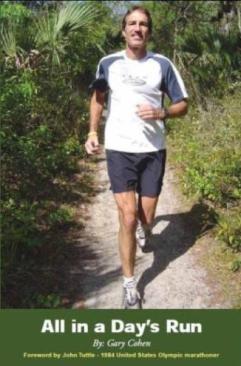 
"All in a Day’s Run" is for competitive runners,
fitness enthusiasts and anyone who needs a "spark" to get healthier by increasing exercise and eating more nutritionally.
Click here for more info or to order
This is what the running elite has to say about "All in a Day's Run":
"Gary's experiences and thoughts are very entertaining, all levels of
runners can relate to them."
Brian Sell — 2008 U.S. Olympic Marathoner
"Each of Gary's essays is a short read with great information on training,
racing and nutrition."
Dave McGillivray — Boston Marathon Race Director
|
 |
|
|
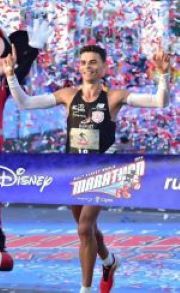
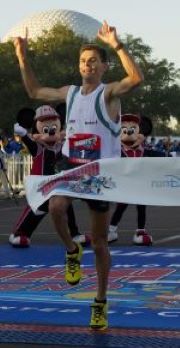
Brazil’s Fredison Costa is best known for winning the Walt Disney World Marathon seven times. Fredison won in 2011, 2012, four consecutive times from 2014 to 2017, and finally in 2019. He also finished second at Disney in 2010 and 2013 by only 33 and 16 seconds, respectively. Costa set his all-time personal best marathon of 2:18:06 in winning at Disney in 2015, breaking his previous best of 2:18:29 set at the 2013 Porto Alegre Marathon, where he finished in fourth place. Fred raced the Sao Paulo Marathon five times, with best finishes of sixth place in 2013 and fifth place in 2014. At Marathon Majors he finished in the top thirty twice in New York City and once in Berlin. Fred was a model of consistency as he raced the marathon 15 times between 2:18 and 2:25. At shorter distances, his top victories include the Meia Maratona Corpore Internacional da Cidade de São Paulo, 2011 Sao Paulo 10-mile, 2015 Jacksonville Half Marathon, OUC Orlando Half Marathon (2015 and 2019), and the Mt. Dora Half Marathon six consecutive times from 2014 to 2019. His personal best times include: 5000m – 15:01; 10,000m – 31:43; 10-miles – 50:10; Half Marathon – 1:05:56 and Marathon - 2:18:06. Fred is a running coach and is sponsored by Dash Sports. He was very gracious to answer questions translated into Portuguese for this interview in December 2025.
|
|
| GCR: |
THE OVERALL PICTURE Fredison, thank you for agreeing to this interview. When we look back to when you were a little boy in a small area in Brazil who had to walk or run a long distance to school and back, what is are your feelings now to be a seven-time Walt Disney Marathon champion with those humble beginnings?
|
| FC |
I really didn't imagine that a very humble boy could go so far, but God has a plan for each of us, and that was God's plan in my life. I came to train and live in the USA, with Coach Brooks Johnson and the American Olympic athletes at the Wide World of Sports Disney Complex.
|
|
| GCR: |
You raced your all-time personal best marathon time of 2:18:06 at the 2015 Disney Marathon, winning by four minutes over Trindade Mateus with perfect weather of 54 degrees. How exciting was it to set your all-time PR as you won the Disney Marathon for the fourth time?
|
| FC |
It was incredible because I never thought about itme, just about winning the Disney Marathon, and in 2015 all the top athletes wanted to beat me. So, when I started the Marathon, I ran alone from the first kilometer to the end, and all without hydration, and to my surprise, I finished in this excellent time!
|
|
| GCR: |
You raced your second fastest marathon time of 2:18:29 at the 2013 Porto Alegre Marathon, finishing in fourth as the top three athletes raced 2:16:27, 2:17:35, and 2:18:01 ahead of you. How did that race play out and what were and are the mixed emotions of racing your fastest marathon at that time, but not making the podium by one place?
|
| FC |
It was a very good moment for me to run that time. Once again, I was there without carbohydrate replenishment during the marathon, and this definitely took a toll on my body. It might have cost me my victory that day. I always ran on sheer will without carbohydrate and electrolyte replenishment, which is not good in a marathon. So, this was another learning moment for me, but still, I really like this way of running nowadays!
|
|
| GCR: |
You were a model of consistency as you raced the marathon 15 times between 2:18 and 2:25. How proud are you of the fact that you were able to run so often at a time that is under 5:32 per mile over the 26.2-mile distance?
|
| FC |
I am truly blessed. God loves me very much for making me this way. I am truly very grateful to God.
|
|
| GCR: |
Since you are in your late forties and are still racing well, what do you find you have had to do to change your training, possibly add more rest and recovery, and are you emphasizing cross training and resistance training more to stay fit and healthy to continue racing strong?
|
| FC |
I need to work more on strength and speed. Also, I try to improve rest and sleep. This will keep you very well and strong. Endurance is already in me. I don't need to do long-distance training. Mental toughness already takes care of that!
|
|
| GCR: |
You have taken your experience, knowledge, and wisdom about distance running to the next level as you coach others. What are some of your overall guiding principles that you utilize with your athletes?
|
| FC |
Discipline, Time, and Patience are the three leveling factors for the next level! This is how I work with my athletes and I combine these keys with Mental Toughness!
|
|
| GCR: |
What do you find are the similarities and differences between motivating athletes of different ages, gender, and ability compared to self-motivation while training yourself?
|
| FC |
I always give my best to my athletes, I work on their minds to bring out the best in them. I can do that, as everything is born in the mind and dies in the mind. I respect the individuality of each athlete and also their moment. This is incredible because I can pass on to them everything I have lived and learned and still live in the sport. This only makes me happier and more motivated to continue and help everyone.
|
|
| GCR: |
If someone wishes to consider utilizing you as an online coach or for personal coaching, how can they connect with you?
|
| FC |
I offer online training and personal coaching on my social media. On Instagram – FredisonCostaTeam and Fredisoncosta1. On Facebook – Fredison Costa. Also, my telephone number is 407-437-1530.
|
|
| GCR: |
SPORTS AS A YOUTH AND YOUNG MAN What sports activities are most vivid in your memories from your youth?
|
| FC |
Really, for everything I was going to do, I would run. When I did that, I was stronger, had more patience, and dreamed of conquering the world while running!
|
|
| GCR: |
Since you lived quite a distance from your school as a child, what combination of running and walking did you do to get to and from school and how did this contribute to your overall fitness?
|
| FC |
Without a doubt, this contributed a lot to me getting to where I am today. To go to school, I would run nine kilometers. When I was getting close to the school, I would start walking to reduce the sweat. But when I was coming back home, I would run until I got home because I was hungry.
|
|
| GCR: |
There was a time when you were training as a boxer. Was running an important part of your routine to help with your endurance?
|
| FC |
Yes, running has always improved my endurance. Running has always made a difference in every area of my life.
|
|
| GCR: |
Did you race for a school team and, if so, what are racing highlights?
|
| FC |
No, I never ran for a team at school because there wasn't a team. When I started running, people discriminated against me and called me crazy. They said I should do something else because I wouldn't get anywhere running. But I never gave up, and look where I ended up!
|
|
| GCR: |
When you were about 16 years old you left your rural area to live and work with your uncle in Sao Paulo. Were you doing much running or other physical exercise at the time?
|
| FC |
I went to live with my uncle in Sao Paulo and worked in a rural area for the Japanese in the fields. I did everything there was to do in the fields and was also responsible for the irrigation system of the farm. I was running to open the water valve and close another water valve to maintain pressure in the water system. I did this work and running in rubber boots during the day. At night I ran to school alone in the dark, which was eight kilometers round trip. Sometimes I played soccer with some friends on weekends.
|
|
| GCR: |
What can you tell us about your early introduction to racing when you were about 20 years old in 1997 when you raised a three-kilometer race with Japanese coworkers and others to celebrate the cherry blossom festival and actually won the race?
|
| FC |
Yes, it was incredible. The first race of my life was at the cherry blossom festival, and I won the first race of my life. It was impressive because the Japanese prize was generous; I won boxes of instant noodles, boxes of cookies, and boxes of laundry detergent. At that moment, I said to myself, ‘Wow, running means this - you win and get a prize, and people say congratulations.’ From then on, I started dreaming of being a great champion, and God made it truly clear to me that running is a purpose in life for me.
|
|
| GCR: |
Did you start running and training more or after that race, was this about the time that you met your first coach, Luis Alberto de Camargo, and what did he do to help you transition into running and racing?
|
| FC |
With the dream of becoming a great champion, I continued, and in 1998 I met my first coach, Luiz Alberto de Camargo. He was very important to me. With him, I learned about interval training, nutrition, rest and, most importantly, he always said that for an athlete to be a good athlete, they first have to be a good citizen, respect their parents at home, enter and leave with their head held high everyplace - in other words, always be a good person!
|
|
| GCR: |
Over the next ten years what were you doing in terms of work, training, and racing that developed you from somebody who wasn't a runner into someone who is ready to start racing marathons when you were about 30 years old?
|
| FC |
I ran every day, I worked at a gas station in Brazil, one of my jobs which lasted 11 years. I would run to work and run back home, all in a mountainous region, with many hilly ups and downs. Relatively, I was being prepared by God in a tough way to receive grace! During this period, I attended college for Physical Education for five years. Thus, I combined science with my practice, and it was incredible! I graduated in 2008. This also led me to have my first personal running coaching client. And he was the guy who introduced me to the marathon. Until then, I only competed in short distances up to the half marathon. He was responsible for me becoming a marathon runner today. He was the Director of Johnson Controls, an American company, and he was the one who secured my first sponsorship. This moment was a turning point in my life. I am incredibly grateful to God and to Carlos Vitório Zaim. Today, I am a happy man who loves the USA where I have lived for the past 13 years
|
|
| GCR: |
What were some memorable races that you remember due to beating tough opponents or winning or racing over challenging terrain during that time period?
|
| FC |
My first race in 1997 at the Kaikan Japanese Association in Piedade, São Paulo when I won the first race of my life. Other races that were memorable were from 2010 and beyond. The Ótima Memória Half Marathon in Puerto Rico in 2015 was one of the toughest races of my life, perhaps the toughest. There is a lot of history in that race. The Disney Marathon in 2010, 26.2 miles without water, without anything was challenging. Also, a tough race was the Porto Alegre Marathon in 2013. I will talk about everything in my upcoming book.
|
|
| GCR: |
Did Mr. Abílio Diniz become your coach and mentor during this time and were there others who had a positive effect on you during training and mental preparation?
|
| FC |
Mr. Abílio Diniz and his son João Paulo Diniz were especially important mentors! I remember that in some of our conversations I was thankful for being sponsored by the Grupo Pão de Açúcar, and Mr. Abílio Diniz told me, ‘Fredison, you don't need to thank us. We don't sponsor just any athlete; besides being an athlete, you need to be a great man of character, commitment, and respect. You have that. Before joining the Pão de Açúcar group, I checked your life!’ Coaches who made a difference for me at Pão de Açúcar were Irineu Loturco who is a phenomenal scientist, Hebert Santana, Capoano Outros, and Jamiro Garcia Elito I am truly grateful for everything I learned from them.
|
|
| GCR: |
DISNEY MARATHON RACING How were you invited to race the Disney Marathon for the first time in 2010?
|
| FC |
It was coordinated by my first sponsor, Johnson Controls, which in Brazil is Heliar Batteries, thru the director Carlos Vitório Zaim. I had already won the first marathon I ran in 2009 and also had the fifth overall place in the Buenos Aires City Marathon in Argentina, thus I was carrying the name of the company Johnson Controls, which is a multinational. The director said, ‘Okay, now you will run in the USA.’
|
|
| GCR: |
What are some of the highlights of your first Disney Marathon as you raced with Adriano Bastos, your countryman, the whole way on a cold 29 degree morning and he ended up running 2:22:08 to win his seventh Disney Marathon with you only 33 seconds back in 2:22:41?
|
| FC |
It was an incredible result for me in my first time running the Disney Marathon, and it was very cold. If I'm not mistaken, it was negative five degrees Celsius with a wind chill of negative ten degrees Celsius. I ran this entire marathon without water and without carbohydrate gel. I really don't know how I managed to do that. When I crossed the finish line in second place overall, I tasted victory. Then the reporter asked me how the race was and I replied that it was amazing and that I would come back next year and win. Hahaha! And that happened in 2011. |
|
| GCR: |
How exciting was it to win your first Disney Marathon in 2011 with the quick time of 2:21:15 by six minutes over Michael Wardian on a beautiful, cool 44 degree day?
|
| FC |
It was one of the best feelings I've ever had in my life! That was unbelievable! And all I wanted was to quickly return to Brazil to celebrate with my children, relatives, and friends. It was undoubtedly a turning point in my life. I gave a lot of gratitude to God.
|
|
| GCR: |
In 2012 you were able to defend your title as Adriano Bastos and you battled the whole way before you pulled away with two miles to go and prevailed by 14 seconds in 2:19:02. Was this even more satisfying since you were able to beat such a tough competitor who had already won the Disney Marathon seven times?
|
| FC |
Yes, it was even more satisfying because the comments were that I wasn't a good athlete and that I was just lucky to win for the first time in 2011. I was really strong. I had pain in my Achilles tendon and ran the entire marathon with that pain, proving to myself that my ability to overcome is very great!
|
|
| GCR: |
The following year at the 2013 Disney Marathon it was a rematch between Adriano and you and this time he ended up pulling away in the final mile as you raced through Epcot to win un 2:21:16 with you sixteen seconds back in 2:21:32. What was it like when you went head to head in that last mile on a warmer day of 61 degrees, especially since the two of you had been training together?
|
| FC |
That year I had many sponsors, so there were high expectations about my possible victory. The external pressure was very intense and always will be, but at that moment I couldn't handle it and was afraid of losing, and that's what happened. I remember that I led the race the whole time, but the fear of losing made it difficult for me to breathe in the final meters, the exact moment for the final sprint, and that cost me the victory. But great champions never lose, they learn. I learned from that, and without a doubt, this lesson helped me win several other races and also brought me to my seventh Disney Marathon title.
|
|
| GCR: |
At the 2014 Disney Marathon, the story was similar with Adriano and you at the front again but you were able to pull away earlier with about four miles to go to win in 2:21:39 by over a minute as Adriano ran 2:22:55. How satisfying was it to win for the third time and to not have to battle all the way to the finish?
|
| FC |
I was preparing quickly, training with Coach Brooks Johnson at the Wide World of Sports Disney Complex, so I was always testing my opponents during the race with speed styles, and at a certain point, I was running alone to win with ease! I was incredibly happy to be winning together with Coach Brooks Johnson.
|
|
| GCR: |
We talked earlier about your fourth Disney Marathon victory in 2015, so let's go ahead to 2016 where the temperature was 71 degrees at the start with 90 percent humidity and it was a tough race in the heat. What can you tell us about how you had to change your thought process and strategy due to the very warm weather and how you still prevailed in a relatively slow time of 2:33:23 over Mateus Trindade who ran 2:34:49?
|
| FC |
It was an exceedingly difficult day for all the runners, and it was no different for me. At the start of the race, I was in the lead from the beginning. At a certain point in the race, I felt it was a difficult day to run. So, all I wanted was to manage and cross the finish line in first place, and I managed to do that. I am grateful to God for that.
|
|
| GCR: |
In 2017, you had your easiest path to victory at the Disney Marathon as you won for the sixth time in 2:23:15 over Vanilson Neves in 2:30:24 with perfect 52-degree weather. Was this a year where you were able to genuinely enjoy the race, all the Disney characters along the way, and people cheering for you since it was like a time trial?
|
| FC |
Yes, it was a year when I ran more easily, and I enjoyed the race and with a grateful heart for crossing the finish line in first place.
|
|
| GCR: |
After not being able to finish at the Disney Marathon in 2018 as Nicholas Hilton won, Nicholas and you faced off at the 2019 Disney Marathon as you won for your seventh and final time in 2:18:45 by three minutes on another temperate 58 degree day. How exciting was it to come back and win after not being able to finish in the previous year?
|
| FC |
It's always good to come back strong, and that was an important moment for me. But once again, I was proving to myself that all of us human beings have an infinite power of overcoming. You truly need to want it and, at that moment, I wanted it.
|
|
| GCR: |
Was it disappointing to not be able to tie Adriano Bastos’ record of eight Disney Marathon wins as you were ill in 2020 and then COVID disrupted the Disney Marathon for the next two years? And was there some consolation in coming back in 2024 at the Disney Marathon to finish fifth in 2:33:29 at age 45 which is a strong time at that age?
|
| FC |
It was never disappointing, but it was really a difficult time for me. I was injured in 2020 and right after that the pandemic hit, which was not good for anyone. I had contracts terminated so I could no longer run as a professional athlete. In 2024, I was satisfied with my placement even though I was no longer a professional athlete, but I still know that I can do much better than that. This is in me.
|
|
| GCR: |
What is your goal for the 2026 Disney Marathon and are you ready?
|
| FC |
My goal is to give my best and yes, I was born ready.
|
|
| GCR: |
OTHER MARATHON AND HALF MARATHON RACES What are your memories of your first marathon, the September 2009 Maratona das Praias, which you won by 20 minutes in 2:28:54?
|
| FC |
I remember that I really wanted to win this race because if I did, I would sign my first sponsorship contract, even if it was small. At a certain point in the race, there were three police motorcycles escorting me, and I had been leading the race alone for a long time and never looked back. I believe that the energy I could spend looking to the sides or behind me, is energy I channel into running faster and stronger. So, I asked the police officer next to me, ‘Is the second place runner very close?’ His response was, ‘You can stop at a kiosk, have a coconut water, and then continue running, because the second place is too far behind to catch up with you.’ That made me feel relieved, and I just wanted to cross the finish line in first place.
|
|
| GCR: |
The next month, in October 2009 at the Buenos Aires Marathon, you dropped your time a big seven minutes as you finished fifth in 2:21:17. Was this the key race where you really zeroed in on how to race a marathon and how exciting was it to hear the cheering crowds and to finish so high in the big city of Buenos Aires?
|
| FC |
Yes, this race was also a turning point in my career. The race that had many African runners and a two-time Pan-American Games marathon champion. I improved by seven minutes from my first marathon during that period, and all of this because I was running with the best runners in the world. It was incredible how much people shouted my name, and that really pushed me to give my best in that marathon. And there I saw that the key to running fast in my next marathons was really there.
|
|
| GCR: |
How did you end up participating in the 2010 Berlin Marathon? And how neat was it to race with such a tough field as you finished in a respectable 2:23:20 for 24th place?
|
| FC |
It was yet another moment when my sponsor was happy with my results, especially the one in Buenos Aires, and sent me to run the Berlin Marathon. It is inexplicable how much the crowd goes to the streets and you really run the 42 kilometers and 195 meters applauded by a human wall that is on the streets. It is unforgettable for me.
|
|
| GCR: |
You raced the Sao Paulo Marathon five times, with best times of 2:23:53 in 2013 for sixth place and 2:23:32 in 2014 for fifth place. What are your takeaways from the Sao Paulo Marathon as to the competition, crowds, and weather?
|
| FC |
The São Paulo Marathon is a very tough race, and the weather wasn't good, especially in the last edition. Something happened in that race which made me sad. I had left eight hydration bottles, one for every five-kilometer fluid station, but my hydration bottles were only at the 5k and 10k points. I was terribly upset with this situation, and it was a factor that might have cost me the victory in this marathon. The São Paulo marathon is a very lonely marathon, with little encouragement from the crowd, which is also not nice.
|
|
| GCR: |
You raced half marathons in Sao Paulo many times and you won the Sao Paulo 10-mile in 2011 in a fast time of 50 minutes and 10 seconds. Was it lots of fun running before crowds who knew you and how exciting was it to win that 10-mile race?
|
| FC |
Yes, it has always been exciting to run the São Paulo half marathons and win, I had a lot of recognition from my fans and that is incredibly good. That for me is fuel. The 10-mile race was impressive. The crowd undoubtedly made the difference for me to win this race as they were shouting my name the whole time.
|
|
| GCR: |
You won the 2013 Meia Maratona Corpore Internacional da Cidade de São Paulo in 1:07:06 over Sivaldo Viana in 1:07:41 and Adriano Bastos in 1:07:58. Did the three of you run together or was someone in the lead and what were the key moments that helped you to win the race?
|
| FC |
At the beginning, we started running together, with the group more united, but after 30 to 40 minutes of the race, I took the lead until the victory.
|
|
| GCR: |
In May 2013 at the Foz do Iguacu Half Marathon you raced a fast 1:06:40 but only finished in twelfth place in the strong and deep field. What are memories of that race?
|
| FC |
It was a very well-organized race with a high level of competitors and a very tough course of ups and downs. Running in races like this, with hilly terrain, are one of my favorites. I was happy with my time and result, but it was a day when I couldn't develop my speed. However, I ran in a way that allowed me to see all the beauty this half marathon offers, and it is a beautiful place.
|
|
| GCR: |
You raced the New York City Marathon in 2016, 2017 and 2019, twice placing in the top thirty with a best time of 2:21:29 in 2019. How tough did you find the course to be through the five city boroughs, were the crowds outstanding and did you like the finishing miles through Central Park?
|
| FC |
The New York Marathon is surreal. You have to respect this marathon. For me, it has always been difficult to run in New York because of the cold. I always spent a lot of energy keeping my body warm, which made me suffer a lot during the races. But in the last edition, I managed to do something a little different as I ate more good fats in the week of the race and in the days leading up to the race. I had more grains, avocado, olive oil, and especially almonds. This made a big difference for me, and I learned from it for the next marathons, especially in the cold.
|
|
| GCR: |
A race you won six consecutive times from 2014 to 2019 is the Mt. Dora Half Marathon, which is about thirty miles from Orlando. Was it neat to make this another race like the Disney Marathon where the race organizers, runners and fans enjoyed your presence and cheering for you?
|
| FC |
Yes, it was very cool to be part of this amazing race like it was at the Disney Marathon. I became popular in the town of Mt. Dora and I love it. Moreover, I have a friendship with the living legend Bill Rodgers, ambassador of the Mt Dora Half Marathon, since the first edition I ran, which means a lot to me.
|
|
| GCR: |
At the Mt. Dora Half Marathon, was there much difference between your first four victories, which were by seven to nine minutes, or the final two where Sergei Zyrianov was two minutes back at the finish in 2018 and Harrison Kirigwiwas a similar two minutes behind in 2019?
|
| FC |
There was no difference in the races, I just ran more aggressively in the first four editions than in the others. My intention was to win, so I tried to run in a way that I would win more economically because a few weeks right after that race I had the Disney Marathon.
|
|
| GCR: |
You raced the OUC Orlando Half Marathon at least half a dozen times finishing first in 2015 in 1:05:56 and also winning in 2019. Is this a good tune up for the Disney Marathon since it's four to five weeks beforehand, and how did you find the last couple miles where some of the city's old brick streets and uneven surfaces come into play?
|
| FC |
Yes, I have a great affection for the OUC Orlando Half Marathon, and it is undoubtedly a warm-up for the Disney Marathon. It is a crucial moment in the race on the old brick streets where the athlete is already tired. Besides being the final part of the half marathon, it is more difficult with these streets. I have beaten some athletes at this point in the race and have also been overtaken at this spot, so perhaps the key point to winning the OUC Half Marathon is for the athlete to arrive well at this point.
|
|
| GCR: |
In addition to marathons and half marathons, you raced many of the Orlando and Central Florida area races such as the Winter Park 10k, Celebration of Running 5k, Battle of the Bands 5k, Park Avenue 5k, and Margaritaville Run 10k. How exciting is it to race on the Orlando area local running scene, and are a lot of these tempo runs for your half marathons and marathons?
|
| FC |
Yes, it's always great to run all these community races where I have many friendships and a lot of affection for the audience. These races are definitely what keep me alive to continue training and competing in half marathons and marathons.
|
|
| GCR: |
Are any of these local races especially memorable due to a good victory, strong competition, inclement weather, or other reasons?
|
| FC |
All of them are special because I love running. When I'm at these races with all these amazing people, I feel alive.
|
|
| GCR: |
TRAINING When you were in your early years of running and racing, how many days did you train per week and what was your base mileage or kilometers per week to build strength?
|
| FC |
I trained every day, running 180 kilometers to 220 kilometers per week. (note – this equals 110 to 135 miles per week)
|
|
| GCR: |
What were your key speed and stamina training sessions on the track or roads, did you do hill repeats, and was fartlek training a part of your regimen?
|
| FC |
Yes, I always did hill repeats, it's extremely important work. Fartlek training has always been and continues to be part of my training system. I did speed work on the track at least two times a week and in some periods three times a week on Tuesday, Thursday, and Saturday.
|
|
| GCR: |
When you added focus on the half marathon and marathon, what did you do in terms of weekly total distance, how long were your long runs, and what were key workouts you did to develop into a top racer at the longer distances?
|
| FC |
For half marathons and marathons, it's 180 kilometers to 220 kilometers per week. My long runs ranged from 25 kilometers (15 – 16 miles) to 44 kilometers (27 miles). My speed work on the track were repeat 200 meters and 400 meters. For stamina speed we did 1,000-meter, 2,000-meter and six-kilometer repetitions, plus long workouts.
|
|
| GCR: |
How did your training change when you moved to the United States and Central Florida in 2013?
|
| FC |
The fact that I came to train with coach Brooks Johnson was an important moment for me. He was a coach at the ESPN complex. I learned a lot from him and from American Olympic sprint athletes, such as Justin Gatlin, Lashawn Merritt, David Oliver, and Dwight Thomas, among other athletes from the NFL and MLB.
|
|
| GCR: |
How important is running form and technique so that you can conserve energy, run relaxed, and be ready to race when you get to the crunch points in a race?
|
| FC |
It is particularly important for the individual to have their technique and always work in an aggressive and economical way. Some simple examples are the individual running with a relaxed jaw, relaxed shoulders, a slightly inclined torso, and directing their arms. It is also important for the individual, when running, to imagine that the ground they are stepping on is extremely hot, so they can lift their foot off the ground more quickly. And above all, it is important for the individual to run with the mindset of being aggressive and economical. All of this is trainable. Everyone can do it.
|
|
| GCR: |
Over the years, did you do much additional weight training, cross training, and have professionals such as chiropractic care or massage therapy to allow you to train strongly?
|
| FC |
All of this is important, but in my case, it was truly a small part of my regimen, as it was a cost I couldn't afford.
|
|
| GCR: |
When you look back, is there anything you would do different or additional in training that may have helped you to achieve better results, or are you happy that you did your best to reach your potential?
|
| FC |
I don't regret anything I did, but I have no doubt that throughout my career I was fortunate to learn a lot, so what I would do differently would be to sleep more and hydrate better.
|
|
| GCR: |
MISCELLANEOUS AND WRAP UP What are some of your goals for the future in terms of personal development, continuing to coach and mentor others, racing into your fifties and sixties, and do you see yourself slowing down or doing as much as you can?
|
| FC |
I plan on continuing to train and mentor others, which is my passion. I will be continuing to compete forever, doing the best I can. I won't slow down.
|
|
| GCR: |
Based on what you have learned from the discipline of athletics, facing challenges, and overcoming obstacles, what advice do you give to youth and adults so that they can be their best and reach their potential as athletes and human beings with the gifts they have been given that all comes together in the ‘Fredison Costa philosophy?’
|
| FC |
Never, ever give up. Always give your best, with the conditions you have, without comparisons, and just do your part. The world turns many times, and you can be sure that you will have your opportunity. everyone has their opportunity. Now the question is, ‘When your opportunity comes, will you be prepared?’ Because your opportunity will come.
|
|
| |
Inside Stuff |
| Hobbies/Interests |
Playing dominoes
|
| Nicknames |
Fredinho
|
| Favorite movies |
Action movies with a good plot
|
| Favorite TV shows |
In childhood, ‘He-man’ and ‘Scooby Doo’
|
| Favorite music |
1990s music
|
| Favorite books |
Holy Bible
|
| First car |
1979 Passat
|
| Current car |
Volkswagen Jetta
|
| First Jobs |
Farming, gas station attendant, physical education teacher
|
| Family |
My children are Gustavo and Julia. My siblings are Sirlei and Valfrido
|
| Favorite breakfast |
Coffee, couscous with butter, sweet potato, and a croissant
|
| Favorite meals |
Pasta and steak
|
| Favorite beverages |
Grape juice
|
| First running memory |
My nine-kilometer run to school
|
| Running heroes |
Haile Gebrselassie and Marilson Gomes dos Santos
|
| Greatest running moments |
1) My first race in 1997, which was three kilometers and I won; 2) Winning the Beaches Marathon 2009; 3) My first Disney Marathon win 2011; 4) Defending my Disney Marathon title in 2012; 5) My seventh Disney Marathon win in 2019
|
| Most disappointing running moments |
The São Paulo Marathon, when my six hydration bottles disappeared on an extremely hot day
|
| Childhood dreams |
Getting a job
|
| Funny memory |
My games were making the animals chase me on my grandfather's farm. For example, when the cow had just given birth, I would get close to the calf so she would chase me, protecting the calf. Also, provoking a bull to chase me
|
| Embarrassing moment |
When I was a little boy, I was peeing the bed
|
| Favorite places to travel |
USA
|
| Choose a Superhero – Batman, Superman, or Spiderman? |
Spider-Man
|
| Choose a theme park – Disney World or Universal Studios? |
Disney World
|
| Choose a a Sylvester Stallone character – Rocky or Rambo? |
Rocky
|
| Choose a star of Brazilian football – Neymar, Kaká, Pelé, Ronaldo, Zico? |
Kakáy
|
| Choose the beach or mountains? |
The mountains
|
| Choose a tough guy – Vin Diesel or The Rock? |
The Rock
|
| Choose movie secret agent coolness – James Bond 007 or IMF Agent Ethan Hunt? |
IMF Agent Ethan Hunt
|
|
|
|
|
|
|