|
|
|
 garycohenrunning.com
be healthy • get more fit • race faster
| |
|
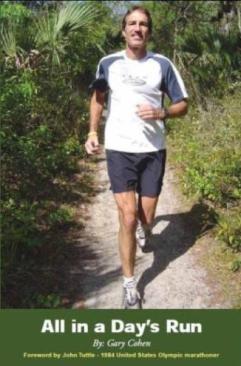 
"All in a Day’s Run" is for competitive runners,
fitness enthusiasts and anyone who needs a "spark" to get healthier by increasing exercise and eating more nutritionally.
Click here for more info or to order
This is what the running elite has to say about "All in a Day's Run":
"Gary's experiences and thoughts are very entertaining, all levels of
runners can relate to them."
Brian Sell — 2008 U.S. Olympic Marathoner
"Each of Gary's essays is a short read with great information on training,
racing and nutrition."
Dave McGillivray — Boston Marathon Race Director
|
 |
|
|
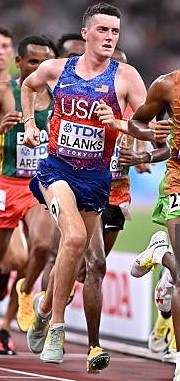
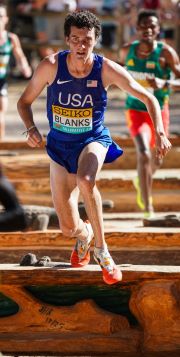
Graham Blanks has represented the USA at three global championships. At the 2024 Paris Olympics, he finished ninth in the 5,000 meters. In 2025 at the World Track and Field Championships in Tokyo, Japan, Graham was 11th at 10,000 meters. He placed 19th at the 2026 World Cross Country Championships in Tallahassee, Florida. Graham qualified for the latter two global championships with a third-place finish in the 10,000 meters at the 2025 U.S. Track and Field Championships and a sixth-place finish at the 2025 U.S. Cross Country Championships. Although he placed fourth at the 2024 U.S. Olympic Trials at 5,000 meters, the third-place finisher had not met the Olympic qualifying standard, so Blanks advanced to the Paris Olympics. At the 2025 Last Chance Indoor National Qualifier at Boston University, he won over 3,000 meters in 7:29.72. At The TEN, a 10,000-meter invitational raced at JSerra Catholic High School in Capistrano, California in the spring of 2025, Graham placed fifth in 26:57.30. In the 5,000 meters during 2025, he raced to a seventh-place finish in Oslo, Norway at the Bislett Games in a PR of 12:48.20 and a Bronze Medal at the Paris Diamond League in 12:49.51. Blanks is the 2024 and 2023 NCAA Cross Country Champion, one of 13 men to win NCAA XC at least two times. In 2024, Graham’s NCAA XC time of 28:37.7 was a course record and Heps XC time of 22:14.6 was the fastest time ever for an Ivy League student-athlete at a Heps 8-kilometer race. At the 2023 NCAA Track and Field Championships he finished sixth at 10,000 meters and second at 5,000 meters. While recovering from a stress fracture, Blanks was fifth in the 2024 NCAA 5,000 meters. Graham is a nine-time All-American and seven-time Ivy League Champion, representing Harvard University. He is a three-time NCAA Northeast Region Cross Country Champion. In high school at Athens Academy, Graham was the 2018 and 2019 Georgia State 1A Cross Country Champion, the latter in Course Record time. Other notable prep cross country wins include at the 2019 Great American XC Festival and 2019 NXN Southeast Regional. He also was the 2019 Georgia State 1A 3,200 Meter Champion. His personal best times are: 1,000 meters – 2:23.16; 1,500 meters – 3:36.11; Mile – 3:56.63; 3,000 meters – 7:29.27; 5,000 meters – 12:48.20; and 10,000 meters - 26:57.30. Graham graduated from Harvard in the spring of 2025 with a degree majoring in Economics with a minor in Philosophy. New Balance signed him to an NIL deal in late 2023 and to a professional contract in late 2024. He was very gracious to spend an hour and fifteen minutes on the phone for this interview in early February just two days after the Millrose Games.
|
|
| GCR: |
THE BIG PICTURE Graham, you made the 2024 USA Olympic team, the 2025 USA World Championships team in the 10,000 meters and 2026 USA World Cross Country team. Though you want to compete for medals and the win, how does it feel to consistently make USA teams?
|
| GB |
It is good to have some consistency. It's neat how you track me now and it'll be interesting to look back in the future as you have tracked my career and to see my thoughts as I progressed as an athlete. I think I'm at the point of my career where I am starting to regain a lot of confidence that I had in college. I'm not really afraid to compete anymore and I'm not afraid to get to the front of the races. That's the next step for me – getting to the front and making an impact. The first step was making all these teams making global finals. I've been able to make three teams now - two on the track and one on the course - so I'm pretty happy with where I'm at but I'm hoping for a big breakthrough soon and expecting one.
|
|
| GCR: |
Since you've graduated from Harvard there's an adjustment to being a pro. What has it been like as, even though you have more free time, you don't have that routine of classes, practice with the team, hitting the dining hall, and all those normal things that we all went through in college? How has it been adjusting to the freedom of being a pro - both the advantages and the challenges?
|
| GB |
It's hard for sure. I was expecting it to be a difficult transition, and it certainly has been. 1t's hard leaving your friends behind. It's hard to be alone now and not having your best friends in the living room when you wake up. We take for granted our time at school. Similarly, it's been hard leaving college and assuming a lot of responsibility that you didn't have to in college such as knowing I could eat in the dining hall, so I didn't have to cook. I had people to train with every day. I had a coach overlooking everything. Right now, as I've trained Athens, Georgia, which is where I'm trying to be during the cold months of the year, it's been a little difficult at first. I have had to get used to doing those things on my own. It’s not from a lack of intrinsic motivation and it's why I was confident that I could be based out of Athens and succeed, but it certainly is still difficult and something that I have to approach every day by being intentional. I have absolutely figured out how to create a system in Athens and in Boston. Likewise, when I train at altitude I really think I can thrive now as an athlete since I have access to the people and facilities that I need in order to succeed.
|
|
| GCR: |
When I interviewed Craig Virgin, we talked about when he was a pro athlete, which of course back then was different because there was money under the table and the landscape was transitioning to the above-board professional structure. I remember Craig went home to his farm where he grew up in Illinois and he found a lot of solace just training on those same roads and doing his hill repeats that he ran when he was running 8:41 for two miles in high school. Have you found that since you have gone back and are running some of those same routes and hills from high school that the familiarity is comforting?
|
| GB |
Yes, absolutely. That's part of the reason I wanted to go back. I wanted to go back to the simple stuff that got me to where I wanted to be. In high school I certainly wasn't an 8:41 two-miler like Craig Virgin. I had a great coach in high school who limited my training and rested me, which gave me a lot of room to grow in college. It feels interesting coming back after being at such a different level of racing. It almost feels like the ‘hero's journey.’ I'm not sure if you've seen that diagram but a lot of stories are structured in literature as the hero starts off at home, goes out into the world and accomplishes something, and then returns. That's how I have felt in a way. I'm not calling myself a hero, but I feel like I've returned to the place where I was before I became who I am now in a way. It's like I'm coming home and I have my identity now. I feel like I've grown a lot as a person and obviously, I'm now a professional runner. With this growth as a runner, it's neat to be back training in the same places and on my high school track. It brings me immense source of inspiration just to be back in my home city and to feel like I'm running for my city.
|
|
| GCR: |
You mentioned earlier that now you're starting to feel like you can take the lead or be competitive in these high-class professional races. I'm sure part of that must be since you lowered your personal best tines in 2025 at 1,500 meters from 3:44 to 3:36, at 3,000 meters from 7:44 to 7:29, at 5,000 meters from 12:59 to 12:48, and at 10,000 meters from 28:15 to 26:57. Do you feel that getting faster in 2025 set you up, you're as fast as almost anyone, you can compete with about anybody in the world, and now it's going to come down to surges and tactics?
|
| GB |
Yes, absolutely. Last year in the moment in many of those races it almost felt like a lackluster year for me. This sounds incredibly ungrateful to say after you just listed the accomplishments, but the reason I felt lackluster was because I was getting my butt beat in so many of those races. Nonetheless, I was improving and dropped all those times. Now I am entering the upcoming outdoor season knowing that I belong whereas last year when I got to these Diamond League races I didn’t know anyone there and I was the new guy. I got in these races that are simply crazy fast. It's just a huge transition and of course I had imposter syndrome while I was competing on that circuit. So now this year's a little different whereas I know I can run fast and now it's time to start mixing it up and rolling the dice in the last few laps. That's what I've been working on this indoor season. In the few races I've done, I'm trying to practice different tactics against some of the best runners in the world so now I feel confident heading into the outdoor season with the previous work I did last year.
|
|
| GCR: |
We'll get to a lot of those races in detail in a bit, but one big picture item goes back to when we chatted in late 2024 and you mentioned your primary goal for 2025 was to make the U.S. team at 5,000 meters. Then the way it played out you made the team at 10,000 meters. When you look at your thought process coming into 2025 and then the results, was it surprising or based on your training and the way the races went, it made sense?
|
| GB |
The 5,000-meter team was much harder to make last year. The 10,000-meter team is difficult in a different way to make just because the qualifying standard is so hard to achieve. There are only so many races throughout the year where we can get under 27 minutes and, thankfully, I was in one of those races. Once I had that standard in the bag, I started approaching race week and was waiting for people to hit the qualifying time. It ended up with only four of us having the sub-27 minute qualifying time, and I was confident I could make the top three and the team. In the 5,000 meters, I came in with a 12:48 time that was significantly faster than most of the competition other than Grant Fisher and Nico Young, but in these tactical races your personal best doesn't matter as it's truly having the fitness to hang the first seventy-five percent of the race and then having the heart and the desire to really close out the last part of the race. I struggled last year for whatever reason. In those 5,000 meters, I found it hard to come in with the expectations that I had in the previous years and toward the end I was completely out of that race for whatever reason. But I was happy to make the 10,000-meter team, though I wanted to in both distances. I took that approach though at the time I thought that the 10,000 meters would be my better event regardless because I wasn't confident in my foot speed at the end of the races. However, this year I'm starting to feel a lot more confident in my abilities in these types of races so I'm hoping I can get back to making those 5k teams because those teams are extremely hard to make in the USA. This year it may be a little easier. It’s funny for me to say that because it's not easy but it's going to be different this year with the Diamond League Championship because athletes qualify based off of world ranking and there's no cap for nations this year. So hopefully I can make the 5k team this year just by doing well in the outdoor season. Then next year the World Championships are on the schedule and hopefully I can make the 5k and 10k team again because that's also my goal for the 2028 Los Angeles Olympics. Also, I want to be fighting for medals in both events.
|
|
| GCR: |
Switching gears a little bit, we briefly mentioned the 2026 World Cross Country Championships which were in Tallahassee, Florida. I attended and watched that event. What was your thought process going into the race and as the race unfolded and what did you think about the different hazards and obstacles - the sand pit, the water trough, the alligator alley barriers, the mud pit, and the ramp? I know you like cross country, so what are your thoughts about the racecourse and how competitive that race was as you came in nineteenth place, but there were amazing runners around you that weren't in the top ten either?
|
| GB |
In terms of the race itself, we were as prepared as for any cross-country races I've done in the past in college. We were aware of these obstacles that were going to be on the course, and we knew it would be difficult. I'm training in Athens, Georgia, which is only a five-hour drive to Tallahassee. So, in the lead up to the race, I went down twice. I would just drive down on a Thursday, stay in a hotel, wake up to work out on the course on Friday, and then drive home. Thankfully, some of the obstacles were in place so I was really able to practice on them. I went back and watched several previous World Cross Country Championship races to get an idea of how the race would play out and these races are actually pretty simple. The athletes just go out hard and they run hard the whole time. That's how these world cross country races go, so I went in thinking this is going to be simple, and I needed to get out and run hard. But you know what Mike Tyson said, ‘Everybody has a plan until they get punched in the face.’ The race was super-fast and there were the obstacles. I kept getting rattled by the obstacles and the gap to the leaders kept increasing. It was humbling no doubt, and it was a bit of a disappointing day for me just because the World Championships were in the south and I genuinely wanted to represent my part of the country well. I felt so much support from the crowd and felt like I performed to my best ability that day. It's a shame because we don't know if the race will ever go back there. Looking back on it now, I'm super happy with the experience and those are teams that I'm going to continue to try to make. I want to make the World Cross Country teams, and I want to see what I can do racing on the grass professionally. Now with that experience I understand you need to be extremely prepared for this race as you have to be able to hang with guys that have run 57 minutes in the half marathon and hang with guys who can run 26 minutes and change in the 10k. It was a crazy race, and I am super grateful for the opportunity, but I want to perform better at a World Championships in the future which unfortunately probably won't be in Tallahassee.
|
|
| GCR: |
RACING Let's talk about some of these individual races. You mentioned feeling lackluster because you weren't placing high, but you were fast in the first four races we're going to talk about as all are personal best performances. One year and one day ago at the New Balance Indoor Grand Prix, you ran 3:36.11 for 1,500 meters for fifth place which equates to about a 3:53 mile. What stands out from that race as you dropped your PR, and it was early in your training block?
|
| GB |
It was very early on - a month into training more or less. New Balance is my sponsor, so I wanted to have some fun. I didn't hope for too much or have big expectations. I knew I would PR because my mile PR at that point was 3:56 and I figured I could run much faster than that. It was a rather good race just trying to hang with those guys and with the pace. I thought I closed well but it was pretty nonconsequential race for me. But I really enjoyed my time there and that was my first professional race other than the Olympics, and I thought it was a bunch of fun.
|
|
| GCR: |
A month later at the Last Chance Indoor National Qualifier at Boston University, you won over 3,000 meters in 7:29.72 and you were five seconds ahead of Valentin Soca and Sam Gilman. Was that sort of nice after the pace setter dropped off and you were in the lead that you could just focus on racing fast and not focus on racing for the win at the end? Also, on the scoring tables that's your highest score as it rates a 1267 which is higher than any of the other PRs. I don't know if you knew that, so what are your thoughts on that race and score?
|
| GB |
I think 12:48 for 5,000 meters is harder than 7:29 for 3,000 meters. I don't think I deserve that many points from that race because I had a great pacemaker that got me through two kilometers right at five minutes flat or 4:59. Then he stepped off the track and I needed to run another kilometer in 2:30. That last kilometer was another race as I figured I could run that fast and I did it by myself. But that's how I like to run anyways as I like to push the last kilometer. When we are that fast the first two kilometers, it's difficult to increase the pace, but I was happy with it. The race was a nice reminder of my fitness, and it was all in preparation for a 10k, so it was a nice checkpoint.
|
|
| GCR: |
At The TEN, raced at JSerra Catholic High School in Capistrano, California, they brought that big group of great runners together and everybody was trying to go under 27 minutes. You came in fifth place in 26:57.30, so how did it feel to see your time go under 27 minutes?
|
| GB |
That race was the focus of my big preparation for that part of the season. I had been working towards that race since right after cross country basically and the goal was to get under 27 minutes and to get the World Championships standard. I figured it would be easy for some reason as I thought there would be a pacer. I thought it would be simple, but as things happened, nothing went according to plan. What happened was there was a weird start as a few people actually missed the start. They were a few meters off the line doing strides when the gun went off so there was a lot of confusion. The rabbit went out right on pace and no one wanted to be right behind the pacer. A lot of these guys in the race already had the standards so they weren't particularly interested in taking that responsibility of keeping the pace fast. So, I had to make a quick decision to close the gap and get the race back on the pacer. Then the rabbit led all the way to about 5k. All of a sudden, the rabbit drops off and I'm staring down at 5k of work which I was able to do for a mile, maybe more or maybe less, before starting to ask for help from guys looking to make the standard. I got a quick lesson as you have to learn that once you're on the track nobody is your friend. They are all the competition, so I put myself in a tough spot in that race and eventually I slowed down off the pace. Thankfully, I closed back on pace as I had a hard time maintaining after leading for so long. I felt like I exerted a lot of energy and thankfully I was able to rally the last 800 meters and get right underneath the standard just by three seconds. So, it was mission accomplished for me to get the time, but I prefer to be alone or in that pack at least competing for the win on that last stretch.
|
|
| GCR: |
Then you went through a training block as you were getting ready to race over in the Diamond League in Europe. What was it like racing with the history in Oslo at the Bislett Games, to run 12:48.20 and drop your PR by eleven seconds as Nico Young won while you're only three seconds back but you're in seventh place and there were dozen runners who all ran 12:51 or better? What was it like to race so fast and to be in such a crowd?
|
| GB |
It was crazy and was different than any race I've ever run and that's how the Diamond League races can be. They usually go out at breakneck speed, and everyone goes with the pace which is the opposite of what I've been doing in the NCAA where races are more tactical. These races just go hard from the start, a crazy experience, and I was happy to come away with a big personal best time. Mostly I was satisfied because it was such an insane experience to do for the first time. Running 12:48 hurts, it hurts a lot, and I was impressed with my ability to handle that pain much better early on. It takes a lot of confidence in yourself to think, ‘I can do this - I can run this pace.’
|
|
| GCR: |
What was it like then eight days later at the Paris Diamond League since you've run 12:48 and you're up there with guys like Yomif Kejelcha and Birhanu Balew and you're able to earn the bronze medal in 12:49.51? Did you go in with more confidence because you knew you could run that fast and were you able to mix it up a little bit better because you had that experience from Oslo?
|
| GB |
We went out even faster in Paris than in Oslo and, despite that, Yomif, Nico, and I went out fast the first 1,000 meters. Certainly, without my experience in Oslo, I would never have done that, and it paid off when I finished third in that race as it would not have happened if I hadn’t gotten out that hot. I knew I could race like I did and that gave me a lot of confidence going that race. Also, running 12:49 in that fashion and finishing third like that was a big day for me. I was really happy with my performance and to beat Nico was also big for me because he was running well. It gave me confidence when I defeated him that day.
|
|
| GCR: |
Early on we talked about the USA championships but what I found interesting was it was such a slow tactical race for most of the 10,000 meters and then when Grant Fisher took the pace, like you know Grant will, he did with four laps to go and Nico, Grant and you ran a four flat last mile. Could you have imagined when you're in high school running a four flat last mile over 10,000 meters and only coming in third place?
|
| GB |
It is crazy the things we're doing nowadays, so I'm sure my high school self would not believe that. It was a fun race to do, and I expected that it was going to come down to the three of us for the win. It was close to being a great race for me. That was one where I was in it at the end and they started getting away that last 150 meters. I just had a hard time accelerating off the curve but raced big time and we were simply happy to come away with a spot on the U.S. squad. I’m always happy to be up there competing with Nico and Grant as they are two guys that are the best in the world.
|
|
| GCR: |
After you missed the U.S. team at 5,000 meters, you were getting ready to go back over to Europe to train and compete. Was there some type of self-evaluation to figure out if there was something you were missing in training, did you need more rest, or was there something that you needed to do before you hit those last couple Diamond League races coming into Worlds as you had Lausanne and Weltklasse on the schedule?
|
| GB |
I just wanted to race again because I felt like that wasn't me that day at USAs in the 5,000 meters. Honestly, I was tired more emotionally than physically as it had been a long season. At that point I hadn’t had much of a break for a good training block in a long time. I had years dealing with how NCAA is structured and you have to take a little break and turn around really quickly. I was starting to see the signs of the cracks right around then and I didn’t get confidence from that race because I felt like crap though I knew deep down it wasn't really me. I wanted to get back on the horse and am always happy to race in Switzerland and get back in the Diamond League races where I get back in front of the crowds and really enjoy racing.
|
|
| GCR: |
In Lausanne the top guys were running 13:07 to 13:09 for 5,000 meters with you a couple ticks back and then in Zurich it was the same thing as the top eight were all 7:36 to 7:38. What was it like running a little bit more tactically in Diamond League races in Lausanne where you finished eighth and Weltklasse Zurich as you finished sixth because the races weren't like those extremely fast sub-12:50s and sub-7:30s?
|
| GB |
It was interesting and different in Lausanne where it was raining super hard, which made it a fun race as we were battling the conditions. Also, I had a buddy there in the crowd which was really cool. My roommate from college made it out so I was pumped to get him into the meet and get to watch me. It was a fun race but at that point of the season I was I was pretty tired and still upset about the 5k at USA's and it showed a little bit. I got a little rattled by the weather and the quick gear changes at the end of the race in Lausanne whereas, if I was truly in my form, when the pace slowed down, I think I would have probably done something about it and took the lead with a kilometer to go to use my strengths to the best of my ability. Nonetheless, it was an amazing experience in that environment.
|
|
| GCR: |
At Worlds, the 10,000 meters was a race in terms of the slow early pace and then the fast finish that was similar to USA's except that you had a lot more guys in it as there were 13 guys in the lead pack. What was that like when it really wound up and it got away from you towards the end and there were ten guys between 28:55 and 28:59 and you were a couple seconds back?
|
| GB |
The race started out very slowly, and it was slow the whole time. I knew when we got on the track that it would be like that because as soon as we stepped out on that track in Tokyo it was extremely hot and it is hard to articulate how it felt once we stepped out to race. Just take my word for it that it was very hot as it was just the way the stadium was designed that kind of trapped the heat inside of it and trapped the humidity. It was intense and that's why the pace slowed down. I don't think the heat necessarily affected me that much. It was just the way the race was run. For some reason I struggled as the pace was slow and then it would speed up and slow back down. It’s hard to deal with the surging while trying to stay calm throughout thirty minutes of a world championship. It was the biggest day of the year for us, and I struggled keeping my cool. I think by the time I got to the last mile I was just exhausted from trying to cover moves. Not only that but, with the nature of the whole season, I think that race showed where I was at physically and mentally, which was just a little tired, a little burned out, and after that race I was exhausted and really ready for a break. I had a great time in Japan, but I was happy to go home and rest a bit because I bit off a little more than I could chew that outdoor season after graduating college. It was a very hectic transition in my life.
|
|
| GCR: |
After a long season with a lot of big races, it's the fall and normally you're having cross country, but you got to do a really fun event as you were part of the Ivy League team going over to Ekiden in Japan. How much fun was running with Talha Syed and Tyler Berg from Columbia, Will Laird from Yale, Derek Amicon from Cornell, James Lawrence from Dartmouth and your Harvard teammates Ben Rosa and Acer Iverson?
|
| GB |
That was an amazing experience. The people in Japan are so kind, and they were so happy to have that team and me over there to compete. We felt like such big deals, and it was crazy how they were excited to have us there. The culture with the Ekiden is super inspiring. It was great to be there with my best friends from Harvard and Ivy League competitors. It was nice to finally meet some of my competitors properly outside of competition and we had a ton of fun. In the Ekiden relay, we got to race in front of big crowds which was pretty cool. I was in really bad shape because I just came off a break from training. I still wanted to help the team and I put us in a good position to do well. We finished fourth, which I feel was a pretty big deal. I'm hoping to go back there with a little more fitness next time and get us in better position to win. I'll definitely be going back to that if I can as much as they want me as it's an amazing experience. I'm also hoping to help out with the organization in the future when I'm done running competitively so that we can give those opportunities to the younger guys in the Ivy League who want to participate in racing Ekiden and have this experience.
|
|
| GCR: |
It's interesting with that many relay legs, when looking at the results, the Ivy League Select Team at 2:10:12 finished exactly a minute behind Koku Gakuin University at 2:09:12 and just behind Waseda University at 2:09:50 and Soka University at 2:10:05. Was it a lot of fun competing without the pressure of your professional races and to experience the camaraderie with your teammates in a more relaxed situation?
|
| GB |
Yes, it was really neat and for me it was like a vacation. I was out of shape there and simultaneously discovered how big of an event it was. That left me wanting more even though it's supposed to be for fun. I think it's just the competitor in me that refuses to lose or perform poorly. It was inspiring being there and now I want to go back and hopefully at some point line it up with my season and be able to really knock it out of the park. With the team we could do something fun, but at the end of the day the greatest part of that trip is just the cultural exchange and getting to meet everyone. That far exceeds the importance of the race which is saying a lot because I get that it's a big deal in Japan.
|
|
| GCR: |
We talked briefly about you competing in Tallahassee at World Cross Country, but first you have to make the team. The top six made it you so what was it like on not the best day for racing with poor conditions for the U.S. Cross Country Championships in Portland, Oregon, and it’s sort of crazy as Nico Young finished fifth and you finished sixth. You guys were two of the top three in the 10,000 meters that made the USA World Championship team and you are the last two making the cross-country team. So, what was it like that day and even though you got that last spot, was it just as exciting as third place to go to the Olympics or World Championships in track? Is sixth place in cross country equally as exciting because you're on the team?
|
| GB |
Initially I was disappointed. It's the third World Team I've made and it's the third World Team where I took the last spot. I'm always grateful to make a team but I want to be making those teams handily and competing for U.S. championships. I didn't foresee myself getting sixth in that race. I truly foresaw myself winning it because I'm the ‘cross country guy’ who won two NCAA titles in college. But there's a quick turnaround after the World Track and Field Championships, I got sick the week leading up to the U.S. Cross Country Championships and then the course ended up being very sloppy. So, that certainly didn't help my performance. But everyone else had to run it as well. Afterward, I got over myself and I was super happy to make another team and especially in cross country which is just awesome.
|
|
| GCR: |
In looking at the results of the 2026 World Cross Country Championships, you were third American behind Parker Wolfe and Wesley Kiptoo. The other 16 non-Americans ahead of you included twelve Africans, mainly from Uganda, Ethiopia, and Kenya. Have you ever thought about spending time with some of these guys, going over to their training camp, and experiencing what they do and what makes them tick since so many of them do so well at the world level?
|
| GB |
They place a lot of value on cross country, their nations support the sport, and it brings a lot of national pride to compete and win in cross country. It's something we don't have as much in the U.S. because we're a more individually focused with our training programs, our teams, and our sponsors. Also, it’s hard to beat those guys because they're so talented and a lot of the terrain they've trained on their whole lives is less than ideal compared to what we've trained on the U.S. We have beautiful, rubberized tracks at about every public high school. The Africans are used to the cross-country terrain and have a lot of national support for those races that we don't really see as much in the U.S. because we don't value the cross-country championships as much as we used to. I’m hoping in the future that we put increased emphasis on cross country and try to make it more of a team event rather than just a bunch of individuals coming together, so hopefully the U.S. can do well.
|
|
| GCR: |
Let’s return briefly to your limited indoor season. First, you raced well at the New Balance indoor with a 7:31 for 3,000 meters. I watched the two-mile at the Millrose Games live on television this past weekend and you pushed it with about five laps to go when the pace was dawdling resulting in your mile splits of approximately 4:07 and 4:01 leading to your personal best of 8:08.60. What are your thoughts on this limited indoor season that has ended as it looks like you're ready this for a breakout 5k if you were still racing?
|
| GB |
I agree and it's my racing strategies that worked out well. In the New Balance 3,000 meters and the Millrose Games two-mile they were different races that I lost, but in both races I took the races into my hands which was something I hadn’t done since college. It was great to be back out front dictating the race the way I wanted it to be run. I honestly can say that in both of those races I feel like I was close to wins. If I did a couple things differently, I think I could have won those races. I feel like I would be on my way to doing something big in the coming weeks, but this is the agreed upon time to take some downtime after indoors. My coach and I are both equally like-minded about bottling up this momentum, the good energy, and saving it for outdoors. We want to save it for the events that I honestly think I'm good at, which are the Diamond League races. That’s where I want to be and that's where I want to win, so the reason I'm shutting down early is that I want to take some downtime and I want to have a really long build which I haven't had in years because of the NCAA seasons. By being patient, hopefully this summer we're going to see some big breakthroughs because I'm starting to see a path towards victory. I want to ensure that I'm doing everything I can to start winning these professional races.
|
|
| GCR: |
TRAINING Let's talk about training, some aspects you've done differently, and training you did in Europe, but first before the U.S. Championships last summer you were in Park City Utah training at altitude. How did that go, what were some of the differences in training, and did you come down from altitude when you did track workouts?
|
| GB |
I was sleeping at 8,000 feet of altitude in Silver Lake and mostly doing my regular runs and long runs around 6,000 feet in Park City. For track work we would go down as far as we could, but it's a little difficult in Utah. When we are in Park City or Salt Lake City, we can never really get too low. About the farthest down we can get is 4,500 or 4,000 feet. We can still feel effects of altitude and that was a tough training block we had up there. Maybe that contributed to me being a little tired but then I also came to that U.S. 10,000 meters swinging, so the whole Park City training block really got me strong. My coach and I are going to adjust my 2026 training and make sure that I still have energy left afterward. We're going to go back to Park City in the summer and try to execute another hard training block while also making sure I have energy reserved for the big races when they start.
|
|
| GCR: |
When you were in Europe leading into the different Diamond League races, were you're doing most of your training runs and track workouts on your own or were there any U.S. team members or other foreign athletes that you were able to hook up with for any of your training sessions?
|
| GB |
For the most part I was training on my own. 1t's hard to get very elite professional athletes to compromise on their training, me included, as it's hard to meet in the middle with people who are doing different workouts. I had no problem going to the track in Switzerland wherever I was. Also, I stayed in Oslo for a week after that race training and had no problem going out to the track to get the work done. In fact, I liked it. When I get to that point of the season things just come a little more naturally. I already have a massive base so it’s all kind of just having fun on the track, running fast, and the workouts are mostly done on my own.
|
|
| GCR: |
I was reading that, when you were in in Europe after you finished up your races in Zurich and Lausanne, you'd find great long run routes that you could do the next day such as a 16.9-miler in Zurich along the Limmat River and an 18-miler in Lausanne with single track trails and tough climbs along Lake Geneva. Also, you had a neat St. Moritz 18.1-miler on dirt trails that climbed towards a glacier. What was that like to get your long runs in while also enjoying this great scenery and foreign country?
|
| GB |
It's so cool to visit these cities and to know I may never have got the opportunity to go through these experiences if it weren’t for my career. I love the post-race long runs and getting to explore these cities. That's got to be one of my favorite parts of the job.
|
|
| GCR: |
How about in Japan when you were there training and getting ready for the World Track and Field Championships? Were there great training routes at Joshin'etsukogen National Park in Nagano, Japan that you enjoyed though they might have been tough when you were training at altitude?
|
| GB |
We were in a very neat spot in the lead up to the World Championships. When we stayed at altitude at Mount Yunomaro, it was a very odd place as on top of the mountain they cut in this altitude camp. The facilities were great and it was everything we needed. It was certainly the experience of a lifetime being out there with some of the guys from Team USA. It's super neat to be where we were in the middle of nowhere. It was really pretty there up in the mountains in Japan. The country was very green and honestly reminded me a lot of where I'm from in Athens, Georgia. The climate is similar as it's very humid, very hot, and there's a lot of kudzu just like there is lots of kudzu in Athens, Georgia, and the southeast U.S. So, in a very strange way it's the farthest I’ve ever been away from home but the most similar to feeling at home I've ever felt when I've been overseas.
|
|
| GCR: |
OTHER TIDBITS You tend to do well in fast races versus slow tactical races. Are you looking forward to this summer instead of being out at the pace you were last year knowing that you might be able to handle a 12:41 or 12:42 pace and still be kicking off of it instead of 12:48 or 12:49? And at some point in time do you get to where there aren’t many guys that can do that? What are your thoughts on continuing to get that extra fitness and knowing at a faster pace there aren't going to be 10 or 11 guys up there with you and there may just be two to four guys who can manage that pace?
|
| GB |
I’ve been thinking about that opportunity, and it excites me. I have been improving year after year and I’m only 23 years old. It’s not like I'm going in the wrong direction with my fitness. I'm only going to get better. This year I want to improve and be in the front. I understand what these fast paces feel like now. I understand how it's going to feel in these races and I envision it during training. I'm going to bring a lot of confidence to these Diamond League races this summer and I want to keep mixing it up. My big goal for this season is to be able to come away with a win in at least one of these Diamond League races. That would be huge for me. To win in front of those crowds would be the biggest crowd I could ever win in front of, so I'd love to get the win in one of the Diamond League races this summer.
|
|
| GCR: |
During the 1988 Seoul Olympics, John Ngugi was in the 5,000 meters and the race was dawdling in the middle. Somewhere after a mile and a half he dropped a big, sustained surge like a 1:58 for 800 meters and nobody went with him because they thought it was too early. Then nobody caught him and he won the Gold Medal. I wonder if you're in a race and it's going along not at a crawl, but at an honest thirteen flat pace when you're six laps in, is there a time where you decide, ‘I'm dropping a 1:58 right now and if somebody wants to go with me they can?’
|
| GB |
It's something I think about for sure. Since there isn’t an Olympics or World Championships this year, it’s something that I would love to experiment with. I hope that my competitors aren't reading your interview! So, it's something that I think would be interesting to try, but it also takes a certain type of crazy to do that. I would have to talk to my coach about it but, at this point Gary, I’ve lost enough races by not running my style. As an athlete gets beat down enough, you feel ‘Let's do it my way.’ I'd rather lose running it my way than lose allowing someone else to dictate how it's run and going out with a whimper. My schedule last year went well on paper and with many personal best times it was a great year. I made progress but, in a lot of those races when I lost, I allowed other people to dictate the race because I didn't have confidence to be effective and be a player in them. I don't like losing but I think the biggest thing going into this year is the thing I hate more than losing is losing and never having an impact on the race. This isn't to say I'm going to start running recklessly. I’m not going out in 52 or crushing it with nine laps left because chaos will torpedo any chances of winning. I want to start finding a good balance of risk and reward. I want to start taking more risks in races because, if there's no risk, there is no reward. I feel like I didn't take a whole lot of risks last year and thankfully for that came some personal bests. This year I want to use my strengths as much as I can. It's mostly being able to get out hard and now I have confidence to do that.
|
|
| GCR: |
Since you’re only 23 years old, do you think about the big picture as you prepare for the 2027 World Championships and 2028 Olympics that a three to five second improvement in your 5,000 meters each year will put you sub-12:40 by 2028? Do you and Coach Gibby discuss how best to both avoid injury and achieve that slow, consistent improvement because, if you get into a championship race and wind it up, there aren't going to be a whole lot of guys that can run that fast ?
|
| GB |
That's what I'm hoping for. I hope to try that out this year as I’ve been healthy for two years now. I haven't had a stretch like that in a long time and for the first time in a few years I feel like I'm due for a big breakout like I had in my junior year of college.
|
|
| GCR: |
I know you're focusing on the 5,000 meters this summer, but are you going to try and pop a 10,000 meters early and aim to see if you can get under 3:50 in the mile to get your speed down or what's the thought process your coach and you have for other distances in 2026?
|
| GB |
I don't think I'll run a 10k as it is just too much of specialty event which sacrifices a lot of my training to do properly. 1 had to take down time in 2025 and it would just interfere with the summer that I have planned in 2026 with Diamond League races. However, I will drop down in the lead up to the outdoor season and race 1,500 meters and 800 meters just to see what kind of speed I’ve got for the 5,000 meters. Hopefully, I'll do that in May in Los Angeles where they have an 800 meters and 1,500 meters the same day. I want to see what I can do at those distances and know fully that would be a nice kind of like rust buster to get ready for the 5ks because you have to have 1,500-meter speed to be competitive in those 5ks in Europe.
|
|
| GCR: |
Do you think before you head to Europe, somewhere on the U.S. racing schedule there is a time where Grant Fisher, Nico Young and you get together for a 5,000 meters, alternate leading laps for ten or eleven laps, set a really fast pace and then every man for himself at the end? Do you guys ever talk about doing that before you go to Europe?
|
| GB |
That would be great but it's hard to set something up. We're all great buddies but, unfortunately, it's just dog eat dog on the track. It would be hard to get into a situation like that together, but I would certainly be down for it. What happens is that certain people would have to fulfil their obligations at the front and, once you get on the track, anything goes.
|
|
| |
Inside Stuff |
| Favorite ice cream flavor |
Strawberry
|
| What animal would you be |
I would be a whale as I think they have pretty peaceful lives and they're smart dudes. So, I'm interested in being one of them
|
| Favorite Saturday Night Live Character |
When Will Ferrell was the cowbell guy - more cowbel
|
| Last books you read |
Right now, I'm reading ‘Mason and Dixon’ by Thomas Pynchon. I’m reading Thomas Pynchon for the first time. I just read a great book by Steve Toltz called ‘Here Goes Nothing.’ It's an imaginative novel about kids’ afterlife and hard to explain. But it's really funny and very philosophical. Before that I read a supposedly fun book I'll never read again which is a collection of essays by David Foster Wallace
|
| Chore you hate doing |
Cleaning my apartment. It's pretty incredible how, if you just leave your apartment as it is, it just slowly gets dirtier even though you don't do anything. It's something I've quickly learned, and I really have to actively keep things clean. I have to regularly do sweeping and wiping dust off stuff
|
| Always in your fridge |
Pickles. Sometimes beer from the offseason will just sit there because I don't drink much during training. Foods I like that I eat often are in there. I like to eat sandwiches, so I keep good deli meats and vegetables and some bread in the fridge to make the sandwiches
|
| Top mentors in your life |
Paul Gompers, who you might remember was a good marathoner back in the day. I worked for him at Harvard Business School and he's been a huge mentor for me, especially in college, helping me in balancing out academics and athletics. He always pushes me to continue to pursue academic interests while running professionally and I'm happy to have him in my life. Sean Kelly is someone I'd love to claim. I've been learning from him as he is a philosophy professor at Harvard and now the kind of the Dean of Arts and Humanities at Harvard. I met with him for lunch today and he's someone who inspires me with his academic career. So, I have two big mentors that I am really grateful to have relationships with. These two guys work at Harvard and have achieved a lot with their lives
|
| Most useless talent |
I think there are definitely a lot of them. One is that I can blow a bubble off my tongue and it's gross. I can't really show anyone it because it's just a nasty spit bubble. I fortunately have this talent, but it just doesn't come in handy
|
| Dumbest way you’ve been injured |
One time in my freshman year, when I was running during the winter, a bunch of high school kids across the street from where I was running with my teammates from Harvard jokingly challenged us to a race downhill during training. I sprinted all out to try to beat on them on this 100-meter stretch of sidewalk and that hurt my Achilles tendon. I was injured and out for two months after that classic freshman mistake
|
| Emoji used the most |
When I look at my texts, it looks like the heart emoji - that's mostly from texting my girlfriend so that's a good thing and a good response
|
| Best music concert ever attended |
I saw Pavement in Boston at the Wang Theater. Pavement from California is an exceptionally good Primavera Sound band
|
| Nervous meeting anyone for the first time |
I'm trying to think of who it might be. I think meeting Meb Keflezighi was a little nervous for me this year just because living in Boston and going to college here, we hear a lot about him because of his winning the Boston Marathon. For some reason, out of everyone I have met, I was pretty starstruck meeting him because he accomplished such a big achievement which resonates in the city of Boston
|
| Would you rather be liked or feared |
I think I would rather be liked. I don't want to be the guy that scares people
|
| Best surprise ever received |
It was on my birthday when I was in middle school. I was still a huge soccer fan as soccer was my main sport. My grandfather, for my birthday, surprised me with a pair of tickets to Chelsea's first game of the Premier League season. So, a few months later, after my birthday, we went out to England in August and watched Chelsea open the Premier League season as the year before they won the Premier League. It was a cool surprise for me at the time and an amazing atmosphere at the game
|
| Toilet paper roll over or under |
Over (note - you're with 80% of the population, including me, and when it was patented, that's the way the diagram looked )
|
| Last selfie |
I thought it was one at World Cross Country or one of these indoor track meets, but there isn’t one. I think the last time I took a selfie that I remember was actually at the World Championships in Tokyo last year. After my race, we got a fun group together. We had some fun and maybe too much fun. We stayed out all night until the first train started running again in the morning. So, right around 6:00 a.m. a bunch of us - Ethan Strand, Nathan Green, Foster Malleck from Canada, and me - were standing on the platform of the train station while the Japanese people were trying to get to work and I thought it was super funny. I had to take a selfie to remember the moment and truly that's the last selfie I think I've ever taken
|
| Go-to shower song |
Lately I've been listening to this one song by Hank Williams, Jr. called ‘All My Rowdy Friends Have Settled Down’ and I’ve been singing along in the shower for whatever reason
|
| Something you learned this week |
I mentioned that I met today with Sean Kelly, that professor at Harvard, and I got to learn about his new book he was writing. He said some interesting things I was curious about. He was talking about ‘The Brothers Karamazov’ by Fyodor Dostoevsky. He chatted about Pascal's Wager and about Soren Kierkegaard. It was interesting as Dostoevsky, Pascal, and Kierkegaard are all Christians but each of them has their own specific Christian beliefs. Dostoevsky was Orthodox Christian, Pascal was Roman Catholic and an offshoot Jansenism, and Kierkegaard was Lutheran. He was making some interesting points about this in an agnostic sense about what we can learn from these quasi-religious texts about how to live life in more of an atheistic framework
|
| Advice you would give your younger self |
I would say, ‘Everything will be all right. Don't stress too much about things as they seem to work out.’ Also, ‘We got a rather good deal younger Graham, and these 23 years have been pretty good’
|
| What does it mean to live a good life |
That is an incredible question. I constantly come back, especially in my twenties now leaving college, and suddenly with being on my own it becomes increasingly clear life has two important facets. First is experiencing planet earth because it's all we have with our eighty, ninety or a hundred years. We should be experiencing different cultures, different parts of the planet, and undergoing as much as we can. Second is relationships we have with other people. We should always say ‘yes’ to meeting someone no matter how close to you or how far apart. That's something I keep gravitating towards - meeting with other humans – as I feel it's humanist and that's the best way to put it – I’m a humanist
|
| Final comments from Graham |
I'm excited to be able to look back years from now at these interviews. I know you do your due diligence as you're one of the most detailed interviewers I know, so it doesn't go unnoticed. I will be in touch absolutely
|
|
|
|
|
|
|