|
|
|
 garycohenrunning.com
be healthy • get more fit • race faster
| |
|
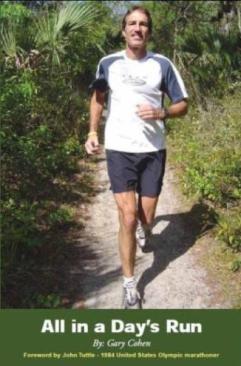 
"All in a Day’s Run" is for competitive runners,
fitness enthusiasts and anyone who needs a "spark" to get healthier by increasing exercise and eating more nutritionally.
Click here for more info or to order
This is what the running elite has to say about "All in a Day's Run":
"Gary's experiences and thoughts are very entertaining, all levels of
runners can relate to them."
Brian Sell — 2008 U.S. Olympic Marathoner
"Each of Gary's essays is a short read with great information on training,
racing and nutrition."
Dave McGillivray — Boston Marathon Race Director
|
 |
|
|
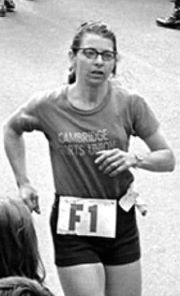
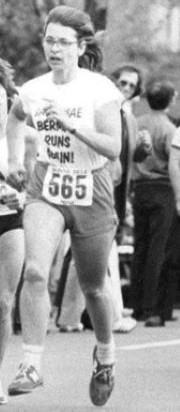
Sara Mae Berman is one of the ‘Pioneers of Women’s Distance Running’ and is best known for winning the 1969, 1970 and 1971 Boston Marathon prior to the addition of the Women’s Division in 1972. These championships were made official by the Boston Athletic Association in 1996 on the occasion of the 100th running of the Boston Marathon. Sara Mae’s other top finishes at the Boston Marathon were fifth place in both 1972 and 1973. Women’s track and field and cross-country were not widely available when she was a teen and young woman, and she was not involved in athletics. After marrying Larry Berman and having three children, he encouraged her to join him in his running avocation. She entered many road races unofficially and competed in both cross-country skiing and ski orienteering. The 1969 Boston Marathon was her first marathon. Sara Mae won the 1971 Plodders’ Marathon in Brockton and Avon in Massachusetts in 3:00:35, not realizing she had set a World Record. She finished the 1971 New York City Marathon in third place. Sara Mae was selected alongside Bobbi Gibb as the 2013 Boston Marathon Grand Marshalls. In 2015 she was inducted into the Road Runners Club of America Long Distance Running Hall of Fame. At the 2019 Boston Marathon, Berman was honored on the fiftieth anniversary of her first victory and fired the starter’s gun. Sara Mae and her husband, Larry, co-founded of the Cambridge Sports Union in 1962 and were publishers of Orienteering North America magazine from 1985 to 1999. She graduated from the Rhode Island School of Design with a Bachelor in Fine Arts degree in 1958, specializing in Interior Design. Sara Mae and Larry have been married seventy years as of December 2025 and reside in Cambridge, Massachusetts. She was very gracious in spending two hours on the telephone for this interview in March 2026.
|
|
| ゲイリー: |
THE BIG PICTURE What are your thoughts on being part of the ‘Pioneers of Women’s Distance Running’ with athletes like Bobbi Gibb, Jacqueline Hansen, Kathryn Switzer, Cheryl Treworgy, Joan Ullyot, Nina Kuscsik, Julia Chase Brand, and Miki Gorman that grew the sport and set the stage for the inclusion of the marathon in the Olympic program?
|
| SMB |
Now I look around the streets of Cambridge, which is where I live, and I see young women running, older women running, and they are in the streets training. I think, ‘This could not have happened if a bunch of us hadn’t done what we did in the 1960s and 1970s. Women running is now commonplace. When I went to register to vote, the clerks commented, ‘We used to see you running every morning.’ They seemed rather pleased. That was part of my training. Larry and I would run a mile-and-a-half loop around several city blocks or two loops for three miles. It took us twelve minutes to run a loop. If our kids needed us, they could come to the front porch of our home and yell to us as we would run by every twelve minutes.
|
|
| ゲイリー: |
In recent years, you have held a Boston Marathon ‘pajama party’ at your home for some of these women including Nina Kuscsik (rest in peace), Bobbi Gibb, Cheryl Treworgy, Ellie Mendonca, and Julia Chase Brand. How much fun is it to connect with these women who were part of the early stages of the growth in women’s distance running?
|
| SMB |
It is fun. I think the first time we got together was the forty-year anniversary of the first sanctioned Boston Marathon for women in 1972, so that would be in 2012. I don’t remember how it got started. We did have a queen size bed in a guest bedroom and also had a trundle bed that Ellie Mendonca had given us, so we could put up four women there. In a back bedroom there were bunk beds, so we had room for two more women. There was plenty of room for guests and it was fun. The relationship I had with these women was the same that Nina and I had. We supported each other and encouraged each other. The better we did, the better it was for the sport and for women in general.
|
|
| ゲイリー: |
For anyone under the age of 50 or 55, it is difficult to fathom the difference in sporting opportunities that girls and women had in the 1950s. Do you recall having your interest in participating in sports increasing from reading newspapers or watching television about the Olympics or professional men’s sports such as baseball, basketball, or football? What types of activities and sports did you engage in as a teenager that set the foundation for your later interest in running?
|
| SMB |
Women could only play half court basketball. I wasn’t a basketball player on a team but did play some. I didn’t play many sports. I didn’t follow the professional men’s sports and don’t to this day. I wasn’t interested in team sports. My interest in sports started with Larry. I became interested in cross country ski races, road races, and mainly individual races with women. Larry got me to pay attention.
|
|
| ゲイリー: |
When you were a young mother with three young children, how did your husband, Larry, spark your interest in running?
|
| SMB |
It was a long time ago – over sixty years ago. I have to relate the picture of where I was. My husband and I were married when I was nineteen and a half years old and he was twenty-one. We had three children by the time I was twenty-six. After a while, he looked at me and said, ‘Are you happy with the shape you’re in?’ Of course, I wasn’t, especially since the first two kids were only fifteen months apart and that is a lot of work. So, Larry said, ‘Let’s go run.’ He’s an MIT guy, so we went to the MIT track and brought the kids with us. We had a little portable playpen for the baby. It was a cinder track. We could see the kids, and they could see us as we went around the track and that is how I got started running.
|
|
| ゲイリー: |
Since Bobbi Gibb won unofficially in 1966, 1967 and 1968, and Kathryn Switzer is known for being the first official women’s entrant in 1967 as ‘K.V. Switzer’ and for her altercation with Jock Semple, were you overlooked a bit over the years despite your three wins in 1969, 1970 and 1971, and how exciting was it to be officially recognized as three-time champion in conjunction with the 100th Boston Marathon in 1996?
|
| SMB |
Kathryn and Jock became good friends later on. I was very, very pleased with the recognition at the 1996 Boston Marathon. I didn’t expect it. The Boston Athletic Association presented Bobbi Gibb and me with medals. On the back of my medal, it is engraved with my name and the three years I finished first. They call us ‘The Pioneer Era.’
|
|
| ゲイリー: |
Both you and your husband, Larry, participated in other endurance sports including cross-country skiing, orienteering and ski orienteering. How prominent in these other aerobic athletic pursuits did you become?
|
| SMB |
In the winter of 1968, I was working on cross country skiing with an aim to make the 1968 Winter Olympic team, but I jammed my big toe skiing in a ski race. I had good cardiovascular ability from my running, but my skiing technique was dreadful. I had hopes that I might be able to make the USA ski team, but it didn’t happen. They had named a national women’s cross-country ski team in the fall of 1968 and had a training camp in Colorado over the Thanksgiving week. I had to choose between going to this training camp or racing in the U.S. Cross-Country Championships in running. Larry and I decided I may have a better chance at the skiing training camp that was going to pick a team for a European tour. I had beaten several of the women who were there. I was thirty-two years old and the rest of the women were teenage girls. The national coach assured me that this was not going to be a Junior trip, and that they were going to select an Open team. I went to the training camp in Winter Park resort which is at 5,000 or 6,000 feet of altitude. There was less oxygen, but I was well-trained. By this time, another person had replaced the national coach. There was a team trial race, and I finished in fourth place. The plan was for them to select three skiers. The first-place woman was from Alaska. Second was Allison Owen, from Washington state, who wasn’t even named to the team before the training camp began, but she did very well. Third was a young girl from Jackson Hole, Wyoming, who was only thirteen years old. I didn’t think they would select a thirteen-year-old. Since I was fourth, I liked my chances as they looked good. In fifth place was a woman from Colorado whose father was the employer of the national coach. Guess who they took? They selected the winner from Alaska. They named the woman who came in fifth behind me to the team. In ninth place was a young lady from Vermont who was the protégé of the new national coach. So, she was selected for the team. That didn’t feel good. Then the coach came over to me and said, ‘Sara Mae, you aren’t going as it will be a Junior team.’ I felt like someone had punched me in the stomach. I had left my husband and children at home to participate and skipped the U.S. running championships because of the idea that this was going to be an open event, and it turned out not to be. That was extremely disappointing.
|
|
| ゲイリー: |
THE BOSTON MARATHON RACES – FROM 1969 TO 1973 Though women weren’t officially allowed to enter the Boston Marathon until 1972, since Bobbi Gibb and Kathryn Switzer had raced already in Boston, why didn’t you race when they did and why did you wait until 1969 to follow in their footsteps as an unofficial competitor?
|
| SMB |
When Roberta Gibb ran the 1966 Boston Marathon, I felt badly that she had and I didn’t. I wasn’t able to run the 1967 Boston Marathon, but I was happy that Kathryn Switzer ran it along with Bobbi Gibb. The following year, as I mentioned, I was working on cross country skiing with an aim to make the 1968 Winter Olympic team, so I didn’t train for the 1968 Boston Marathon. I had to wait a year for my toe to behave itself so that I could run the marathon in 1969.
|
|
| ゲイリー: |
As your first Boston Marathon in 1969 approached, what were keys in your training as far as weekly mileage, long runs, speed work and longer races that had you well-prepared for the Boston Marathon racecourse and distance?
|
| SMB |
Since I wasn’t named to the U.S. cross-country skiing team for that European tour, I had the whole winter to train for the 1969 Boston Marathon. That was okay. I knew I wouldn’t be running officially because women weren’t allowed, but I planned to cover the distance. Larry provided great coaching advice. He studied coaches such as Ernst Van Aaken, Arthur Lydiard and the methods of Tom Costill. One time Arthur Lydiard was in our backyard talking to teenage boys in our running club. Larry knew about the most advanced training programs. Once a week I would do a road race. The races were generally 10 kilometers or 15 kilometers, though occasionally, they were 10 miles or 25 kilometers. The purpose was for me to run faster than marathon pace since the race distances were shorter. The next day, Larry and I would do a long run of several hours. I didn’t run these too often on the roads. We ran on a local golf course and on woodland trails because running on the roads is hard on your knees and legs as there is a spring on the roads that increases your performance and pace. If you run on soft surfaces, there isn’t much bounce back so, when you do run on roads, it feels truly fast. Larry was training the guys in our club and me. Larry ran with me at the 1969 Boston Marathon and I ran 3:22:46. It turned out that I was the first woman, though not officially.
|
|
| ゲイリー: |
Did you know you were the first woman during the 1969 Boston Marathon and was there much recognition for you after finishing?
|
| SMB |
There was excitement and recognition for me. I finished and this big, burly reporter came up to me and said, ‘Why did you do the marathon?’ I thought to myself, ‘A thousand men are running this race, and I need to have an excuse?’ I was incredibly pleased.
|
|
| ゲイリー: |
What were the similarities and differences at the 1970 Boston Marathon since you knew the logistics and the course, but the weather was cold with rain?
|
| SMB |
For the 1970 Boston Marathon it was a cool day. Larry had looked at the weather forecast and it was projected to be in the upper forties. We only wore shorts and t-shirts, but the weather was colder than forecasted and only in the upper thirties. There had even been snow at the start in Hopkinton. I was cold. I ran with one of our club teenagers, Dick Moore. I had run one marathon, and this was Dick’s first one. So, Dick and I ran along. I was the experienced runner and we ran together. We were running pretty well. Previously, Larry and I were part of measuring the course accurately since it was being used as the 1968 Olympic Trials qualifier and needed to be accurate. I had driven the car while Larry and another club member, John, had their bikes calibrated and measured the course which was a bit long but within the tolerable margin of error. Dick and knew where the quarter mile marks and mile points were as we ran since I had been on the course measuring crew. There weren’t any official markings. We were running well but, with the cold temperatures and wind, I was very cold. Also, I wasn’t wearing a hat. I began scanning the crowd to see if anyone had some cheap looking gloves that I could beg from them. As we passed Wellesley College about halfway, Julian Segal, a local runner, came by and said, ‘How are you doing Sara Mae?’ He knew me from many road races. I said, ‘You were smart to wear gloves.’ He said, ‘Take them.’ So, he gave me his white cotton garden gloves. My hands were so cold that I pulled them on with my teeth. Dick and I were running along, and his hands were also cold. So, every half hour or so we would let each other wear the gloves and we traded them back and forth for the rest of the race. When we got to Kendall Square, there was Larry on the course. He had run a personal best marathon of 2:38:03 and ran back to me. Larry was surprised to see me so soon because I was faster than expected. Dick picked up his pace and took off while Larry ran in with me. A friend of ours took a picture of us running in as Larry was wearing his warm-ups, and I had on white garden gloves. It was extremely exciting. I ran 3:05:07 which was beyond belief as far as I was concerned. I couldn’t fathom that I could run that fast. Since the race officials were expecting some women to run, they had a place for us after the race which was the women ice skaters’ dressing room. I was tired and all they had were wooden benches for us. They gave me a blanket, and I lay down on the bench and rested a bit. At this point, Larry didn’t know where I was. This was when the race finished at the Prudential Center. I finally found Larry and he had my extra clothes.
|
|
| ゲイリー: |
How challenging and competitive was the 1971 Boston Marathon since Nina Kuscsik passed you after Heartbreak Hill and you had to switch mentally into competitive mode to fight back, pass her, and win again?
|
| SMB |
This was the first actual competition between two women to win the Boston Marathon. Late in the race, I was heading up Commonwealth Avenue toward Boston College. When I got to the top, all of a sudden, Nina Kuscsick and some of the guys from New York who were running, sailed past me. I didn’t want Nina to beat me, so I picked up the pace as much as I could. Eventually, I caught her on Beacon Street. I think I beat her by about half a minute. I ran about 3:08:30 and Nina ran around 3:09:00. Many of the journalists who have written about the history of the Boston Marathon acknowledge that was the first competition amongst women.
|
|
| ゲイリー: |
What was the atmosphere like the following spring leading up to the 1972 Boston Marathon and on race day since women were now officially allowed to enter and to race and eight women toed the starting line? How did that 1972 race play out since, as I understand, you weren’t in top form that day due to either an injury or sickness and you placed fifth?
|
| SMB |
It was satisfying that we were official runners. Unfortunately, I had influenza and a slightly elevated temperature of ninety-nine degrees. Larry said to me, ‘Why couldn’t you just get a blister or something minor?’ I responded, ‘The officials have always said that women were too delicate to run a marathon. It is a manor of honor amongst women that we don’t start unless we can finish.’ I ran 3:48, which was my slowest Boston Marathon. As an aside, the only time I ran slower was 4:03 in Atlanta in 98-degree heat. In 1972, it wasn’t a bad weather day, but I didn’t run well in another road race for a whole year. I had wiped myself out.
|
|
| ゲイリー: |
You followed that up with another fifth-place finish at the 1973 Boston Marathon. Since you were 37 years old and raising three children, how tough was it to focus on training and racing? Also, were you still not fully recovered from the previous year’s Boston Marathon?
|
| SMB |
I was ‘elderly.’ (laughing) But I was in a pattern of training, and it wasn’t like I was doing it alone. Larry was my training partner and my coach.
|
|
| ゲイリー: |
After a break of a few years, you raced three more times at Boston as a master’s runner, finishing in 1977 in 61st place in 2:28:45, in 1978 in 171st place in 3:44:13 and in 1979 in 232nd place in 3:28:04. Did the race organizers have official master’s results?
|
| SMB |
Even though I was a master’s runner, they didn’t have official results for that division.
|
|
| ゲイリー: |
TRAINING AND OTHER RACES What can you describe about your early training which focused on running a mile, then longer and longer distances and finally getting faster?
|
| SMB |
When I started running, eventually I was able to run a whole mile around the track and then two miles. I thought it was terrific that I had accomplished this. Then Larry told me that now I had to run faster. That was a whole new concept to me. This was in the early 1960s – a time when women were seen mostly as mothers and housewives, not as athletes. There were some Olympic athletes in the sprints but no longer distances.
|
|
| ゲイリー: |
What were your thoughts about running longer distances since this wasn’t a part of Olympic racing for women or included in U.S. national championships?
|
| SMB |
It’s a fact that, until 1958, the longest distance recognized by the AAU for women was 220 yards. That happened due to what occurred in the 1928 Olympics. They held the 800 meters for women in 1928, and it may have only been a demonstration event. There were eight or nine entrants who trained and finished well. But the newspaper reporters were disappointed because there was no drama to report from this new, long distance. Some of the women had finished with a sprint and collapsed in exhaustion and the news photographers took pictures that were published. The AAU and IAAF officials were upset because this looked terrible for women running this ‘long distance’ and they decided it wouldn’t happen anymore. Finally, in 1960 at the Rome Olympics, the 800 meters was included in the Olympic program. So, the AAU had to ‘get religion’ and start increasing the race distances for women so our country could compete in this newly approved Olympic distance. In 1962, at the AAU convention, a program on women’s cross country running passed beginning in the fall. The distance was supposed to be a mile-and-a-quarter. Convention attendees trained their athletes for that distance. However, coaches who read the rule book trained their athletes for a mile-and-a-half as there was a typographical error due to the design of the old typewriters. The small finger on your right hand pressed on a fraction key when you also held down the shift key. Somebody didn’t execute this properly and, instead of the quarter fraction, the rule book had a half fraction. So, the rule book had the distance at a mile-and-a-half. Nobody died running that distance, so they used that distance. Throughout the 1960s the distance gradually increased to two-and-a-half miles for cross country.
|
|
| ゲイリー: |
How long did it take before you were able to step up your training runs to three and then five miles and what was your typical pace per mile?
|
| SMB |
I wasn’t worried about all those rules and distances that the AAU was prescribing. I ran longer and longer under Larry’s guidance until I could run five miles and survive in one piece. I was enormously proud of myself.
|
|
| ゲイリー: |
Since Larry was an accomplished marathon runner who eventually achieved a personal best under 2:40, averaging around six minutes per mile, what type of track sessions did Larry have you do to work on your speed?
|
| SMB |
Again, Larry told me that now I should work to run faster. This wasn’t something that a proper mother and matron thought about doing. Larry knew what he was doing, so I agreed that it was a good idea. We worked on increasing my speed and Larry had me doing some repeat 220-yard intervals at the proper pace to run five miles under forty minutes. That was my goal – eight-minute mile pace. When I was running around the track, I just couldn’t do it.
|
|
| ゲイリー: |
What can you relate about your first race, a five-miler in Marlborough, Massachusetts, that you had to run unofficially, since women weren’t allowed to enter races with men, and how pleased were you to run under eight minutes a mile in 38:37?
|
| SMB |
Since I wasn’t getting faster on the track, finally Larry said, ‘We have to go to a road race. There will be lots of guys running around you and that atmosphere is worth forty seconds per mile.’ I thought that would be terrific. It sounded simple – run in the race with lots of people around me and I would improve forty seconds a mile. But it also sounded like a miracle. The five-mile race that Larry chose in Marlborough, Massachusetts was a handicap race. The slower runners started first. So, I was on the starting line with two old men in their late fifties and two young teenage boys. The race started and I was trying to run the pace that Larry had me run on those 220-yard intervals. Eventually, the runners in back of us began to catch up with us. As guys passed me, they were terrific and said nice things. ‘Hey, you’re doing good,’ ‘Nice going,’ and ‘Keep it up!’ If they had been mean, I would have had a totally different experience. But they weren’t. They were encouraging. They were pleased to see me in the race. I heard, ‘I wish my wife ran’ and ‘I wish my girlfriend would run.’ It was a wonderful experience. When I ran 38:37 for the five miles, I thought, ‘I did it!’
|
|
| ゲイリー: |
Since you were racing unofficially, results from the races you ran are impossible for me to find. What can you relate about some memorable races over the next few years as far as the courses, distances, and your times as you improved your fitness and raced more strongly?
|
| SMB |
I ran many other road races throughout the 1960s. We had to assume that the race distance was what the race organizers stated, though that wasn’t always the case. There was one race in a small Massachusetts town that I remember. I was running along and the guys were very pleased that I was running. We turned from the main road into a residential neighborhood and there was a bar on the corner. Some of the beer-belly guys came out and began to make nasty comments about me. The guys I was running with peeled off and chased them. I shouted, ‘Don’t do that! You’ll wreck your time!’ One thing I learned from road racing with the men is that long distance runners respect each other. You can’t cover the distance unless you have done the training, so they respect each other’s training. In the early races, I would finish in the last third of the runners. As time went by, I would finish in the last half. Later on, I began to do well, and I would finish in the top half of the competitors.
|
|
| ゲイリー: |
I’ve raced fifty marathons including twelve Boston Marathons, including my 2:22:34 personal best, and I am always interested and fascinated by others’ training. We all get to the starting line with many similarities and some differences in our preparation. Were you training seven days per week and what was the training flow in a typical week?
|
| SMB |
We were running as much as we could together. We would plan our workouts and have a day with some type of intervals and there would be days of straight distance. For example, our house is three miles from Fresh Pond. We would run up to Fresh Pond and back home for six miles. Sometimes, in addition to running the round trip to Fresh Pond, we would add a run around the pond and a little bit more which made the run a total of nine miles. When I was adding distance, sometimes I would run twice a day. I ran three or six miles in the morning and then six or nine miles later in the day. I built up my milage from thirty miles a week to seventy miles a week and more. In 1970, in the month before the Boston Marathon, I ran two weeks of eighty plus miles each. One of the patterns of our training is that we would run in a race on Saturday and do our long runs on Sunday. The purpose of the road races was pace. I was running at a shorter distance, but faster pace than in a marathon. The thought was that this would make the marathon pace feel comfortable.
|
|
| ゲイリー: |
Nina Kuscsick and you competed in many races together in the late 1960s and early 1970s. Did you enjoy the friendly competition and what do you recall of the 1970 Road Runners Club of America Marathon, which was sanctioned by the AAU, held in Atlantic City as you won in 3:07, five minutes ahead of Nina in 3:12?
|
| SMB |
We absolutely had a good relationship. There were no hard feelings between us. Both of us pushed the other to be our best in competition. There was mutual respect. We didn’t get mad at one another when we didn’t win. We kept pushing one another to do our best.
|
|
| ゲイリー: |
As women approached breaking three hours in the marathon, you came very close in 1971 at the Plodders’ Marathon in Brockton and Avon in Massachusetts, as you won in 3:00:35. What were the key points in racing your personal best that day and coming close to being the first woman to break three hours and how cool was it to break the Women’s World Record, which you held for three months?
|
| SMB |
That race was only a month after the 1971 Boston Marathon. It was enough time to recover for the most part, but maybe not quite enough time to recover fully. The temperature that day was in the lower to middle sixties which wasn’t ideal for optimum performance. We hoped for weather in the fifties. Larry ran with me and, in the last 600 to 800 yards, he said to me, ‘Sara Mae, if you are going to break three hours, you have to go for it.’ I pressed on and sped up as much as I could. I finished and collapsed. I may even have fainted. The race organizers knew I had run a good race, but I don’t know if they knew it was a World Record. I didn’t even know that it was a World Record. Again, all the guys in the race were friendly and supportive.
|
|
| ゲイリー: |
A few months later, at the 1971 NYC Marathon, which was run in several laps around Central Park, Beth Bonner won in 2:55, and Nina Kuscsick was second in 2:57 as you finished third in 3:08. Though you were behind Beth and Nina, how exciting was it to be a part of the first marathon when women went under three hours?
|
| SMB |
Yes, they both broke three hours which I never did. On one hand, I was very pleased for them. On the other hand, I wasn’t pleased with myself. I believe we ran four laps of six-and-a-half miles around Central Park. I never ran the New York City Marathon when it was run through all five boroughs. It was brilliant from the race organizers’ point of view to make it a five-borough race as it was good for the sponsors and so many more people were attracted to the marathon when it went through all five boroughs. That was smart of the New York Road Runners.
|
|
| ゲイリー: |
MISCELLANEOUS AND WRAPUP What are fond memories of the 1964 Olympics in Tokyo which Larry and you attended as spectators?
|
| SMB |
It was extremely exciting. This trip was a present from my parents. We hitched on with the Track and Field News tour. They arranged for us to stay at a Japanese lodging called a Ryokan which is a traditional Japanese inn. We were able to see some of the sights of Tokyo. It was sensational to see a place so different from what we knew in the United States. Larry and I ran through a park, came back and our bath was ready, and then had breakfast. At our hotel, the tour arranged an early breakfast for those of us who were going to the stadium. We took the subway from our hotel to the stadium. The 10,000-meter final was the first final event that we saw. The competitors were running around and around and around. The track was a cinder track, and the inside lane was all chopped up because everyone was running in that lane. Billy Mills wasn’t on any of the reporters’ horizons to possibly win. At one point near the end, Billy was pushed toward an outer lane and we saw this happen. Those lanes were not chopped up and he took advantage of that, zipped through, and won. That was so exciting. Bob Schul won the 5,000 meters and his parents were staying in our hotel. One evening, there Bob was with his parents showing them his Gold Medal. We were thrilled. I don’t think we met any other athletes or their families. We did buy an entire case of running shoes in Japan for our running club members because we couldn’t find them reasonably priced in the U.S. Also, the available running shoes back home weren’t made as well. So, we had the case of shoes shipped to our home to supply the teenage members of our club with nice running shoes.
|
|
| ゲイリー: |
Larry and you competed in Nordic skiing and orienteering events, organized women’s cross-country races since the early 1960s, and in 1962 formed one of New England’s oldest running clubs, the Cambridge Sports Union and publishers of Orienteering North America magazine from 1985 to 1999. Is it neat that some refer to you as America’s First Couple Of Aerobic Exercise?
|
| SMB |
They didn’t call us that in person. Larry learned about sports and exercise in school. He was a poor kid who earned a scholarship to Phillips Exeter Academy. Part of the program at Phillips Exeter was participating in sports. He tried many sports and found that he was good at cross-country running. He advanced from there. When he went to M.I.T. he ran and ended up as Captain of the M.I.T. cross-country team. I knew him starting when he was a sophomore at M.I.T. I was the unofficial team mascot and watched Larry and his team when they were running. When Larry encouraged me to run, it wasn’t strange. He was an M.I.T. and he must know what is important. We married when I was nineteen-and-a-half and he was twenty-one. It sounds young, but couples did get married at younger ages in those days. He was an M.I.T. man and my parents were very pleased.
|
|
| ゲイリー: |
From 1971 to 1980 the number of fast women’s marathon performances grew from less than ten sub-3:00s each of the first few years to hundreds of sub-3:00s and nearly 200 sub-2:50s in 1980. Could you believe how many fast women there were running marathons?
|
| SMB |
It’s not surprising. When we look at shorter distances and how much women’s times improved for ten kilometers, ten miles, and fifteen miles, as more and more women competed in these races, times improved. First there were women who thought they could do it. Then there were women who were more talented. I remember when Joan Benoit Samuelson ran 2:22:43 in 1983 to win the Boston Marathon which was a new record for the fastest women’s marathon.
|
|
| ゲイリー: |
Sara Mae, I remember that because my marathon personal best was 2:22:34, nine seconds faster and I thought, ‘Well, no woman has still run faster than me.’ Though a year earlier, the first time a woman beat me at any distance occurred at the Orange Bowl 10k when Grete Waitz finished ahead of me and I thought, ‘Okay, if the top women in the world can beat me, that is alright.’
|
| SMB |
Shame on you (laughing). Of course, all the top men were ahead of me. Here is a funny story that has a similar thought process. I was running a race, I think in New Bedford, Rhode Island, and I was running along at a good clip. I passed a teenage boy who eventually caught up with me. ‘No woman is going to beat me!’ He charged ahead. But I caught him later in the race and finished ahead of him. I was running steadily and he was doing surges. He wasn’t pleased but I said, ‘I trained more than you.’ In the future, I was running in a three-mile road race in new Hampshire and this same teenage boy passed me. After the race, he told me, ‘I trained better.’ He wasn’t mad at me anymore. He understood.
|
|
| ゲイリー: |
Based on your own running background, when novice runners find that they have a previously unknown aptitude to run well, what are the most important elements of training that will help them to step up to the next level?
|
| SMB |
I can only give advice based on how Larry treated me. He didn’t have me running two miles and then start running ten miles. We gradually increased the distance by half an hour at a time. Runners can’t advance too fast or they will sustain injuries. Our bodies have to get used to what we are now doing.
|
|
| ゲイリー: |
I live in Florida where we have to put up with a lengthy period of heat and humidity where dehydration is a factor. You trained in Massachusetts where you had months of cold, wind and snow. What advice can you give on successful training strategies in the winter with regard to building mileage, completion of long runs and intense workouts?
|
| SMB |
In the winter I did mainly cross-country skiing. I did some running, but I did not run in slippery icy conditions because that puts stress on our Achilles tendons.
|
|
| ゲイリー: |
Since you aren’t running now due to a combination of a knee replacement, age, and focus on cross-training, what do you miss the most about running? Also, can you describe your cross-country skiing?
|
| SMB |
Running feels so good. We ski locally at a golf course that is about a twenty-to-twenty-five-minute drive from Cambridge. We ski on grass in the summer and on snow in the winter. They have snow guns to make artificial snow. This winter we also had three good snowstorms. We ski once or twice a week. Three days this winter we have gone to Waterville Valley in New Hampshire There is a good downhill skiing area, that we don’t use, but there is also a wonderfully groomed cross country skiing area. Larry and I ski classical form versus skate form . The classical style is a walking style to propel forward that utilizes two tracks that have been cut into the snow. The other style is like ice skating back and forth on one ski at a time and is faster than the classical style. Larry and I ski classical style. At the 2026 Winter Olympics, this was the first time that a fifty-kilometer race was included for women. A local young lady, Jessie Dinkins, finished fourth and we are immensely proud of her. I skied fifty kilometers in 1971. I was almost thirty-five years old. The men’s national championship was originally scheduled for Colorado but the temperature on the day of the race was fifty-five degrees. The snow was what we called ‘mashed potatoes’ and wouldn’t provide a fair surface for such an important champio0nship. The race was postponed from January to February. The U.S. team coach was John Caldwell, who I believe was on the Olympic team in 1956. He offered to host a replacement championship at the Putney School in Putney, Vermont where he was a teacher and ski coach. The course was six loops of between eight and nine kilometers to make the appropriate fifty-kilometer distance. Since Larry and I lived close by, only about a three-hour drive away, we decided to go to the race. When we signed up, John said, ‘This is a men’s race, and you can’t compete in it. I’ll let you ski in the college men’s race which is twenty-six kilometers.’ I said to John, ‘Are you going to stand in the track and stop me when I come through?’ He said, ‘No,’ and I did the whole fifty-kilometer race. Not only did I complete the entire distance, but my last lap was also faster than Larry’s last lap, though he beat me by twenty-five minutes. Additionally, I beat about five guys. There weren’t qualifications, just open entries. The winner, Bob Gray, finished in two hours and twelve minutes. Larry did around 2:58 and I did 3:22 or 3:24. And there were guys in back of me! I was very pleased.
|
|
| ゲイリー: |
You were selected alongside Bobbi Gibb as the 2013 Boston Marathon's Grand Marshals. How neat was this recognition?
|
| SMB |
Not only were we the Grand Marshalls, but we were also lucky to not be near the marathon bombing incident. It was a frightening moment. It was fun for Bobbi and me to be the Grand Marshalls. We rode in an open car. It was fifty-five degrees. There was a breeze since it was an open car, so I wore a wool suit with a vest underneath to keep warm. In pictures, you will see that I am wearing a fedora hat. I bought that hat in Germany, and it I made of wool
|
|
| ゲイリー: |
A couple of years later, in 2015, you were inducted into the RRCA Hall of Fame, National Distance Running Hall of Fame. How neat was that since your main running accolades were done unofficially?
|
| SMB |
It was extremely sweet of them to consider me. In the running community it is meaningful. To the general public, it is an interesting factoid.
|
|
| ゲイリー: |
In 2019, you were recognized on the fiftieth anniversary of your first Boston Marathon win along with Joan Benoit Samuelson and Bill Rodgers on the fortieth anniversary of their 1979 win, and Meb Keflezighi on the fifth anniversary of his 2014 win, plus you fired the starter’s pistol. How surreal is it to be honored with these all-time great athletes and to fire the starter’s gun?
|
| SMB |
I must tell you that I was honored to meet Meb Keflezighi. I am honored to know Bill Rodgers and Joan Samuelson. This also reminds me of a picture that was taken at the 100th Boston Marathon in 1996 of former champions. There are many sitting up front and a line standing in the back. It’s easy to spot me because I am wearing a red outfit.
|
|
| ゲイリー: |
What have been the positive effects of the discipline and tenacity learned from running on other aspects of your life? Or do you think we have that discipline in us already and it contributes to us being a runner?
|
| SMB |
They go hand in hand. At this point in life, I’m not trying to go faster. I try to exercise longer. The faster running and skiing were a long, long time ago.
|
|
| ゲイリー: |
Are there major lessons you have learned during your life coming out of the Great Depression and World War II, from taking the plunge as a pioneer of women’s running while you had three children, the discipline and mental fortitude necessary to race at a high level, and adversity you have faced, that you would like to share to help people to be successful in athletics and successful in life?
|
| SMB |
I hope that people can plan a program that is sensible. As I said, Larry always had me increase my distance gradually. He also had me increase my interval training gradually and not all at once. Sometimes he would have me run intervals at an odd distance such as 600 meters rather than a quarter mile so I could extend my pace for more distance and to improve in that way. An athlete has to get a good coach or read up on the methods of the good coaches.
|
|
| |
Inside Stuff |
| Hobbies/Interests |
I went to the Rhode Island School of Design. My specialty is Interior Design, which means that I plan interior spaces. I have applied that to my own home. You should see my kitchen and dining room. It truly works. I like to cook and bake and am good at both. If you are ever in the area, let me know and we will treat you to supper
|
| Nicknames |
I never had nicknames. You told me that Jack Welch, the running author, called me ‘The Notorious SMB’ but I’ve never met him. I did have a high school friend named Jack Welch
|
| Favorite movies |
I haven’t been to a movie in quite a while. Larry and I are operetta lovers. We are Gilbert and Sullivan afficionados
|
| Favorite TV shows |
I like MASH, with both Colonel Blake and Colonel Potter. It depends on the story. Larry Linville, who played Frank Burns, was quite a character. Loretta Swit was wonderful. Alan Alda was good. I love that show to this day. We have a show that is aired locally called ‘Mysteries of the Museum’ that I like. The host goes to museums, finds odd artifacts, and explains what they are and their history. I also like ‘Modern Marvels’ which discusses advances in technology and is very interesting
|
| Favorite music |
We like opera. I’m crazy about Mozart operas though there are many operas that are pleasant to listen to. As I said, we like the Gilbert and Sullivan operettas. Larry and I both sang them in school. The music director at one school invited all the eighth-grade students to a presentation on ‘Gilbert and Sullivan’ and that is when I was introduced to it. When I found out Larry liked it, that was terrific
|
| Favorite books |
Books by Jane Austin, Agatha Christie, and John Grisham
|
| First cars |
Larry and I were given a car from my parents so we could drive back to Manchester, New Hampshire where my dad and mom lived. It was a Chevy, but I don’t remember the year. We got a Volkswagen van in 1960, and we could convert part of it into a sleeping area when we took our kids on trips
|
| Current car |
We have a small business selling orienteering supplies. We started in sports with running, added skiing, and then orienteering which combines both. Now we go to big meets, put the Caravan seats down to the floor and store the supplies we have for sale, including equipment, shoes, and clothing
|
| First Jobs |
I did some babysitting. Do you know how long ago that was? Over seventy years ago. When Larry and I were newly married and living in Boston, I worked at one of the department stores for the summer. I went to school, but not during the summer
|
| Parents, Siblings, Family History |
I am the oldest of five children and was born in 1936. My brother, Eugene, was born in 1938 and shortened his name to Gene. Then our family moved our business, Pandora Sportswear and Sweaters, from New York to New Hampshire. A large factory space had opened up because the previous company had gone bankrupt. Also, in New York the mafia was giving my parents trouble. When my grandfather heard about this open space in New Hampshire, he found that the bank who held the mortgage was anxious to rent it out on the cheap. There were many textile workers who didn’t have jobs, who were happy to work at my parents’ business in rural New Hampshire. They had an extraordinarily successful business. My mom helped out as she was a very bright woman. Pandora became a well-known name in the fashion industry. My grandfather maintained the fashion showroom in New York City and my dad ran the factory in Manchester. My next brother, Ralph, was born in 1944, though he has passed away. Then two sisters were born later, Rebecca Lee in 1947, who died of cancer in 1974, and Martha Jane, born in 1949. I was thirteen when she was born and wanted her to be named Miriam, but my mother named her after a family friend. I picked her nickname, which I first wanted to be Marty, but then went with Mickey. When she became an artist, she changed her name to Michella Storid. That is how she is known now and she is a weaver. She does tapestries, is well known in the field, has published a book, and has a second book being issued this spring So, there are three of us left. My father’s name was Saul Sidore. My mother didn’t like the S.S. initials, so she added an ‘O’ in the middle that didn’t stand for anything, but dad’s initials became ‘S.O.S.’ My mom’s name was May Sidore. My dad died in January of 1964, and I attribute that to my grandfather who didn’t treat my father very well. He tried to promote my mother’s younger brother as the ‘Prince’ to be anointed, and my uncle did not do very well despite many chances in business. My grandfather couldn’t see his daughter’s husband, my father, as head of the family business. The pressure was too much for my dad who had heart trouble and passed away. Then my mother took over the firm and bought out her brother and father. My mother remarried in 1967 to a genuinely nice man name Sam Gruber. Sam was a widower and his wife had died the previous June. She brought two daughters to the family. Mimi, with her husband, lives in New York. Lisa lived on the west coast and had since passed. Mom ran the company with the executives that my father had hired and trained. She ran the firm until she sold it nineteen years later in 1983
|
| Children and grandchildren |
Our oldest daughter, Pandora Beth, was the first granddaughter for my parents. Our second child is a son named Alexander and we call him ‘Sandy.’ We named him after my husband’s father who was still alive. Larry’s family was shocked as people at that time weren’t supposed to name a baby after a living relative. That supposedly meant you wished them ill. That wasn’t the case as we wanted to honor Larry’s dad. Larry’s dad, Al Berman, was thrilled. In fact, Sandy calls himself Alexander Berman the Second. Sandy was married for over thirty years to Nancy before they divorced at least eight years ago. They had three children. The oldest is Christopher but he calls himself Knute now. He belongs to a reenactment group. The next child is Nick, and he studied Biology in School. Nick lives in Westboro and works for Moderna. The youngest is Zohar. She lives in Roxbury with her cousin and works for the Boston Workers Circle which is a charitable organization which does good works and promotes the Jewish culture. Nancy was Methodist and all three kids went to church with Nancy. But some of them have chosen to honor Judaism. Sandy works for a company that makes machinery for the paper industry. They make machines that make big rolls of paper. His company was initially located in Nashua and then was taken over by a Canadian company. Afterward, they were bought out by a Finnish company and Sandy found himself travelling in different parts of the world because the paper industry is where the trees are. His company has a main office in Karlstad, Sweden. When Sandy was there, he went to a party with a co-worker and met his friend’s sister, Analee. They fell in love and were married in our living room by one of our city counselors who is a Justice of the Peace. Sandy and Analee live in Karlstad. Sandy travels to India, Australia, China – you name it, wherever there are trees Our younger son is Jonathan. He was married to a nice lady named Doria. They had three girls but eventually they divorced. Jonathan is now living in western Massachusetts. He is an accountant and works for a small accounting firm in Adams, Massachusetts. Doria maintains a home for the three girls. One lives in Brighton with some friends, one is still in college, and the older daughter is a Special Needs Art teacher in Randolph
|
| Pets |
Larry had a dog when he was growing up. Our son, Jonathan, had a pet rat and a gerbil. We have a big side yard to our property so there are many birds, rabbits, and a cat who wanders in every now and then. We have a small vegetable garden and had to put chicken wire around it. First, we had plastic mesh, but the rabbits ate through it and that is why we switched to chicken wire
|
| Favorite breakfast |
Generally, I have yogurt with some fruit and a little bit of jam in it. Larry makes a wonderful pot of oatmeal that is to die for. I add dried cranberries to it
|
| Favorite meal |
I make many nice dinners. I make spaghetti sauce ahead of time. I make big batches and freeze them. I make big batches of stew and freeze pint containers of the stew. I bake cakes and put them in the freezer. I am fond of seafood. I like clam chowder and, if you give me a lobster roll, I am happy
|
| Favorite beverages |
Milk and fruit juice
|
| First running memory |
When Larry encouraged me to start running
|
| Running heroes |
There were no women running longer distances. Of course, Larry was my hero. He was not only a good guy, but his training was sensible as he used the advice of the good coaches – Arthur Lydiard, Ernst van Aaken, and Tom Costill
|
| Memorable Running Moments |
There were many times when I was running in road race with the guys that I was pleased with my performances. I was able to keep up with and even pass some of the guys. But there were no hard feelings as we were pushing each other to do our best. That is the difference between running and a team sport where you beat up each other like in hockey or football. Running is a very cooperative event. When you mentioned about me running the World Record marathon, I didn’t even realize at the time that it was a World Record as things were kind of ‘loosey goosey’ back then. There were also a number of women’s cross-country races where I did well and set course records, but I don’t remember them all
|
| Most disappointing running moment |
At the 1972 Boston Marathon, I knew I couldn’t run my best since I was sick. I wanted to be a challenger, but all I could do was to finish. There was an unspoken pledge amongst the early women runners that we didn’t go to race unless we would finish
|
| Childhood dreams |
I wanted to be a mother. I was born in 1936, so I was a teenager in the late 1940s and into the 1950s. Women were wives and mothers. Larry showed me a whole new view of the world and of myself. He is awesome
|
| Favorite places to travel |
We like to go to places with activities like skiing. We like Sweden as it is nice. When we had the orienteering magazine, we did quite a bit of travelling. In 1985, the World Championships of Orienteering were in Australia, so we went there. We went to Bulgaria in 1986 for the championships. In 1987, the championships were in France. We went to Italy, Finland, Norway, Germany, Scotland, Sweden, Austria, Czechoslovakia, Hungary, and many nice countries. We had a nice marathon friend in Hungary, Sarolta Monspart. She was the first non-Nordic to win the World Orienteering Championship, which she accomplished in 1972, and she was also a world class marathon runner. We stayed in Budapest in a sport hotel on an island in the middle of the Danube and stayed with an athlete near Lake Balaton. We participated in an orienteering event in a place called Balasz de Juman. We also did much travelling around the United States and Canada when we covered the orienteering sports for our magazine. We were still young enough to appreciate what we were doing and where we were visiting
|
| Final comments from Sara Mae |
The other ladies who were early women runners along with me share a bond. We all did our best at a time when we were not allowed to be official entrants. I wouldn’t have been where I am without my husband, Larry. He is an incredibly special guy. Not only was he a poor guy who earned a scholarship to Phillips Exeter, but he also earned a scholarship to M.I.T. He is a sweetheart. Larry worked on the Apollo Moon Landing Project from 1962 to 1972. We have been married for seventy years as of December 2025
|
|
|
|
|
|
|