|
|
|
 garycohenrunning.com
be healthy • get more fit • race faster
| |
|
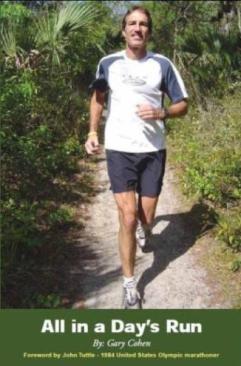 
"All in a Day’s Run" is for competitive runners,
fitness enthusiasts and anyone who needs a "spark" to get healthier by increasing exercise and eating more nutritionally.
Click here for more info or to order
This is what the running elite has to say about "All in a Day's Run":
"Gary's experiences and thoughts are very entertaining, all levels of
runners can relate to them."
Brian Sell — 2008 U.S. Olympic Marathoner
"Each of Gary's essays is a short read with great information on training,
racing and nutrition."
Dave McGillivray — Boston Marathon Race Director
|
 |
|
|
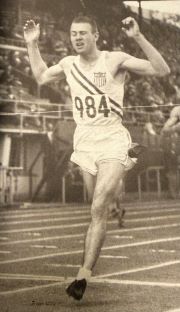
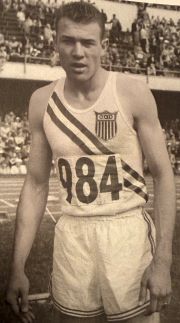
Thane Baker is a four-time Olympic medalist who first earned a Silver Medal in the 1952 Helsinki, Finland Olympics in the 200 meters. In 1956 at the Melbourne, Australia Olympics, he earned a Silver Medal in the 100 meters, Bronze Medal in the 200 meters, and Gold Medal in the 4 x 100-meter relay as he and his U.S. teammates set a World Record of 39.5 seconds. Baker set the World Record of 29.4 seconds for 300 yards. He tied World Records at 60 yards indoors twice in 6.1 seconds, 100 yards in 9.3 seconds, 200 meters twice in 20.6 seconds, and 100 meters in 10.2 seconds which equaled Jesse Owens – all on cinder or dirt tracks. Thane earned the Silver Medal at the 1952 U.S. Olympic Trials at 200 meters. At the 1956 U.S. Olympic Trials, he scored the Bronze Medal at 100 meters and Silver Medal at 200 meters. At the U.S. Championships, Thane earned a Gold Medal in 1956 at 200 meters, a Silver Medal in 1953 at 100 yards and Bronze Medals in 1953 at 220 yards and 1956 at 100 meters. At the 1953 NCAA Championships he finished first at 220 yards and second at 100 yards. Thane was an All-American in both sprints at the 1951 and 1952 NCAA Championships with a best finish of third place at 200 meters in 1952. He won twelve Big Seven Conference Gold Medals at 60 yards indoors (1951, 1953), 440 yards indoors (1953), 100 yards outdoors (1951, 1952, 1953), 220 yards outdoors (1951, 1952, 1953), and in the mile relay (1952 indoors, 1952 and 1953 outdoors). At the Kansas Relays, Thane won the 100-yard dash in 1951, 1952 and 1953 while anchoring the mile relay champs in 1953. After turning forty, he set World Records in 1982 in the M50 age group of 11.3 in the 100 meters and 23.4 in the 200 meters and was 1983 World Champion M50 in 100 meters and 200 meters. His personal best times are: 100 yards – 9.4; 100 meters – 10.2; 200 meters – 20.6; 220 yards (straight) – 20.4; 300 yards – 29.4; 440 yards – 47.1; 4 x 400-meter relay – 39.5. Thane was inducted into the Kansas All-Sports Hall of Fame in 1975, Kansas State High School Activities HOF in 1977, Kansas State HOF in 1999, and the Texas Track and Field Coaches HOF in 2011. He was selected ‘Outstanding Official’ by the Texas Relays Committee in 2010 and had his hometown track named after him in Elkhart, Kansas. The Thane Baker Invitational annual indoor track and field meet has been hosted at Kansas State since January 2025. Thane graduated from Kansas State in 1953 with a degree in Economics Education, served in the U.S. Air Force and Air Force Reserve, and had a 39-year career with Mobil. He was married for 66 years to his wife, Sally, who passed away in 2020, and now resides in the Omaha, Nebraska area. Thane was very gracious to spend over two hours on the telephone in August 2026 for this interview.
|
|
| GCR: |
THE BIG PICTURE Thane, thank you for agreeing to do this interview. First, how has being an Olympian and a four-time Olympic medalist impacted your life for over 70 years as far as opening doors and credibility as an athlete since you are once and always an Olympian and a four-time Olympic medalist?
|
| TB |
I didn't run very well in high school. Afterwards, I went to Kansas State and asked the coach if I could go out for the track team. Three years later I was on the Olympic team. In college I was not on scholarship other than for my tuition which paid $67.50 a semester. I had to work while I was in college and I mopped in the laundry for $10 a week. I did that seven days a week. I also wash dishes in a fraternity house. I sold programs at the football games and did any other work I could do for $0.50 an hour. I appreciated the opportunity to run. I had to work my running in around my school studies and other activities including I was vice president of the student council and president of the K-Club. I was busy and didn't get much sleep, but I wouldn't change a thing. I worked for Mobil research and development for most of my career. I was not an engineer but was a manager of materials and transportation. The fact that I was an Olympian wasn't really brought up much. I was busy with my career and the only time I really took some time off was when I took 30 days off when I ran in the master's program after I turned 40 years old and I toured Europe. As to how my Olympic credentials affected my life, it opened a lot of doors mostly through speaking engagements. I have spoken in front of classes of about 100 students of every age. I've spoken to Rotary clubs and Lions clubs and that's been a lot of fun, and it affected my life but it's not as much in some ways as you might think. That has been a wonderful situation in my life, but I also had a beautiful marriage for 66 years to a wonderful lady. We traveled a lot during our lives, and my track and field time was in the background more or less.
|
|
| GCR: |
After your athletic career, how did the characteristics you learned from athletics such as structure, discipline, tenacity, and overcoming adversity, serve you well in the Air Force, the Air Force reserve and in your career in the petroleum industry?
|
| TB |
I used a systematic approach to running. I had about 15 elements of what I was going to do as I ran around the curve. I had a number of racing aspects that I did when I was sprinting after the curve. I did many exercises to enhance my ability to succeed. I also did push-ups and other exercises. Back then we didn't have the knowledge that they do now. Athletes today know the muscle groups to develop. I did quite a bit of that back in my day and I was the only one who was doing some of this extra exercise routine. So, I structured my life systematically and what I used in track and field I also used in life. I was very busy and had to budget my time systematically. I had a great coach when I was running. Everything was regimented to a degree in running and was systematic as was the rest of my life.
|
|
| GCR: |
My dad was born the same year as you in 1931, though he passed away six years ago. It makes me think of what my mom and dad instilled in me. How did the example and characteristics of your father and mother, Walt and Susie Baker, help forge you into the person who was bent on being your best in all you do and especially in athletics?
|
| TB |
My mother always told me to remember that no matter how good I thought I might be at something, there was somebody around the corner who was just a little bit better. She told me, ‘Whatever you do, do it the best you can. I don't care if you're digging a ditch, dig it straight and dig it deep. Do everything the best you can in life.’ My father's education only went through two years of high school, and he left at age fourteen to help support his family and was working three jobs. My mother was an athlete and was a softball pitcher back in her day, so I had that sports connection. She was a mean horseshoe pitcher! We used to have many competitions pitching horseshoes. My parents did not spare the rod when it was necessary to use it. The worst thing was that I had to go out and find the switch. It couldn't be too brittle. It couldn’t be too big. But I had to go out and find it before I got a spanking.
|
|
| GCR: |
What are your biggest memories of the Opening ceremonies of the 1952 and 1956 Olympics as far as the fanfare, crowd excitement, athlete camaraderie, and the weather? And were you able to attend the closing ceremonies in 1956 as I know you missed in 1952 due to post-Olympic competitions in Europe?
|
| TB |
After the 1956 Olympic competitions, I was in Sydney, Australia and another couple cities for some exhibition meets while the games continued and finished. So, I didn't get to participate in that closing ceremony after not participating in the previous one in 1952 in Helsinki. We arrived a couple weeks early for the 1952 Olympics, were in the Olympic village and had a good track to train on. The weather was wet and cold for the Opening Ceremonies. Some of the track and field athletes did not participate in the Opening Ceremonies but I did. We stood there in the rain and got wet. I was wearing white buck shoes. The track was composed of red brick dust, so our white shoes turned red by the end of the parade. Another item of interest is that our uniforms were supplied by the American Wool Growers Association. We had wool jackets and wool pants that we wore in Helsinki after wearing them in parades in New York City before we left and we were perspiring. In fact, in New York City we listened to the governor speak for quite a while and sweat was rolling down our face because it was so hot. But back to the Opening Ceremonies in Helsinki which were really something for a 20-year-old kid from Kansas to be a part of. At one point, they released a flock of pigeons which flew over. We were standing in formation by country until Paavo Nurmi ran in with torch. Everyone ran over to the track to take pictures. Paavo Nurmi was running around the track, and I remember him having to dodge athletes. Then we went back into our team ranks and stood listening in the rain to many speeches. It was very emotional for me to think back to when I was a kid dreaming of running in the Olympics after I met Glenn Cunningham, the 1936 Olympic silver medalist in the 1500 meters who was from my area. I was stationed over in Germany, and I got a letter from superiors in Washington, D.C. and they asked me if I wanted to train for and try out for the 1956 Olympic team while I was in the Air Force. I said to my wife Sally, ‘we plan to travel but I have the opportunity to try out for the Olympics one more time. I'll take you to Australia with me to the Olympics if I make it.’ And Sally said, ‘Let's do it.’ I wrote back and told them I did, so I was transferred to Lockbourne Air Force Base in Columbus, Ohio.
|
|
| GCR: |
The 1952 and 1956 Olympic track and field teams are considered some of the strongest from the USA in history. How amazing was it to be a part of these great teams with so many unbelievable athletes Such as Harrison Dillard, Bob Richards, Horace Ashenfelter, Al Oerter and Bobby Morrow?
|
| TB |
They were great teammates. Also, they're all great people too. I was roommate with Al Oerter in 1956. One quick aside, I was staying in the dorms in 1952 in Helsinki and we had mattresses filled with straw. A guy walked by me and I said I know you! Your Bobby Bickle from Elkhart, Kansas.’ he was a boxer on the 1952 Olympic team. I knew him and remembered him from when he was around a sophomore in high school. The guys on the Olympic team were always friendly and helpful. We ate in a big tent, and everybody associated nicely no matter who you sat with. There was no segregation by race as there was in parts of the U.S. back then. We had a great camaraderie. We tried to inspire each other in workouts. We would talk to each other when we were warming up underneath the stands and would inspire each other and encourage each other out on the track. It was great camaraderie as they were outstanding people on the track and also in their hearts.
|
|
| GCR: |
Your daughter, Catherine Baker Nicholson, performed a labor of love by going through your memorabilia and news clippings, interviewing many people about your career, and doing impeccable research which resulted in the book ‘Running in Borrowed Shoes: Thane Baker and the 1952 Summer Games.’ How amazing was this whole process and, if someone wants to read this book, where can they purchase it? And are autographed copies available?
|
| TB |
The book is available online from Amazon. If someone goes to a Barnes and Noble location, it may be on their shelves, or their employees can pull it from their warehouse. If anyone mails the book to my daughter, Catherine, and me, we are happy to autograph it and mail it back. We have also autographed books at speaking engagements.
|
|
| GCR: |
Since the title of the book is ‘Running in Borrowed Shoes: Thane Baker and the 1952 Summer Games,’ let’s delve a bit deeper into the title. Everyone these days, whether a professional athlete, collegian, or high school runner has running shoes. Can you discuss how, back in the 1950s, a runner may have been using shoes that had been issued by his school to another runner in the previous season, and the shoes were borrowed from the school rather than owned by the runner?
|
| TB |
During my freshman year when I was a walk-on runner, I ran in hand-me-down shoes. By the time I was a sophomore, I got a new pair of shoes every year. I practiced in old shoes but ran in the meets in my newest shoes. One year five of us from Kansas State got in Coach Ward Haylett’s car and drove west for meets in Washington and California. I ran in my new shoes but didn’t have a second pair so I asked Coach Haylett if I could borrow a pair leading up to the Olympics. I hadn’t been thinking very strongly about making the Olympic team since I hadn’t raced many of the top guys, so I had those borrowed shoes. All my shoes were from Kansas State as I hadn’t bought any shoes of my own. I couldn’t afford to buy any track shoes. In my hometown of Elkhart, Kansas, the shoes are on display and there is tape holding them together. I raced in them in meets after the Olympics, so they had more use.
|
|
| GCR: |
Are your Olympic Medals on display for the public, does your family have them, or are they stored away?
|
| TB |
The original medals in in a bank safety deposit box. What I did years ago though was that I went to a dentist that had molds and plaster that he used to make dental impressions. This was high-quality plaster. I took one of the Olympic medals, he put the plaster in shallow dish, and I pressed the medal into the soft plaster. When I took the medal out, I had a mold. When it hardened, I put plaster into the mold, let it harden, popped it out and did this to make multiple replica medals. I spray-painted them gold, silver, and bronze, and made a set for my high school, for Kansas State, and for the local museum. I put each set in shadowboxes. The backs are blank. When the medals are glued down in the shadowboxes, you can put them side-by-side with the original medals and can’t tell them apart. They are perfect matches down to the details since the plaster is such high-quality material.
|
|
| GCR: |
ATHLETICS AS A YOUTH AND IN HIGH SCHOOL As a youngster, did you participate in organized sports, neighborhood activities with your friends, or sports at school?
|
| TB |
I played all sports. We didn’t play baseball but did play softball. We picked teams. My eighth-grade year I had to keep my weight under one hundred pounds, but didn’t, so the coach said I had to run with the big boys. In high school we didn’t have a track. They graded a path around the football field and I’m not sure what the distance was. We ran up and down the road which was graded smoothly from the highway to the high school. We called it ‘the half mile hill.’ In organized sports, I played football in my freshman year in high school. I tried out and made the football team as a freshman as a running back until the accident when I got that steel in my knee. That kept me out of sports, including football and basketball, for two years. My junior year I received permission from my doctor to try to play football. He told me to stop if it hurt.
|
|
| GCR: |
How did you get interested in running and can you relate about meeting Olympic Silver Medalist Glenn Cunningham in elementary school?
|
| TB |
There was a Glenn Cunningham Day after he came back from running in the 1936 Olympics and being the Silver Medalist in the 1,500 meters. He ran down Main Street in his Olympic uniform and that was the greatest thing I had ever seen in my life. I was standing there with my father and I said, ‘I want to run in the Olympics like Glenn Cunningham.’ My father looked down at me and said, ‘You will have to work at it, and you will have to do your best, but it will be worth your trouble.’ My father was a mechanic in a garage, and he had a whistle he would blow at noon every day. I stood at the edge of the school grounds and, when I heard the whistle, I would run home for lunch. My mother would be standing on the front porch with an alarm clock that didn’t even have a second hand. When she heard the whistle, she would look at the clock. When I got home each time I would ask her, ‘How was my time today?’ She would often say, ‘It is a little better.’
|
|
| GCR: |
You had a severe knee injury in a machine shop accident when you were 14 years old. How did the accident occur, what were the doctors able to do, what was your recovery process, and how tough this emotionally was in addition to physically having to deal with this whole situation?
|
| TB |
I was working at the Ford garage where my father worked when I was 14 years old. I had started out at $0.35 a day and I think I'd worked my way up to $2.00 a day by then. If there was anything to be done where I could help, that is what I did. At that time motors came in woo den boxes That were about four feet by four feet by eight feet. The mechanics would take the motor out of the box and install it in a car. I was tearing up those wooden boxes and if you can visualize it, I had two claw hammers, one in each hand. I hit the head of one hammer with the other to try to pry up the wood so I could disassemble the empty box. A piece of the claw of one hammer broke off and went through my skin into my knee. I went across the street to Doctor Buckmaster who had an office above the Drug Store. He said I should go to the hospital on Monday and they would try to remove the metal from my knee. He did say to get an X-ray beforehand so, on Sunday we drove down to Liberal, Kansas and got an X-ray. They took X-rays in both horizontal and vertical positions, developed the film, and we took it to the hospital the next day. We gave the films to Doctor Buckmaster and went back to the operating room. He used ether on me as a sedative. That was back in the days when they put it on a mask over your mouth which is terrible to wake up from. The doctor had taped the two X-rays on the window, and he looked at them while he started cutting. I was unconscious at the time, but the story is that he cut for a while and decided that he couldn't get the medal from the claw of the hammer out of my knee. After the surgery, he told my mother and I that he couldn't remove the metal. His next suggestion was for us to go to Hayes, Kansas to Doctor Coffey. The plan also included to get another type of X-ray where you stand on a device, and it took a picture of the knee sort of like we did back those days when we were getting a new pair of shoes and it took a picture of our feet. Doctor Coffee operated and afterwards he talked to us. ‘I'm sorry that I couldn't get it out. I could see the metal in there, but I didn't want to tear up your knee. I decided to leave it in there and, if it ever bothers you, we can take it out then.’ So, he left it in and told me that I was going to have to give up athletics. My mother was sitting in a chair near me. I said, ‘but I was wanting to run in the Olympics one day.’ Again, Doctor Coffey repeated, ‘I'm sorry, but you're going to have to give up athletics.’ For two years, during my freshman and sophomore years in high school, I started out using crutches and progressed to using a cane. After two years I wasn't feeling pain and I met with the Doctor Who told me I could go out for football but that, if I did feel pain, I needed to tell him. I had no pain and it never bothered me again. That piece of metal is still in my knee to this day. The thought process was that a piece of metal in your body may slowly work its way downward because of gravity and it could end up at one point in time down toward my foot, but that didn't happen.
|
|
| GCR: |
How exciting was it a couple of years later when you were able to resume sports activities?
|
| TB |
I went to all the football games and basketball games when I couldn’t participate so I could support my teammates. There were only twenty-four in my class – eighteen boys and six girls. When I was a freshman and sophomore, we hadn’t won a football game at Elkhart in several years. My junior year we got a new coach and we were good. By then I was playing. We won seven or eight games and lost the regional game. My senior year we thought we were pretty hot. I played both ways on offense and defense. I memorized the plays for every position in the backfield so, every time someone got hurt, I would play whatever position where they needed me. My usual position was tailback in the single wing formation. There were a couple guys, Joe Glisten and Joe Cramer, who blocked and they were my interference most of the time as I averaged two or three touchdowns a game. In basketball I wasn’t that great, but I did play in and out of the first team. I wasn’t that talented but practiced with an old basketball and a hoop in my back yard.
|
|
| GCR: |
What were highlights of high school running your junior year and early in your senior year prior to the state meet?
|
| TB |
In the spring there weren’t many track meets. We had some practice meets against schools in Diamond, Oklahoma. We only had two or three track meets before the regional meet. We were in the High Five League. I did six events at the Diamond meet.
|
|
| GCR: |
Yes, I read that you competed in many events including 100 yards, 200 yards, 440 yards, hurdles, relays, the broad jump, and the discus. Did you enjoy the multiple events and was it fun helping your team as much as you could?
|
| TB |
Everybody who competed did everything. Some of the football and basketball players did not go out for track and some did. I did everything I could just to be doing it. I did the scissor jump technique. As an aside, when I went to college, Coach Haylett saw me doing the broad jump, as we called it back then, and he said, ‘I don’t want to see you doing the broad jump anymore.’
|
|
| GCR: |
You made it to the state meet but finished in the back of the pack with times of 10.1 seconds for 100 yards and 22.5 seconds for 220 yards. I’m sure those races were all run on dirt or cinder tracks. Were you pleased with your progress after not being able to run for several years?
|
| TB |
I did run well in the meets. I went to the regional meet with a few of my high school teammates. The regional meet was held on a half mile horse racing track. Instead of a quarter mile track, we ran on this half mile track and ran halfway around for the quarter mile. They rolled the track but, since it was a horse track, the surface was loose. I was the only one from my school to qualify for the state meet. I had shin splints so bad for the state meet. We taped them and did everything we could. I was the last one to qualify for the finals in the 100 yards as two or three of us were very close in the prelims. I got sixth place in the finals of both the 100 yards and 220 yards. Years later there was a celebration of hosting track meets in Wichita, Kansas for one hundred years. Inside the gym there was a big poster of Jim Ryun and his performances from the Kansas high school state meet. There was another poster with Wes Santee and his accomplishments. Then there was Thane Baker, Olympian, but only sixth place at State in the 100 tards and 220 yards.
|
|
| GCR: |
Are there any other high school competitions that are memorable for winning a close race or for inclement weather or track conditions?
|
| TB |
At the High Five track meet in Elkhart, Kansas, we encountered a wet track. We lined up for the 220-yard straightaway and there was water all over the track. We asked the starter, ‘Do we have to stay in our lanes?’ he said, ‘No, you do not.’ I ran down the track and got to a water hole. I looked next to me and his lane was dry. I slowed down and got in behind him. Then I passed him on the other side and won the race.
|
|
| GCR: |
How did you decide to go to Kansas State, and did you have any dreams at this point in time of computing in track and field at the collegiate level?
|
| TB |
Basically, I was going to college to get my education. My sister had gone to the University of Kansas and became a pharmacist. Before I went to Kansas State, I had gone up there with a friend, Elvin Moore, and we looked around the campus. It was a school for more of the small-town kids and those from rural areas while Kansas was more of a school for kids from larger cities. I went to Kansas State because I felt I fit in better there. I didn’t go there to run track.
|
|
| GCR: |
KANSAS STATE AND COACH WARD HAYLETT – FRESHMAN THROUGH JUNIOR YEARS Can you please describe how you started as a walk on at Kansas State with the track and field team under coach Ward Haylett, what his overarching philosophies were, and how your training went during your freshman year as you adjusted to the collegiate atmosphere?
|
| TB |
One day Coach Ward Haylett had an announcement put in the school paper – ‘Anyone wanting to come out for track and field, meet at Nichols Gym at seven o’clock’ on an upcoming date. About twenty students showed up. He talked to each of us individually. Dick Towers and I were the only two who met with Coach Haylett that day who survived. Dick was a half-miler. So, that is how I ended up trying to run for Kansas State. As to my indoctrination in Kansas State, I didn’t start out well with my grades. At my small high school, I didn’t have to study that much. With all due respect to my teachers, we could get A’s and B’s without studying a lot. I hadn’t applied myself that much in high school and when I got to college it was a different ball game. I didn’t do well in my first semester. I studied some civil engineering and decided that I didn’t want to do that and stand out in the rain with a sextant. I took some tests that measured my interests and they indicated I could be a teacher, a preacher or a businessperson. I decided on business and went that route. I settled down and studied. Freshmen weren’t able to compete back then when I was at Kansas State, so I held starting blocks for the sprinters and timed races for the varsity. In training, I did what the big boys were doing. As to Coach Ward Haylett, every day he put the workouts on the board. He was a one-person track and field coaching staff and coached all the events. He had been a decathlete in Nebraska, and he knew something about all the events. He had no assistant coaches.
|
|
| GCR: |
These days we are used to modern track surfaces. Can you describe the Kansas State track back in the early 1950s?
|
| TB |
The surface was cinders. Every now and then Coach Haylett would tell us that it was ‘rock day.’ We lined up across the track, and we walked around the oval. We picked up rocks and threw them off the track. The surface started with big rocks, little rocks and crushed cinders. The rocks worked their way up to the top so we had to throw them off so we wouldn’t step on them at practice and sprain an ankle
|
|
| GCR: |
What did you do for training in the winter when the weather was cold and snowy?
|
| TB |
In the wintertime when it was cold, there was a practice area under the stadium where the football team could work out and eat meals. The snowplows would scrape snow from the football field and drop it off under the stadium in that area. The track team would practice there and have to dodge the wet areas where snow had melted. That was our indoor training for what it was.
|
|
| GCR: |
Your sophomore year in 1951, you won Big Seven Outdoor Championships at 110 yards in 9.8 and 220 yards in 21.3 seconds. How did you develop so quickly and was it exciting to bring home Gold Medals and to help Kansas State in the Big Seven team competition?
|
| TB |
Going back to before my sophomore year, after I finished my freshman year in the month of May, there was a Missouri Valley AAU competition during the summer in Kansas City. I was scared as it was my first track meet as a collegiate athlete. I won the 100 yards, 220 yards, ran a leg on the winning relay, and got another medal for earning the most points. I came home with four Gold Medals and that motivated me to think that maybe I could run track well. I trained even harder as I became a sophomore because I didn’t want to let the team down.
|
|
| GCR: |
At the NCAA Championships in Seattle Washington, you garnered two All-America finishes with a fifth place at 100 yards in 9.9 seconds and fourth place at 220 yards in 21.0 seconds. Then at the U.S. championships you finished sixth at 100 meters and fourth at 200 meters. What were the main factors that transformed you from sixth place in two events at your high school state meet in 1949 to one of the best in the country in 1951 and were you amazed at how far you had come?
|
| TB |
Yes, it was surprising. I wanted to make progress every week and to improve every week and I did. Coach Haylett was very helpful. We did a lot of sprint work. I was still in awe of how I was racing.
|
|
| GCR: |
In 1952, during your junior year, you won Big Seven conference championships indoors at 60 yards in 6.3 seconds and outdoors at 100 yards in 10.0 seconds and 220 yards in 22.8 seconds. Also, you anchored mile relay champions both indoors and outdoors. How tough was the competition in the Big Seven and did your opponents know when you were on the line that they were ready for some fierce competition?
|
| TB |
I can’t speak for them, but I always congratulated the other runners. I felt that they helped me as much as they helped me. Since my junior year was the Olympic year, I turned down the opportunity to go out for the Kansas State football team. I told the football coach that I wanted to save myself for track and didn’t want to take a chance of getting a bummed-up knee. I made some good friends with sprinters from other schools. We talked between races. We discussed the race we just did and how it went. We would talk about the curve of the track which was dirt and how the outside lanes would often be loose while the inside lanes were wet and muddy if there had been rain. That’s just the way it was.
|
|
| GCR: |
The 1952 NCAA championships were held in Berkeley, California where you finished eighth at 100 meters in 10.8 seconds, though with the same time as Lindy Remigino, future 1952 Olympic Gold Medalist who was fifth, and you were third at 200 meters in 21.2 seconds as the top seven all finished within of a second of each other. At this point, were you starting to feel your chances to make the U.S. team were pretty good as the Olympic trials approached?
|
| TB |
In 1952, six of us got in my coach’s car and drove to the west coast. We had a lot of camaraderie between the five athletes and our coach. I thought that, if I did my best, I would have a chance of being among the top three. I had to do everything I could without compromising my grades but to focus on what I had wanted to do in life, so my thoughts were on trying to make the Olympic team. The competition was so close that Dean Smith had exactly the same time as Lindy Remigino in the 1952 Olympics in the 100 meters and didn’t get a medal.
|
|
| GCR: |
1952 OLYMPIC TRIALS AND OLYMPICS In the Olympic trials 100 meters you finished seventh in 10.7 seconds, but only one-tenth of a second behind Lindy Remigino in second and Dean Smith in third place. Since you were so close to making the team, and you're stronger at 200 meters how did you feel after the 100 meters leading into the next day's event?
|
| TB |
I was disappointed but that did make me work that much harder in the 200 meters. I did think that the 200 meters was my better event.
|
|
| GCR: |
The next day in the 200 meters Andy Stanfield pulled away to win by three-tenths of a second in 20.6 seconds as you nipped Jim Gathers for second place with both of you finishing in 20.9 seconds and making the team. What was your feelings as you crossed that finish line and knew that you had accomplished a childhood dream of becoming an Olympian?
|
| TB |
I worked hard coming off the curve because I wanted to come off the curve in good position. I had a burst at the end because I worked in practice to run the last twenty yards of every sprint faster than I had been running. That was always my goal. I went into the race with hopes of making the team, but I was realistic that I had to run well against the competition or I would not make it. When I did make it, I was overcome with emotion. All my life, that was my dream and, here I was, I had made the Olympic team.
|
|
| GCR: |
Now that you were an Olympian, there were all the logistics of getting your passport and uniforms, traveling to Helsinki Finland, and catching up on your sleep before training for the actual event. What were some of the main points that stick out as you went from trying to make the Olympic team to getting ready to perform your best?
|
| TB |
The coach made sure that I had all my shots and my picture for the passport just in case I made the team. When we left from California for New York City, we were flying over eastern New Mexico or west Texas and an engine on our plane caught fire. We landed somewhere and the fire went out. We were told to get back on the plane and some of the guys weren’t going to do so. The officials told us, ‘If you don’t get back on the plane, you aren’t on the Olympic team.’ There wasn’t another plane for us to get to New York City. Everyone got back on the plane. When we arrived in New York City, we didn’t have passports. I don’t know how the team officials did it, but they must have pulled some strings. We were there ten days or two weeks before we left for Helsinki and, in that short period and at the last minute, we all got passports. As to the travel, we stopped somewhere, I believe in Newfoundland to refuel. We were supposed to fly on to London, but we didn’t have enough gas and we stopped in Shannon, Ireland so we had enough fuel to get to London. Regarding the time situation, we lost a lot of sleep.
|
|
| GCR: |
In Helsinki, what was the coaching available as you prepared for your events?
|
| TB |
There were four coaches for the 1952 Olympic track and field team. Clyde Littlefield was assigned to the sprinters. His health wasn’t good and much of the time he wasn’t there at the track with us. Larry Snyder helped us with starts for the 1952 Olympics and was the coach afterward at the Vienna, Austria exhibition meet. Larry worked on gun starts with the sprinters and hurdlers.
|
|
| GCR: |
Once the competition got underway, you won easily in both your heat in 21.62 seconds and your quarterfinal in 21.64 before finishing behind MacDonald Bailey of Great Britain by two steps in your semifinal in 21.50. As you readied for the final, were you ready to fire on all cylinders mentally physically and emotionally and did Andy Stanfield, Jim Gathers, and you feel you were ready to sweep despite an athlete as strong as Bailey being in the field?
|
| TB |
We talked of course but I don’t think we talked specifically about beating the rest of the field. We did talk about the fact that there was no use wasting energy in the qualifying rounds and that all we needed to do was to make the finals which we did. If we could win in the first rounds that was fine, but we were looking around as all we had to do was to qualify for the next round. We did encourage each other before the final to see if we could beat these guys who wanted to be us. Andy Stanfield was one of the favorites as was McDonald Bailey. It was another step in the big picture that we had to conquer and that was our attitude. We could beat these guys, and we set out to do it.
|
|
| GCR: |
Can you take us through the final including your start, going around the curve and pushing for the line as Andy Stanfield won two steps ahead of you and James Gathers was third a step behind you in a USA sweep? How exciting was this for you and your teammates and what do you recall of when you knew you had a medal, the medal ceremony, and listening to the national anthem?
|
| TB |
I do recall the fact that in 1952 and again in 1956 I had the outside lane both times. That’s not the best lane. It is an advantage that you have to turn less but the disadvantage is that you have no one in front of you to look at and follow. You are on your own in the outside lane, and it was a disappointment to be assigned that lane. I did have a system to set up my blocks toward the outside of the lane. The athletes had to pound their blocks into the lane with stakes, so the middle of the lane got chopped up from those long spikes. Since I set up on the outside, I could run straight longer before I had to start turning on the curve. I figured that out by myself it was a better way to have an advantage. I wasn’t in great position on the final stretch, but I ran that last twenty yards strongly. I never had a practice or race where I didn’t run fast that last twenty yards. It was emotional as much as physical. I knew this was where I had to truly push it. We hadn’t talked about finishing one-two-three very seriously, but we did say ‘Let’s beat these guys’ and we encouraged each other that way. I said to myself after the race, ‘This is it. I achieved my dream.’ Since I saw Glenn Cunningham running down the street, I wanted to be in the Olympics someday and that was always in the back of my mind. Here I was. When I received my Silver Medal, you can imagine how I felt standing on the podium after achieving what I had dreamed about. I knew I wanted to take what I learned in track and field and apply it to the rest of my life because I had had the opportunity to be a part of the Olympics. That was the highlight of my life. I think I heard the Star-Spangled Banner playing during the ceremony, but I was very emotional. Some of the guys had been on the big stage before but I hadn’t so I was overcome with emotion.
|
|
| GCR: |
Were you able to watch many of the other track and field competitions and to see other sporting events and what are some of the highlights you recall?
|
| TB |
I didn’t see any competitions in other sports. I concentrated on watching track and field competitors in other events. I watched the high jump. I watched the other heats in the 200 meters so I could see if my competitors had good starts and how they raced. I saw the 3,000-meter steeplechase which was very interesting to watch. We never expected that Horace Ashenfelter was going to win but he did.
|
|
| GCR: |
When you were in Helsinki, you met a special friend, Tuija Timonen. Can you relate the story of meeting her and becoming lifelong friends and how you almost missed out because you left Finland so early after your Olympic competitions?
|
| TB |
I met Tuija and we danced to music during two evenings. After the second night, I was asked to leave with some U.S. Olympians for a track meet in another Finnish town. I didn’t have Tuija’s phone number or any information. She was able to contact me by just sending a letter and envelope with my name and my hometown of Elkhart, Kansas and it got to me since we're such a small town. In 1953, I was running various track meets on an exhibition tour and, when we were in Helsinki, went to the music store where she worked. We had lunch. Again, I did not get her phone number. In 1972, I went back to Helsinki for a track meet as we were trying to get the Masters track and field program going there. I stopped by the music store and a lady who had worked there for thirty years remembered Tuija and knew Tuija’s aunt. She called her aunt and. In a few minutes, she had Tuija on the phone and then we had lunch. Now I had her information, so we exchanged Christmas cards after that. Once or twice each year, if there was something important like her changing jobs, she would call or I would call her. But long-distance phone calls were expensive, so we didn’t talk too long. There was another year that Sally and I were on a tour of the Scandinavian countries and we were in Helsinki, so Tuija met ally and me for dinner at our hotel. One time when my grandchildren were about twelve years old, I took them on a trip, and they chose the Scandinavian countries. So, I saw Tuija one more time. She told me a funny story about how she bought a small island and didn’t tell her husband about it for six weeks. She spent time there with her two boys in the summers. The only way to get to the island was by boat which came once each week with the groceries people ordered the previous week and to take orders for the next week’s groceries.
|
|
| GCR: |
After the Olympics, you performed well on USA relays at the British Empire Games anchoring the mile relay to a Silver Medal and running a 220-yard leg on the medley relay that got a Gold Medal in a new British record. Then in Vienna you won the 100 meters over Harrison Dillard who sustained an injury before you were a team member on the winning 4 x 100-meter relay and sprint medley relay which netted you the best athlete award of the meet award. How thrilling was it to race in these post-Olympic events and were the fans really excited to see all the Olympians race and to ask for autographs?
|
| TB |
You mentioned when I raced against Harrison Dillard. I went by him and he pulled up. Afterward, I told him, ‘I didn’t beat you legitimately. I didn’t beat the best man because you were ahead and you pulled up lame.’ And Harrison said, ‘No sir Baker. You beat me fair and square today.’ He was a fine gentleman, and I talked to him a number of times. Unfortunately, he called me on the phone a couple of times a few years ago and, when I called him back, he had died in that time. I got back to him too late, and I was so sad about that. In Vienna I was surprised that I got the best athlete award. It wasn’t fair that I beat Harrison Dillard, and I told everybody that. The fans were very generous. In 1952, the kids would line up and slip pieces of paper through the fence and we would sign autographs. The group of kids was so large that they never left. I was thinking how amazing it was that these kids wanted my autograph. Who would have ever thought that would be a factor in my life. The people everywhere were very generous with their encouragement.
|
|
| GCR: |
When you arrived back in Elkhart, Kansas, how was the reception at home after the 1952 Olympics and was it more than you could have anticipated?
|
| TB |
I was there when our town had the reception for Glenn Cunningham when I was a boy and they wanted to do the same for me. I went back to Elkhart and felt kind of bad that all these people were coming out to see me. I made a speech and Glenn Cunningham said a few words. Doctor Buckmaster was the master of ceremonies. I asked my mother and father to stand up when I was speaking and they did. That is when I mentioned that my mother always said, ‘No matter what you do, there is always someone around the corner doing better’ and how my father said ‘Always do the best you can.’ I said that in front of everybody there.
|
|
| GCR: |
1953 TO 1955 FINISHING COLLEGE AND SERVING IN THE AIR FORCE You still had your senior year of school and competition ahead and you did so as an Olympic Silver Medalist. At the 1953 Big Seven Conference Indoors you won the 60 yards in 6.2 seconds and 440 yards final easily in 50.3 after a 48.6 in the prelims. You were undefeated in 16 races indoors. At the Big Seven Outdoors you won the 100 yards in 9.8 seconds, the 220 yards in 21.0 seconds, and anchored the mile relay team in 3:15.4 with teammates Sartorius, Rowe, and Caldwell. Was it fun bringing home four individual Gold Medals and a relay Gold Medal with your teammates?
|
| TB |
We were teammates and Sartorius was struggling on the first leg, so I ran along with him a bit and encouraged him. After the Big Seven meet there was a big trophy for the 100-yard dash, and the rumor was that whoever won it three years in a row would get to keep the trophy. Well, I won it three years in a row, but I didn’t get the trophy.
|
|
| GCR: |
You were one of the top collegiate athletes in three events going into the 1953 NCAA meet, the 100-yard dash, 220-yard dash and 440-yard dash. What transpired that only allowed you to run the two shorter sprints and not the one lab event at the NCAA championships?
|
| TB |
In those days at the NCAA championships, the coaches who had athletes entered in an event would gather and had a vote on the number of rounds there would be including the possibility of heats, semifinals and finals, if needed, or just one round and the final. In the 220-yard dash there were 22 athletes and we ran preliminary rounds and went straight to the finals. In the quarter mile there were only 18 entrants and there were only that mainly because the coaches from Kansas and California put in some extra ringers just to increase the number of entrants. A vote was taken and the decision was to have preliminaries, semifinals and finals though there were not a huge number of entrants. My coach was extremely disappointed. So, that is why I only ran the 100 yards and 220 yards and did not enter in the quarter mile. This one newspaper said I had the fastest time in the 440 yard dash that year coming into the NCAA quarter mile and so that's why I guess that the other coaches didn't want me to run the 440. I can't remember what the time was but that's why they didn't want me in the race.
|
|
| GCR: |
At the 1953 NCAAs in Lincoln, Nebraska you almost won the 100 yards as Willie Williams won in 9.7 seconds ahead of you in 9.8 seconds and Les Laing also in 9.8. Then in the 220 yards you won by a few yards in 21.4 ahead of Rod Richard and Les Laing, who both ran 21.7. Was it a nice capstone to your college career to earn a Silver and Gold Medal at NCAAs that year?
|
| TB |
Interestingly there, the wind was so strong in the preliminaries in the 200 meters that, when I came off the curve, the wind just blew me down the track. I felt so great and ran fast. When I finished that race, some coaches ran to the finish to see what time I ran. Unfortunately, the timers had missed the gun. Coach Haylett said that was the fastest 200 meters he had ever seen. He had his time on his watch, but it didn’t count. The meet officials gave me a time of 22.5 which wasn’t right. I never asked Coach Haylett what time he had for me. I guess I wasn’t curious about it. I raced well in both finals.
|
|
| GCR: |
At the 1953 U.S. Championships, Arthur Bragg was on the scene, and he won the 100 meters in 9.5 seconds followed by five competitors all in 9.6 seconds – you, James Golliday, Joe Scatzle, Joe Graffio and Olympic Champion Lindy Remigino. Then at 220 yards the top five were so close with Olympic Gold Medalist Andy Stanfield winning in 21.2 seconds followed by Arthur Bragg in 21.3, you in 21.4, Joe Schatzle in 21.5 and Herb McKenley in 21.6. Were the sprints at the 1953 U.S. Championships stronger and deeper than the 1952 Olympics?
|
| TB |
There were six strong athletes in each race. We did have a tail wind, so the times were not approved records. I can’t recall what lane I was in for the 220 yards. You might say that I just had one of those good days.
|
|
| GCR: |
At the Kansas Relays, you won three consecutive championships in the 100-yard dash in 1951, 1952 and 1953 with a best time of 9.5 seconds in 1952. Did you also receive Kansas Relays watches for your victories?
|
| TB |
I have four watches from the Kansas Relays in the mile relay and the three 100-yard dashes. One year in the four by 100-meter relay Jerry Murchon handed off to Verl Switzer and they dropped the baton. We could have won that relay. To this day they kid about that and each blame the other. About five years ago, Dick Towers and I ate breakfast with the two of them and they were still arguing about that handoff.
|
|
| GCR: |
What can you tell us about that fourth championship at the Kansas Relays when you anchored the mile relay?
|
| TB |
We had more time to train after the 1952 Olympics to get ready for those championships. My coach always wanted me to train more for the quarter mile, and I did repeats of 600 yards to get ready for it. I liked the quarter, but I didn’t like running the whole lap in lanes. I liked running inside on the mile relay. At the Kansas Relays we were way back in about sixth or seventh place when I got the baton and I weaved my way through the pack. What I did was put my hands together like in a prayer and pushed the guys apart to go right through the middle of that pack.
|
|
| GCR: |
In 1954 and 1955 you were serving in the U.S. Air Force in Germany and not planning to compete in the 1956 Olympics. Were you running to stay in shape and did you race for the Air Force team?
|
| TB |
In 1954 I didn’t run, but in 1955 I ran in a meet in Trier, Germany and it was raining as usual. I went to the Air Force Championships of Europe. A pilot flew me to that meet in T-33. We drew for lanes. I knew who my main competition was and he lined up in a dry lane which was not the lane he drew. So, I went to the starter and said, ‘Sir, we have an individual who has switched lanes to run in a dry lane. He drew lane three and he is out in lane six. That isn’t quite right, is it?’ The starter put him in his lane and then we both had a wet lane. In the All-Service meet in 1956, in the 200 meters we started the race middle of the straightaway, ran the curve, and finished in the middle of the other straightaway.
|
|
| GCR: |
1956 U.S. CHAMPIONSHIPS, OLYMPIC TRIALS AND OLYMPICS You mentioned earlier how you started training for the 1956 Olympics after working in 1954 and 1955 as an officer in Germany when you received a letter from Major Johnson in Washington, D.C. asking if you would like to return to the U.S. to train for the 1956 Olympics as a member of the Air Force. You must have been firing on all cylinders at the 1956 U.S. Championships as at 100 meters Bobby Morrow won in 10.30, followed by Leamon King in 10.45, you in 10.52 and John Haines in 10.53. Then at 200 meters, you blasted a World Record equaling 20.60 seconds to edge Andy Stanfield in 20.63. Did this give you great confidence leading into the 1956 Olympic Trials?
|
| TB |
When I was in the Air Force and left to go to Ohio to train for the Olympics I worked out with coach Larry Snyder and his Ohio State team. I hoped I was ready for the U.S. Championships. After those 200 meters were over, Andy Stanfield was sitting at the side of the track smoking a cigarette as he usually did after he got through running. He came over and I said, ‘Andy, that sure was a close one. I was lucky to be able to beat you.’ He said, ‘Let me see that medal that I won.’ That was funny.
|
|
| GCR: |
At the 1956 Olympic Trials, Bobby Morrow was on fire as he won both the 100 meters and 200 meters. It was tight in the 100 meters as Bobby ran 10.28 followed by Ira Murchison in 10.32 and you in 10.36 as you were five-hundredths of a second ahead of both Leamon King and Theo Bush. In the 200 meters, Morrow won in 20.6 with you at 20.7 and Andy Stanfield at 20.8. You hadn’t even planned on the 1956 Olympics and now you had qualified in both the 100 meters and 200 meters and would be on the four by 100-meter relay. Was it exciting to fulfill your Olympic dream for a second time and to be competing in three events?
|
| TB |
Everything you mentioned is true. I had hoped to make the team in 1956. I had a strain in April when we went out to the west coast for a meet. I went back to Columbus, Ohio and worked with the trainers. Larry Snyder was my coach there. I did tell Andy Stanfield after the Olympic Trials 200 meters, ‘Andy, I was able to beat you at the U.S. Championships and the Olympic Trials, but that doesn’t mean anything. The big dance is what we need to concentrate on. Best of luck to you in that.’
|
|
| GCR: |
Since there were several months after the Olympic Trials until the Olympic Games which coincided with summer in Australia and wouldn’t be held until November, how did you handle this extended period of time available for training?
|
| TB |
After I qualified for the Olympics in July of 1956 there was quite a bit of time before the Olympics would be held in Australia in November which was their summer. I had a choice to either get out of shape and then get back in shape or to try and stay in shape the whole time. I decided to get a little bit out of shape and then I worked for two months with Ward Haylett, my college coach, to get back into shape. Not all athletes did that as Ira Murchison stayed in shape the whole time and ran some exhibition meets. Maybe that helped him and maybe it didn't.
|
|
| GCR: |
The U.S. Olympic team flew on five planes to Australia. Meanwhile, your wife, Sally, was on the Track and Field News tour and stayed at a private home in Melbourne. Was it an exciting and fun process getting to Australia and seeing the sights?
|
| TB |
I saw more in 1956 than in 1952 in California. On the way over to Australia, we stopped on an island in the middle of nowhere to refuel then we were on to Fiji and to Sydney for exhibition meets. In Sydney we ran on a grassy track. I had heard of that but never ran on one. The track was cinders with grass growing up through it. We couldn’t warm up on the track. They even had a guy come out with a trowel to smooth off the track from where the hurdlers landed as the officials didn’t want us to mess up their track. We did spend some time on the beach. Since Sally was staying in that private home, between my races, the occupants of the home would pick me up and I had a chance to spend some time with Sally. Because of that, I didn’t have as much time to see Melbourne as I had seen Helsinki.
|
|
| GCR: |
The 1956 Olympic 100 meters was your first event and, like the 200 meters in Helsinki, you had no trouble winning your heat in 10.93 and quarterfinals in 10.62. In your semifinal, Bobby Morrow won in 10.52, with you second in 10.61 just ahead of Hec Hogan of Australia in 10.62. Can you tell us about the final as Bobby Morrow separated for the win in 10.62, but it was extremely close for the next two medals? Could you tell where you placed as you ran 10.77, Hec Hogan was also timed in 10.77, and Ira Murchison ran 10.79? Or did you have to wait until names were posted on the scoreboard?
|
| TB |
We had to wait until we saw the names. When we look at the photo finish, Hec Hogan had part of his body ahead of me, but I had a lean like I practiced in the United States especially at indoor meets. I only beat Hector Hogan by about three inches, but the picture did show my torso was ahead of his torso. I beat him legitimately, but it was so close that I couldn’t tell. Of course, I knew that Bobby Morrow was out there in front.
|
|
| GCR: |
In the 200 meters you won your heat in 21.92, won quarterfinal in 21.34, and even won your semifinal in 21.35, ahead of Bobby Morrow in 21.48. In the finals, Bobby Morrow won in 20.75, with Andy Stanfield second in 20.97 and you in third in 21.05. Was that exciting again for the U.S. to sweep the three medals in the 200 meters in back-to-back Olympics and you were a part of it both times?
|
| TB |
It was good with the exception of the fact that I beat Andy in the AAU me to qualify for the Olympic Trials, and I beat him at the Olympic Trials. But Andy beat me in the Olympic finals as I just died in the end. I didn't usually do that because the last 20 yards was a strong part of my race, but that day I just didn't have it in the last 20 yards.
|
|
| GCR: |
In the four by 100-meter relay, the U.S. won their heat and then won the semifinals in 40.34 while the Soviet Union won the other semifinal in 40.36. What are your recollections of the final as Ira Murchison led off, handed the baton to Leamon King, who passed it to you and then Bobby Morrow anchored as you set a 39.60 World Record ahead of the Soviet Union 39.93? What do you remember of your leg and your two handoffs and was it exciting watching Bobby Morrow bring the relay home for the Gold Medal after you hand it off to him?
|
| TB |
In either the heat or the semifinals, I can't remember which, I looked over and Bobby Morrow was rubbing his leg because he had a bit of a cramp. So, I ran as hard as I could to give Bobby as big of a lead as I could and, afterward, he said he just tried to run loose, which he did, and we won that preliminary. The four of us talked and we decided that we weren't going to try and stretch the handoffs in the finals, but we were just going to aim for the win. I waited too long and Lamont King came up on me, so our handoff had a bit of slack. I had the Russian in my sights on my left as he was in the lane on the inside of me and I was able to pass him and hand the baton off to Bobby with the lead. We set the world record, but it was a loose track, and we had safe passes so we knew we could have run a lot faster. Afterward we talked about how we set the record, but we wish we could have had better passes and really raced our best.
|
|
| GCR: |
What was it like to be on the podium when your teammates and you won the four by 100-meter relay, you received the Gold Medals and heard the Star-Spangled Banner and were you close personally with your relay teammates?
|
| TB |
One of the disappointing aspects of the relay was that the podium in Melbourne only had enough room for one person to stand for each medal. When they asked for one person to stand for the U.S. team on the victory stand for the Star-Spangled Banner, the team all pointed at me. ‘You’re the old man.’ I stood on the victory stand and they handed me four Gold Medals and four floral bouquets. I thought that was a crying shame because they deserved to be up there with me. That fell to me and I always felt bad about that. When I handed the medals and bouquets to my teammates, I told them it was a shame that the podium wasn’t big enough for all of us in a four-person event. We weren’t close personally. Andy Stanfield was a good guy, but he had two or three other guys on the team that he hung around with. Ira Murchison was a guy I didn’t associate with much. Bobby Morrow was a nice guy but wasn’t a conversationalist. We didn’t have much camaraderie and small talk. Also, I had been taking as much time as I could to spend with Sally, so that was as much my fault as theirs.
|
|
| GCR: |
OLYMPIC TEAMMATES I have interviewed nearly ten of your Olympic teammates who, sadly, have most passed away. I’d like to hear thoughts you have of them as an athlete and person. First up is Bob Richards, who won Gold Medals in the pole vault in both 1952 and 1956.
|
| TB |
Bob and I were good friends. We both spoke once at a conference for track and field coaches and officials in Wichita, Kansas. We had a snowball fight afterwards.
|
|
| GCR: |
Lindy Remigino, 1952 Olympic Gold Medalist at 100 meters and in the 4 x 100-meter relay.
|
| TB |
We didn’t know each other well.
|
|
| GCR: |
Harrison Dillard, four-time Olympic Gold Medalist – 1948 100 meters, 1952, 110-meter hurdles, and 1952 and 1956 4 x 100-meter relay.
|
| TB |
He was a great guy. We talked quite a bit. He taught me how to lace my shoes. The leather racing shoes didn’t fit our feet just right because they didn’t expand with the width of our feet. Harrison showed me that when we laced our shoes, we skipped the eyelet on the inside and the outside on the widest part of our feet. That gave us a little bit more width there and the shoes didn’t push each foot together so tightly.
|
|
| GCR: |
Three distance runners - Curt Stone, three-time Olympian in 1948, 1952, and 1956; Horace Ashenfelter, 1952 Gold Medalist in the 3,000-meter steeplechase; and Charlie Capazzoli, 1952 Olympian in 5,000 meters.
|
| TB |
The distance guys, sprinters and field event guys usually hung out by themselves though there were some exceptions. They were training together while the sprinters were doing gun starts and such. I knew Charlie Capazzoli and we talked a few times over the period of the weeks we were together, but I didn’t get a chance to know him well.
|
|
| GCR: |
Elliot Denman, 11th place in the 1956 50-kilometer race walk who is alive and well in New Jersey
|
| TB |
We knew each other.
|
|
| GCR: |
Tom Courtney, 1956 Gold Medalist in the 800 meters
|
| TB |
Here is an interesting story about Tom. We were on the bus in the Olympic Village and people wanted to see the Gold Medals. They were passing around my Gold Medal and Tom’s Gold Medal. The medals weren’t in the cases. When we got ready to depart from the bus, we looked at the medals and didn’t know which medal was Tom’s and which was mine. It didn’t make a difference so we each took one. That is a true story.
|
|
| GCR: |
One teammate of yours that I didn’t interview was your buddy Dean Smith. What are your biggest takeaways from your relationship with Dean?
|
| TB |
Dean Smith was a character and we were good buddies. He was a jokester. I got to know him better after the Olympics because our paths crossed a number of times. He moved to Texas and I went to his farm a few times. He was a good guy and country boy.
|
|
| GCR: |
TRAINING What was a typical week of training in high school, who was your coach, and what did he do to take you from a boy with a knee injury and metal stuck in his knee who couldn’t run for two years, to sixth place in the state of Kansas in the 1000 yards and 220 yards?
|
| TB |
My coach was a football player at Oklahoma State, and his name was Coach Collins. He coached football, basketball and track even though basketball and track weren’t his sports. He would have us run around the graded track while we dodged the potholes. With all due respect, he didn’t help us much in training as far as sprint work.
|
|
| GCR: |
When you arrived at Kansas State, what did Coach Haylett do to focus on your starts, acceleration, form, strength and finish that transformed you into a better athlete?
|
| TB |
Every day Coach Haylett had the workouts on the chalkboard for sprinters, distance runners and the various field events. These were our daily workouts. They could include starts at a certain time, straightaways at an ensuing time and so forth. Since I was also training for the quarter mile, I would have to do the repeat 600 yards which the other sprinters didn’t have to do. Coach Haylett was knowledgeable. He read books and he was also the 1948 Olympic decathlon coach who coached Bob Matthias. He mentioned a couple times that he helped Bob Matthias and I’m sure he did because Bob didn’t have a lot of decathlon training in all events before the 1948 Olympics. Coach Ward Haylett was a dedicated coach and looked out for our best interests. He helped us with wind sprints. One thing we did was I ran sprints with Dick Tower who was a half-miler. We would start at the curve, and Dick Towers would be five or six yards in front of me. We would say, ‘Three quarter speed.’ We would run smoothly. Then ‘Seven eighths speed’ and we were as smooth as we could be. I would yell ‘Full speed’ and I would have to catch Dick before we got to the end of the straightaway. We would do that and I always called Dick my rabbit.
|
|
| GCR: |
When you came back to the U.S. to train for the 1956 Olympics, what did you do to switch from reduced training in Europe to get ready for the 1956 Olympics?
|
| TB |
I came back from Germany and trained under Coach Larry Snyder at Ohio State. That fall before the 1956 Olympics, I went back to Kansas State to work with Coach Haylett.
|
|
| GCR: |
MASTERS COMPETITION, TRACK AND FIELD OFFICIAL, AND WRAP UP After turning forty, you participated in the Masters Track and Field program and held numerous world records. How amazing was it as a fifty-year-old in 1982 to set World Records in the M50 age group of 11.3 in the 100 meters and 23.4 in the 200 meters and to be 1983 World Champion M50 in 100 meters and 200 meters at the meet held in Puerto Rico? Was it fun testing yourself 25 to 30 years after your Olympic exploits?
|
| TB |
A guy named David Payne, who was a lawyer in California, put together a team of about a hundred athletes. There were fifty or sixty from the United States, twenty from Australia and fifteen from Canada. His wife was a tour operator, and she arranged all of our travel, transportation, hotels and track meets. We did a 30-day masters track tour in Europe. That was the most fun to do after age forty. In one age group I held the records for 100 meters, 200 meters and 400 meters at one time. It was so much fun with the camaraderie. We trained with laughter and fun. I still have a good friend who was a Masters runner and we are in contact. He is five years younger than me and he used to joke that it was good we were in different age groups or I could have beat him.
|
|
| GCR: |
I've stayed close to the sport of track and field with my running website, as a track and field announcer, as a coach and by doing my monthly interviews. How has it been for you to stay close to the sport as a track meet starter for over 50 years in some big meets such as the NCAAs?
|
| TB |
It was great as I got to talk to the competitors. A lot of times guys are sitting around in between races and I was able to chat with them. I started my first meet as a race official and race starter in 1959 and did my last one in 2014 when my wife became I'll. I was a starter for meets in California, Arkansas, and Kansas, amongst other places. There was a meet in Wichita, Kansas for seven years that was an international meet. It was great to be around it and to be a part of it. I enjoyed being out on the track and still smelling the gunpowder, so to speak.
|
|
| GCR: |
The Thane Baker Invitational started in January 2025 and is an annual indoor track and field meet hosted by Kansas State University Athletics. How exciting is it to be honored, to be a part of the festivities, and to have the athletes look back at what you did to help establish Kansas State University track and field?
|
| TB |
That is more than generous and is humbling for me. There is a picture of me at the side of the track both indoors and outdoors. It is an honor that somebody else may have deserved more than me but I'm happy with it. There is also a bust of me that was commissioned by the athletic department and presented at a ceremony. They also trotted it out at halftime of a football game with me which was quite an honor. I don't think they have any other busts of K-State athletes and, needless to say, it is so humbling. I was at the right place at the right time with the right parents and the right coach and was so blessed to live the life I have lived. How can anybody be as lucky and fortunate as I have? I just look back and say, ‘Why me Lord? Why me?’
|
|
| GCR: |
Thane, your voice sounds so strong at age 94 and you will be 95 years old in October. I compare you to my mom who is still going strong and who will be 91 years old next month. How is your current health and what do you do for exercise and fitness to stay mentally and physically sharp?
|
| TB |
My daughter challenges me all the time. She will ask me if I have thought about different things I can do and she is very generous with her comments. She motivates me. I used to belong to the YMCA with my wife when she was alive. She exercised in the pool, and I worked out on the machines. I had to get up off the floor this morning as every morning I put a big towel down on the floor and do my exercises. I do pushups and stretching and when I get up off the floor, I feel energized and ready to go for the day. I would like to do that every day, but I don't always get that done every day. I need to do more walking in addition to my stretching and exercises. My daughter, who is sitting here right now, will get me to walk up and down the cul-de-sac With her and I do feel better when I do so.
|
|
| GCR: |
After your successful running career, years later you were inducted into the Kansas All-Sports Hall of Fame in 1975, Kansas State High School Activities HOF in 1977, Kansas State HOF in 1999. Texas Track and Field Coaches HOF in 2011. Also, you were selected ‘Outstanding Official’ by the Texas Relays Committee in 2010 and had the track named after you in your hometown of Elkhart, Kansas. Are these accolades both an honor and humbling?
|
| TB |
I can't believe it and I don't know if I deserve it. Other people did just as well in other athletics, in music, or in other activities. So many are just as deserving. I have to admit that I worked hard at what I did and other people did too, but I guess I'm just blessed with the right muscles to do what I've been able to do.
|
|
| GCR: |
Your civic involvement included serving as president of a Rotary Club chapter, a member of the Cotton Bowl Athletic Association board of directors, the United States Olympians board, and volunteering on other boards and associations. How important was it for you to give back and serve the community?
|
| TB |
If the good Lord has given you these opportunities that you have, then you have to give back. Catherine has developed a PowerPoint presentation, and we are able to speak to clubs and other organizations. It's fun to do and Catherine knows more about track and field than I do. She keeps up with all the current top athletes and the different track events and field events and can talk about them.
|
|
| GCR: |
When you reflect on what you’ve done – balancing academics, athletics, and being in the Air Force plus adversity you had with that terrible injury as a teenager – when you sum up in one of two minutes ‘The Thane Baker Philosophy’ of being your best as an athlete and your best in life, what are the key points you want to emphasize?
|
| TB |
Whatever you choose to do, make sure you put in enough effort so that, if you have the opportunity and the capability, then you will get more out of it than anything you do in life because you will have the achievement after you have worked at it. That is more important than anything you will do in life. Have goals, set goals, and achieve those goals. If you have the wherewithal to do something, then you need to do it and that's it in a nutshell.
|
|
| |
Inside Stuff |
| Hobbies/Interests |
I liked going hunting. We would go jack rabbit hunting and pheasant hunting when I was a kid. I did pheasant hunting into the 1960s. I love to dance and used to do the jitterbug. I had a girl I knew in high school, and I would throw her all around jitterbugging. I also danced in college
|
| Nicknames |
When I worked at the garage where my father worked, he was ‘Big Bake’ and I was ‘Little Bake.’ All the guys in town would come in and say, ‘Hey, Little Bake’
|
| Favorite movies |
I like movies that have a mission and you feel good when you walk out afterward. I also like mysteries
|
| Favorite Radio and TV shows |
Every Tuesday night there were three radio programs in a row. My folks and I would sit there with the radio and listen. ‘Bud Abbott and Lou Costello’ was one. Then there was ‘George Burns and Gracie Allen’. We listened to ‘The Shadow’… ‘The Shadow Knows.’ As far as regular TV programs, I like ‘NCIS.’ I watched ‘Gunsmoke’ and ‘Bonanza.’ The big guy, Dan Blocker, who played Hoss Cartwright, was from Texas and came back a few times
|
| Favorite music |
I like good operas. For singers, I enjoyed Bing Crosby and Frank Sinatra
|
| Favorite books |
I must confess that I don’t read a lot. I do read stories about the stock market and companies to figure out what is going on in the world. I like to keep up with world events. Since I was in the Air Force, I have tried to keep up with military planes
|
| First cars |
My father found a 1946 Ford Coupe in a cornfield, and he bought it for two hundred dollars. He brought it home, fixed it up and gave it to me. I traded that in later for a 1950 model Ford. In 1956 I bought a new Oldsmobile for seven hundred dollars. Oldsmobiles were my cars forever until they quit making them
|
| Current car |
Now I drive a Buick
|
| First Job |
My first job was in the garage where my father worked, and I started at age fourteen at thirty-five cents a day. When I was in college, I worked there and I was a parts man. I ordered parts and sold parts across the counter
|
| Post-collegiate jobs |
The recruiters came to Kansas State University to recruit graduating seniors. The recruiters were looking for engineering students because of the strength of our Engineering programs. We had to sign up on a board for interviews. I would sign up for the positions with the last slot of the day at four o’clock. When I went into interviews, the first thing I would say is, Sir, I’m not an engineering student. Here is my business resume. I think I would be a good fit for your company.’ I did that six times and received five offers. But I went into the Air Force. Then I worked for Mobil Oil for thirty-nine years
|
| Family |
I had one sister. She was a pharmacist and married a pharmacist. Her husband pharmacist didn’t like that profession, so he came back to Kansas State and studied to become a veterinarian. She worked as a temporary pharmacist wherever there was a need. She has passed away. I am so fortunate to have the son and daughter that I have. They humble me each day with their accomplishments and what they do. When my son, Doyle, retired, he was Vice-President of Production for the Bell Corporation. He travelled to many of their locations, including in France. They produced the Laughing Cow cheeses. and he would advise on production. It was very exciting to watch his career and to be happy for him. Catherine is active in volunteer work at her church. She is back in college working on her Doctorate. I couldn’t be blessed with a daughter any more than I am with Catherine. She was an 800-meter champion in college when she was at Rice. She didn’t go out for track until her sophomore year in college. Watching her run was a great highlight of my life
|
| Pets |
Sally and I raised registered Airedales. Then we raised Wire Fox Terriers and we sold those. I inherited a couple cats when I moved here with Catherine, but they are gone now. The owners were getting rid of them, so I took them
|
| Favorite breakfast |
I like cereal and particularly granola
|
| Favorite meal |
Anything Catherine’s husband cooks is good. And I do like fruits – apples, bananas, and oranges - and vegetables
|
| Favorite beverages |
Diet Root Beer
|
| First running memory |
We had a county track meet between the only two schools in the county. They had flag races when I was in third or fourth grade
|
| Running heroes |
Glenn Cunningham and Jesse Owens
|
| Hanging out with athletes |
One time Jesse Owens was in Dallas, and I signed autographs alongside him. Bob Hayes and some other Dallas Cowboys football players were also there, and I got to know quite a few of them. In another sport, the basketball player, Bob Boozer, went to Kansas State. I got to know him because whenever there was a grand opening of a store or restaurant, we would be there signing autographs, and we got to know each other
|
| Greatest running moments |
The 1952 Olympics were my first, so it had its moments because of that. The 1956 Olympics were the greatest because I participated in more events. The four by 100-meter relay was the best
|
| Most disappointing running moment |
|
| Childhood dreams |
: Of course, after I saw Glenn Cunningham, I wanted to be an Olympian. As far as work, I decided that I didn’t want to be a mechanic like my father. I wanted to go into business and own a store, but that didn’t work out
|
| Funny memories |
In a Literature class with Doctor Combes, they had a class picnic scheduled. I asked this professor to appoint Sally Doyle and me to the committee to choose the picnic location so that I could get to know her. That led to a very wonderful relationship and marriage
|
| Funny memories |
I wasn’t inclined musically. I remember telling Catherine that she needed something to do one summer, so we went and joined the choir at church. After a short while they told me, ‘You don’t have to come to choir practice if you don’t want to.’ In other words, ‘Goodbye.’ Catherine stayed with it
|
| Inspirational memory |
In 1957, I was in Kiwanis club with a gentleman named I.F. Kelley. We called him ‘If Kelley.’ He passed around a bag of marbles and told us each to take one marble. He said, ‘Any time you have a situation where someone rubs you the wrong way, rub that marble and think of three good things about that person or that day before you let go of that marble. When you do, you will be much happier than when you picked up that marble.’ To this day, I still have a marble in my pocket. I still have friends come up to me and say, ‘Hey – I still have my marble’
|
| Favorite places to travel |
Internationally, the Scandinavian countries. In the U.S., I like Texas even though I was born and raised in Kansas. I spent a lot of my life in Texas
|
| Final comments from Thane |
Thank you for calling and thank you for taking all the time to research and do this interview. I appreciate it and I am honored to put my name in with your previous interviews
|
|
|
|
|
|
|